> ## Documentation Index
> Fetch the complete documentation index at: https://docs.coverbase.com/llms.txt
> Use this file to discover all available pages before exploring further.
# Agent Ledger and AI governance
> A record of every action an AI agent takes on your data, the policies that say what agents may do without a person, personal data redaction before model calls, and calibration from your own reviewers' corrections.
For AI agents: a documentation index is available at [https://docs.coverbase.com/llms.txt](https://docs.coverbase.com/llms.txt). This page is also available in markdown by appending .md to the URL.
Your Coverbase representative turns on the third-party lifecycle features, including the Agent Ledger, for your organization.
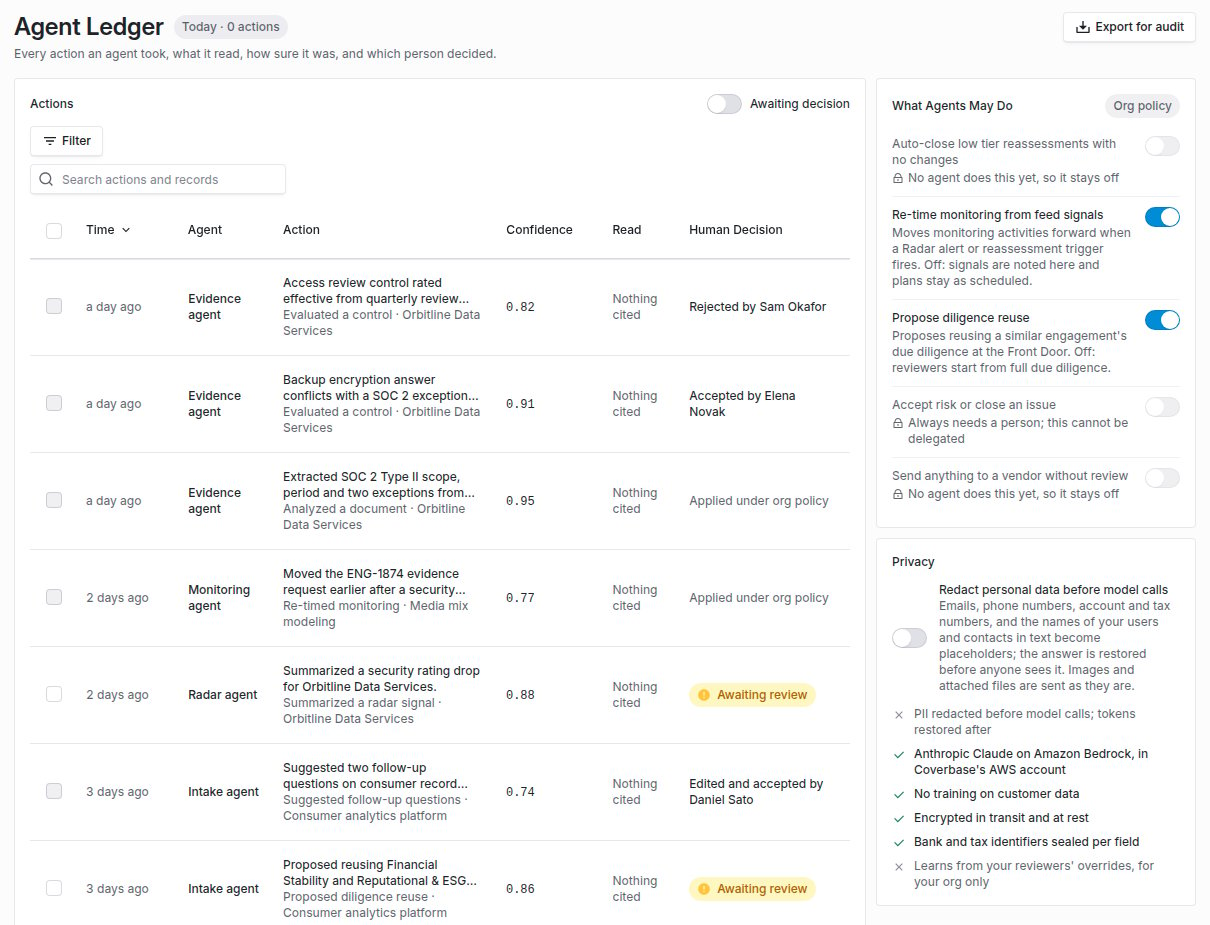
The **Agent Ledger** page under **Configuration** answers the questions an auditor, a model risk team or a regulator asks about AI in your program: what did an agent do, to which record, based on what, how sure was it, which models did it call, and what did a person decide. Beside the ledger sit your organization's AI settings.
 ## What it does
Which agent, what it did, to which record, what it read, what it cited, its confidence, the models it called and how many personal details were redacted. A person can accept, edit and accept, or reject an action, one at a time or in bulk.
What agents may do without a person, enforced where the agent acts. Re-timing monitoring from feed signals (off by default) and proposing diligence reuse (on by default) are live. Accepting risk or closing an issue always needs a person and cannot be switched on.
Off by default. When on, email addresses, phone numbers, IBANs, US tax IDs and the names of your users and your vendors' contacts are replaced with placeholders before a request reaches the model, and put back in the answer before anyone sees it.
When a reviewer overturns a control evaluation, the correction becomes an example for that control. Nothing reaches an evaluation until you turn learning on, and you can switch any example off.
**Export for audit** writes the actions matching your filters, up to 50,000, to a CSV in the background, with citations, models, the redaction count and the human decision.
## What is recorded today
These agents write to the ledger: control evaluation, vendor matching and question planning during intake, follow-up suggestions, the [Intake Agent](/products/intake-agent) reading a request from a message, questionnaire drafting in the portal, document analysis, the Zero Touch automated review, contract clause review, [claim checks](/products/claim-check), the risk report narrative, and Radar signal summaries.
## Agent policies
A policy is checked where the agent acts, against the current setting, so a policy switched off a moment ago holds.
| Policy | What the agent does | With the policy off |
| - | - | - |
| **Re-time monitoring from feed signals** (off by default) | Moves monitoring plan activities forward when a Radar alert or reassessment trigger fires. Each moved plan gets a row reading **Applied under org policy**. | Nothing moves. One row per vendor and signal reads **Held back by org policy**. |
| **Propose diligence reuse** (on by default) | Picks the similar engagement inside the reuse window that the Front Door starts reviewers from. Recording the disposition writes a row with the reviewer's acceptance or rejection. | No proposal. Reviewers start from full due diligence and still see every match. |
**Auto-close low tier reassessments with no changes** and **Send anything to a vendor without review** have no agent behind them yet, so they stay off and cannot be switched on. **Accept risk or close an issue** always needs a person.
Writing a ledger row never fails the action it records. A failed action is recorded as **Failed**.
## How redaction works
Redaction runs in the connection to the model provider, not in individual features, so every model call your organization makes passes through it. If Coverbase cannot read whether redaction is on for your organization, the call fails rather than going out unredacted. Placeholders look like `[[PERSON:1a2b3c4d5e6f]]`. Each is a keyed hash under a secret held for your organization, so the same person gets the same placeholder across calls and a placeholder cannot be reversed by guessing. Only placeholders the redactor issued are restored.
Redaction covers the text of a request. It does not reach inside images or attached documents, such as a PDF sent to the model as a document, or a file the model provider reads directly from storage. Bank and tax identifiers stored on supplier records are sealed per field and never reach a prompt in clear, whether or not redaction is on.
A model request type that redaction does not cover fails while redaction is on, so a new kind of call cannot bypass it.
## How learning works
A daily job collects every evaluation a reviewer moved across the issue boundary in the last 180 days, in either direction, as a learned example for that control. With learning on, a control's evaluation gets up to five of its enabled examples and your organization's evaluation guidance, marked as reference data. With learning off, evaluations use the baseline prompt unchanged. Learning applies to your organization only.
## Where to go next
Read the ledger, record a decision, set policies, turn on redaction and learning, and export.
How Coverbase selects, tests and constrains the models behind these agents.
How assistants connected through MCP are logged and constrained.
Encryption, field-level sealing and tenant isolation.
This documentation is built and hosted on [Mintlify](https://mintlify.com), a developer documentation platform.
## What it does
Which agent, what it did, to which record, what it read, what it cited, its confidence, the models it called and how many personal details were redacted. A person can accept, edit and accept, or reject an action, one at a time or in bulk.
What agents may do without a person, enforced where the agent acts. Re-timing monitoring from feed signals (off by default) and proposing diligence reuse (on by default) are live. Accepting risk or closing an issue always needs a person and cannot be switched on.
Off by default. When on, email addresses, phone numbers, IBANs, US tax IDs and the names of your users and your vendors' contacts are replaced with placeholders before a request reaches the model, and put back in the answer before anyone sees it.
When a reviewer overturns a control evaluation, the correction becomes an example for that control. Nothing reaches an evaluation until you turn learning on, and you can switch any example off.
**Export for audit** writes the actions matching your filters, up to 50,000, to a CSV in the background, with citations, models, the redaction count and the human decision.
## What is recorded today
These agents write to the ledger: control evaluation, vendor matching and question planning during intake, follow-up suggestions, the [Intake Agent](/products/intake-agent) reading a request from a message, questionnaire drafting in the portal, document analysis, the Zero Touch automated review, contract clause review, [claim checks](/products/claim-check), the risk report narrative, and Radar signal summaries.
## Agent policies
A policy is checked where the agent acts, against the current setting, so a policy switched off a moment ago holds.
| Policy | What the agent does | With the policy off |
| - | - | - |
| **Re-time monitoring from feed signals** (off by default) | Moves monitoring plan activities forward when a Radar alert or reassessment trigger fires. Each moved plan gets a row reading **Applied under org policy**. | Nothing moves. One row per vendor and signal reads **Held back by org policy**. |
| **Propose diligence reuse** (on by default) | Picks the similar engagement inside the reuse window that the Front Door starts reviewers from. Recording the disposition writes a row with the reviewer's acceptance or rejection. | No proposal. Reviewers start from full due diligence and still see every match. |
**Auto-close low tier reassessments with no changes** and **Send anything to a vendor without review** have no agent behind them yet, so they stay off and cannot be switched on. **Accept risk or close an issue** always needs a person.
Writing a ledger row never fails the action it records. A failed action is recorded as **Failed**.
## How redaction works
Redaction runs in the connection to the model provider, not in individual features, so every model call your organization makes passes through it. If Coverbase cannot read whether redaction is on for your organization, the call fails rather than going out unredacted. Placeholders look like `[[PERSON:1a2b3c4d5e6f]]`. Each is a keyed hash under a secret held for your organization, so the same person gets the same placeholder across calls and a placeholder cannot be reversed by guessing. Only placeholders the redactor issued are restored.
Redaction covers the text of a request. It does not reach inside images or attached documents, such as a PDF sent to the model as a document, or a file the model provider reads directly from storage. Bank and tax identifiers stored on supplier records are sealed per field and never reach a prompt in clear, whether or not redaction is on.
A model request type that redaction does not cover fails while redaction is on, so a new kind of call cannot bypass it.
## How learning works
A daily job collects every evaluation a reviewer moved across the issue boundary in the last 180 days, in either direction, as a learned example for that control. With learning on, a control's evaluation gets up to five of its enabled examples and your organization's evaluation guidance, marked as reference data. With learning off, evaluations use the baseline prompt unchanged. Learning applies to your organization only.
## Where to go next
Read the ledger, record a decision, set policies, turn on redaction and learning, and export.
How Coverbase selects, tests and constrains the models behind these agents.
How assistants connected through MCP are logged and constrained.
Encryption, field-level sealing and tenant isolation.
This documentation is built and hosted on [Mintlify](https://mintlify.com), a developer documentation platform.