> ## Documentation Index
> Fetch the complete documentation index at: https://docs.coverbase.com/llms.txt
> Use this file to discover all available pages before exploring further.
# Warehouse data share
> Push your third-party risk tables to your own Snowflake account, Amazon S3 bucket or BigQuery dataset on a schedule, so Power BI, Tableau or your data lake read them without going through the API.
For AI agents: a documentation index is available at [https://docs.coverbase.com/llms.txt](https://docs.coverbase.com/llms.txt). This page is also available in markdown by appending .md to the URL.
Your Coverbase representative turns on the third-party lifecycle features, including data share, for your organization.
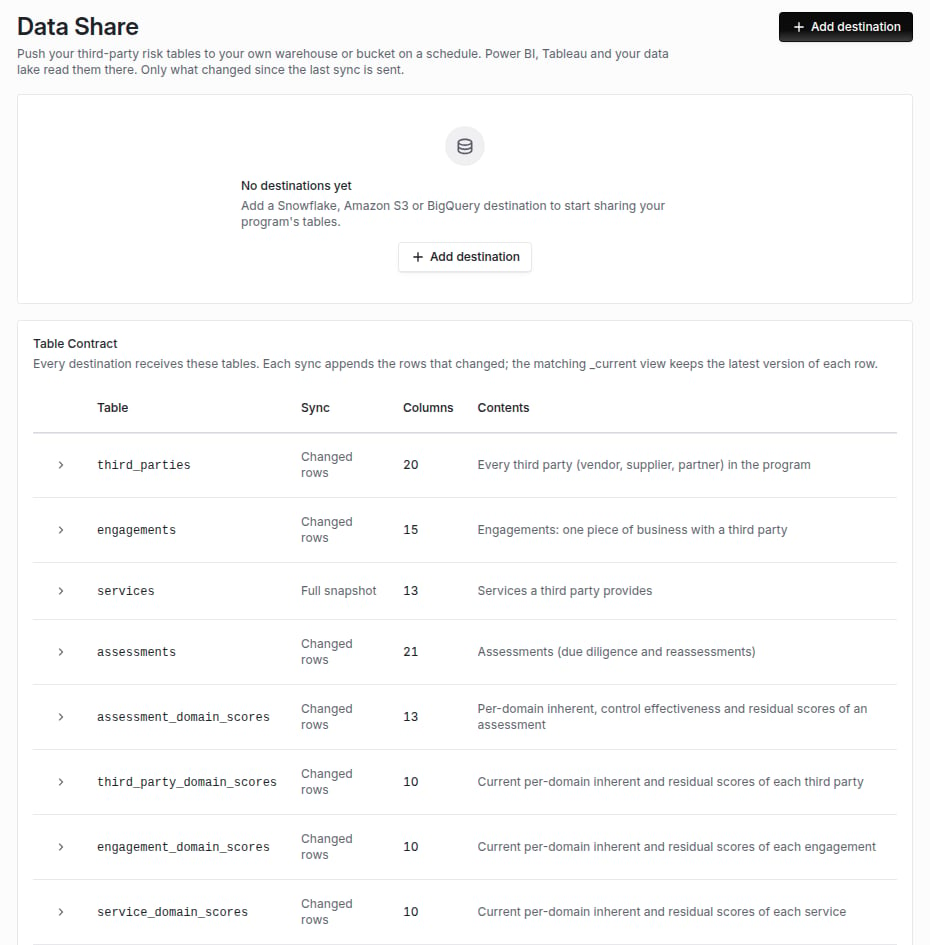
Data share writes the tables behind your third-party risk program into storage you own, on a schedule. Your BI team models against stable tables and views in their own warehouse instead of paging through an API, and nothing has to be exported by hand.
## What it does
Snowflake (key-pair authentication through the SQL API), BigQuery (a service account key), and Amazon S3 (a role in your account that Coverbase assumes, with no stored secret).
Each sync appends the rows that changed since the last successful one, stamped with when they were written. A failed sync is retried from the same point by the next.
In Snowflake and BigQuery, each table has a `_current` view that keeps the newest version of each row. Point your BI model at the views.
Eighteen tables, from third parties, engagements and per-domain scores to findings, risk acceptances, contracts, obligations, monitoring and Radar. Columns are added over time but never renamed or removed in place.
 ## Schedule
Each destination syncs **Hourly** or **Daily**, and on demand with **Sync now**. A **Sync now** that lands while a scheduled sync of the same destination is running is dropped rather than run twice.
## What lands where
* **Snowflake and BigQuery:** one table per contract table, created on the first sync. A column the contract adds later is added to the table. Beside each table, a `
## Schedule
Each destination syncs **Hourly** or **Daily**, and on demand with **Sync now**. A **Sync now** that lands while a scheduled sync of the same destination is running is dropped rather than run twice.
## What lands where
* **Snowflake and BigQuery:** one table per contract table, created on the first sync. A column the contract adds later is added to the table. Beside each table, a `_current` view keeps the latest version of each row.
* **Amazon S3:** files in gzip CSV, gzip JSON Lines or snappy Parquet at `//synced_date=YYYY-MM-DD/-.`, with each table's contract at `/_contract/.json`. Deduplicate on `id`, keeping the latest `_cb_synced_at`, the same way the views do.
Timestamps are UTC. Archived records stay in the share with `is_archived` set. A hard delete is not sent, except that the `services` table is a full snapshot on every run, so a deleted service drops out of its current view.
## Credentials
A destination's credential is write-only. It is stored in a secrets manager the moment you submit it, and the page shows only a non-secret hint: the key's fingerprint for Snowflake, or the service account email for BigQuery. Archiving a destination deletes its credential. Amazon S3 stores no secret at all. Coverbase assumes your role with an external ID generated for that one destination. See [Integration credentials and signing](/security/integration-credentials#customer-s3-roles-and-external-ids).
## Where it shows
The **Distribution** card on [Program Overview](/user-guides/program-insights), under **Dashboards**, lists each destination with its status and last sync, beside the board pack and your scheduled dashboard emails.
## Where to go next
Add a destination, test it, read the run log and the table contract.
Key-pair setup and the grants the Snowflake user needs.
The role, its trust policy and the external ID.
The service account and its roles.
This documentation is built and hosted on [Mintlify](https://mintlify.com), a developer documentation platform.