> ## Documentation Index
> Fetch the complete documentation index at: https://docs.coverbase.com/llms.txt
> Use this file to discover all available pages before exploring further.
# Monitoring plans
> Set the cadence matrix, signal re-timing, pausing statuses and scorecard rubrics, then read an engagement's monitoring plan, edit an activity, keep or revert a signal move, refresh an IRQ and confirm its diff, answer an owner attestation, and score a performance scorecard.
For AI agents: a documentation index is available at [https://docs.coverbase.com/llms.txt](https://docs.coverbase.com/llms.txt). This page is also available in markdown by appending .md to the URL.
This guide is part of the [User Guides](/user-guides/overview) collection. It covers **Configuration → Monitoring Plans** and the **Monitoring Plan** and **Scorecard** tabs on an engagement or service. It sits beside [The engagement record](/user-guides/engagement-record) and [Working Radar signals](/user-guides/radar-signals). For what the module is, see [Monitoring plans and scorecards](/products/monitoring-plans).
Your Coverbase representative turns on the third-party lifecycle features, including monitoring plans, for your organization.
Every active engagement gets a monitoring plan: which activities it owes at its tier, who owns each, and when each is next due. A service outside any engagement gets a plan of its own. You set the rules once, and plans follow them.
The mistake people make most often is changing the reassessment interval on the cadence matrix and finding it does not move. The reassessment interval comes from your reassessment rules, and the plan only mirrors it.
## Step 1: Set the methodology
Open **Configuration** and choose **Monitoring Plans**. Changing it needs a role that can change organization settings.
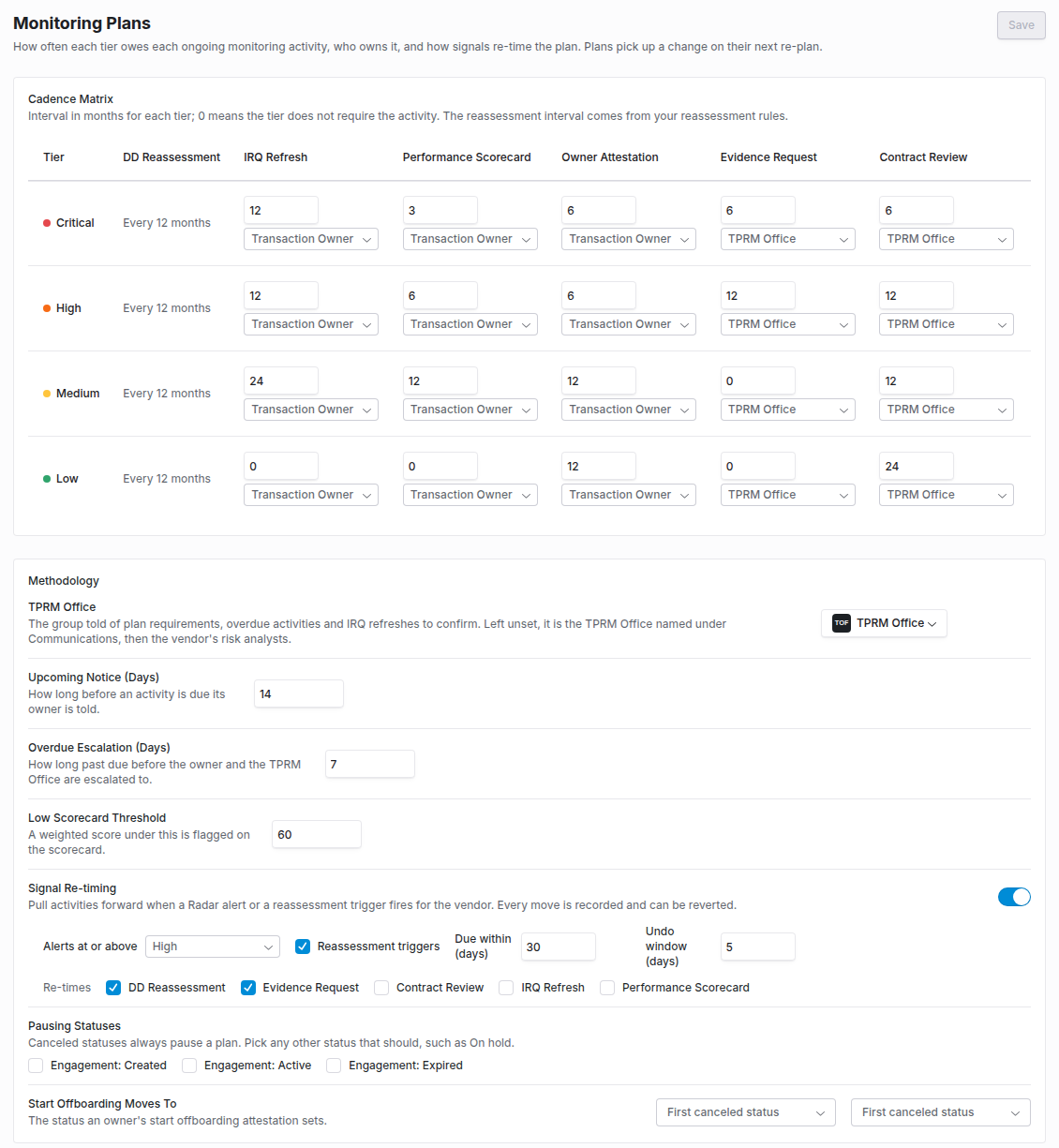
For each tier of your risk scale, set the interval in months for each activity: **IRQ Refresh**, **Performance Scorecard**, **Owner Attestation**, **Evidence Request** and **Contract Review**, and who owns it, the **Transaction Owner** or the **TPRM Office**. 0 means the tier does not need the activity. Until you save, the page shows the default intervals, ranked by tier. **DD Reassessment** reads your reassessment rules and **Continuous Monitoring** is Radar, so neither is set here.
Choose the **TPRM Office** group (left unset, it is the TPRM Office named under **Configuration → Communications**, then the vendor's risk analysts), the **Upcoming Notice (Days)** before an activity is due, the **Overdue Escalation (Days)** after which the owner and the TPRM Office are escalated to, and the **Low Scorecard Threshold**.
Choose **Alerts at or above** a severity, whether **Reassessment triggers** count, how far forward to pull activities (**Due within (days)**), the **Undo window (days)**, and which activities a signal **Re-times**. Signals move plans only while the **Re-time monitoring from feed signals** policy is on in the [Agent Ledger](/user-guides/agent-ledger#step-3-choose-what-agents-may-do). It is off by default, and the page warns when the rule is on but the policy is off.
Canceled statuses always pause a plan. Add any other engagement or service status that should, such as On hold. Under **Start Offboarding Moves To**, choose the status an owner's start offboarding answer sets (the first canceled status unless you choose one).
Click **Add binding** to bind a **Rubric** to a tier (or **Any tier**) and a **Service Category** (or **Any category**), with its **Respondents**. The most specific match wins. With no binding, the default rubric is scored by the owner.
Click **Save**. Plans pick up a change on their next re-plan.
 ## Step 2: Read a plan
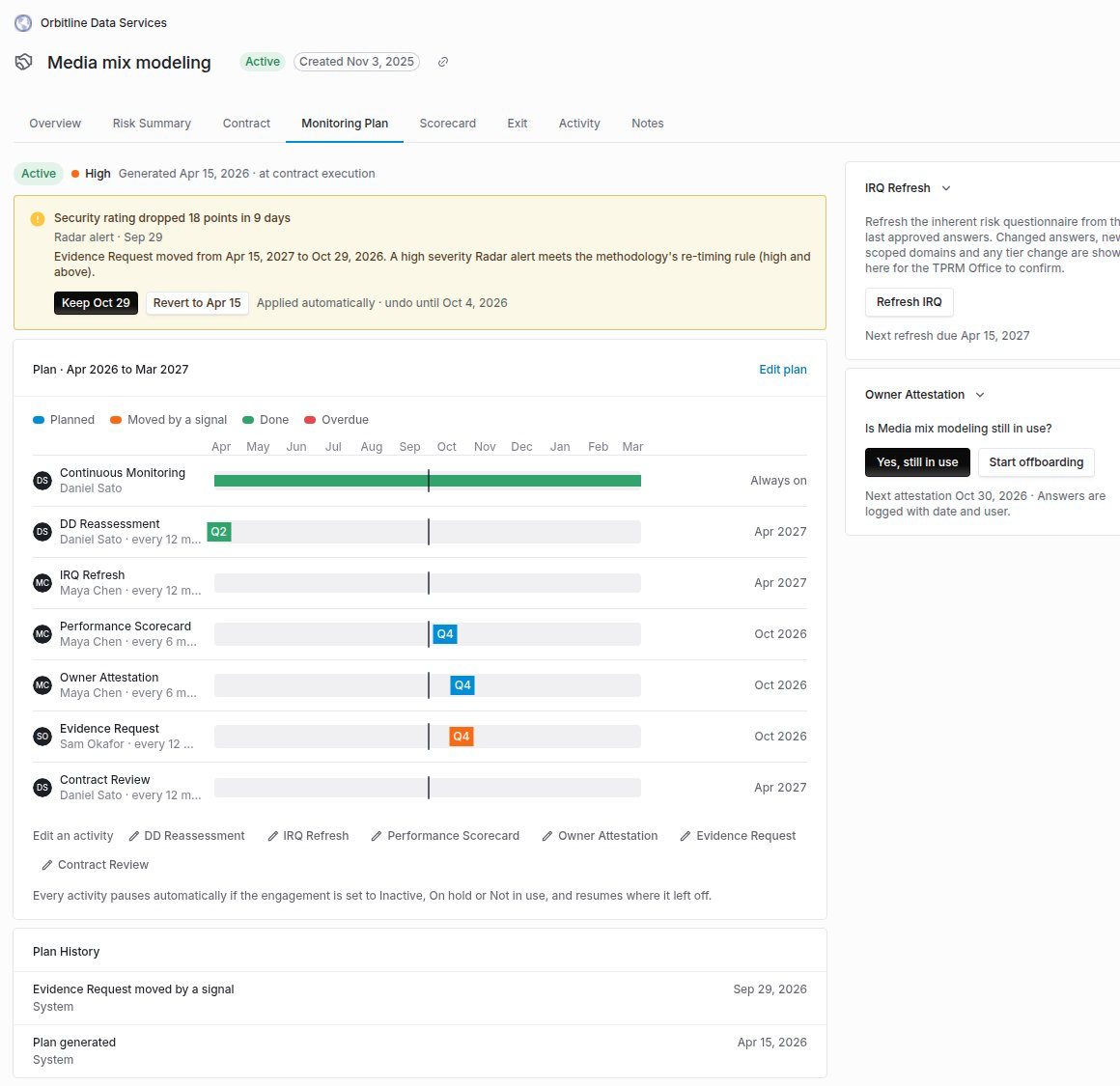
Open the engagement (or the service) and choose the **Monitoring Plan** tab. The header says when the plan was generated and why, for example **when the engagement went active** or **at contract execution**. If no plan exists yet, the TPRM Office can click **Generate plan now**.
The timeline shows the next twelve months for each activity, with its owner and interval. Markers read **Done**, **Planned**, **Overdue** or **Moved by a signal**, and **Today** marks the current date. **Continuous Monitoring** reads **Always on** while Radar watches the vendor.
## Step 2: Read a plan
Open the engagement (or the service) and choose the **Monitoring Plan** tab. The header says when the plan was generated and why, for example **when the engagement went active** or **at contract execution**. If no plan exists yet, the TPRM Office can click **Generate plan now**.
The timeline shows the next twelve months for each activity, with its owner and interval. Markers read **Done**, **Planned**, **Overdue** or **Moved by a signal**, and **Today** marks the current date. **Continuous Monitoring** reads **Always on** while Radar watches the vendor.
 A service that belongs to a live engagement shows **This service is monitored under its engagement's plan.** with **Open engagement plan**.
## Step 3: Edit an activity
The TPRM Office clicks **Edit plan**, picks the **Activity**, and changes its **Interval (Months)**, **Next Due Date**, **Owner** (a person, or **By role**) or **Enabled**, with a **Reason**. Click **Save**.
An edited activity keeps its interval, owner and due date when the plan is re-planned. Moving the reassessment's due date moves the vendor's reassessment schedule, so the reassessment is created on the new date. A date is never moved inside the window reassessments need to be prepared in.
## Step 4: Keep or revert a signal move
When a Radar alert or a reassessment trigger matches your signal rule, the activities you chose move forward at once, and the plan shows what moved: **IRQ Refresh moved from 12 March to 2 January**, with the signal's source and date. Within the undo window, the TPRM Office clicks **Keep** or **Revert**. Reverting restores each schedule the move changed. A signal moves a plan once, however often it is delivered.
## Step 5: Refresh an IRQ
The Transaction Owner opens the **IRQ Refresh** card and clicks **Refresh IRQ**. The questionnaire opens prefilled from the last approved IRQ, and every answer saves as you go. Change what is no longer true, then **Submit for review**.
The card then shows the diff for the TPRM Office: each answer that changed, before and after, each domain's score and level, **Newly in scope** domains, and the **Engagement Tier** before and after. The TPRM Office clicks **Confirm and re-plan**, or **Confirm and schedule reassessment** when a domain was newly scoped or the tier rose. A reassessment is then raised straight away for the engagement's services. **Withdraw** abandons a refresh before it is confirmed.
The Transaction Owner can refresh the IRQ and answer it without any vendor or questionnaire permission: access comes from owning the engagement.
## Step 6: Answer an owner attestation
When an attestation is due, its owner sees **Is ... still in use?** Answer **Yes, still in use**, or **Start offboarding**. Every answer is logged with the date and user.
**Start offboarding** files an offboarding request with you as the requester and your note as the justification, moves the engagement to its not-in-use status, and pauses the plan. Answering twice never files a second request. A service outside any engagement has no offboarding request.
## Step 7: Score a scorecard
When a scorecard comes due, each respondent is assigned and notified. On the **Scorecard** tab, click **Score now**, score each category (each shows its **Weight**), add **Notes** and **Submit scorecard**.
The tab shows the **Weighted Score** for the period, the change from the previous period, a flag when it is **Below the threshold**, the **Categories and Weights** of the rubric, and **SLA Adherence** from the vendor's SLAs (Met and On track count as adhering). The period closes when every respondent has scored or the escalation window passes.
## Work across plans in the Monitoring workbench
Open **Monitoring** in the left navigation. **Activities** lists every scheduled activity with its engagement or service, owner, due date and status. **Plans** lists every plan with its tier and when it was generated. Search, choose which **Activities**, the **Due** window (**Overdue**, **Next 30 days**, **Next 90 days** or **All**), and **Owned by me**.
Select activities, then:
* **Reschedule**: **Move to a date** or **Shift by days** (a negative number pulls them earlier), with an optional **Note**. Each move is logged as a TPRM Office edit. A reassessment moves its scheduled date too.
* **Send scorecards**: opens each scorecard's current period today and asks its respondents to score.
Up to 20 activities run at once. More run in the background with progress, and the result reads, for example, "18 moved, 2 need attention", listing each with its reason.
## Compare submissions
On the vendor's **Questionnaires** tab, **Compare** shows a finished submission beside the vendor's earlier submission of the same questionnaire: **Domain Scores** before and after (with **Risk rose** where it did), and every answer **Changed**, **Added**, **Removed** or **Unchanged**, with its score. Show only the changes, or all answers.
## Plan history
**Plan History** records everything that happened to a plan: generation, re-plans, every edit with before and after, completions, notices and escalations, signal moves and whether they were kept or reverted, pauses and resumes, attestations, IRQ refreshes, reassessments raised and offboarding requested.
## Troubleshooting
| What you see | Cause | Fix |
| - | - | - |
| No **Monitoring Plan** tab | The third-party lifecycle features are not on for your organization. | Ask your Coverbase representative. |
| **A monitoring plan is generated when the engagement goes active or its contract is executed.** | The engagement has not started yet. | Wait, or click **Generate plan now**. |
| The plan is **Paused** | The engagement or service is in a canceled status, expired, or in one of your pausing statuses. | Move it back to an active status. Due dates shift by the time spent paused. |
| Radar went quiet for a vendor | Every plan for the vendor paused, and no other live engagement needed Radar. | Resume a plan. Radar comes back on where the pause turned it off. |
| The reassessment interval on the matrix cannot be edited | It comes from your reassessment rules. | Change the reassessment rule, or move the reassessment's date with **Edit plan**. |
| A signal moved an activity you did not want moved | Your signal rule re-times that activity. | **Revert** within the undo window, and remove the activity from **Re-times**. |
| Signals never move a plan | The **Re-time monitoring from feed signals** agent policy is off. | Turn it on in the Agent Ledger. Held-back moves are listed there. |
| A bulk reschedule skipped some activities | Each skipped activity was paused, had no date, or would land in the past or inside a reassessment's collection time. | Read the reason on each, and adjust the date. |
| **Generate plan now** is refused for a service | The service belongs to a live engagement. | Use the engagement's plan. |
| No scorecard was issued | No tier requires one, or the activity is not yet within its notice window. | Set a **Performance Scorecard** interval for the tier. |
## Related
The engagement page the plan lives on.
The alerts that re-time a plan.
What Start offboarding sets in motion.
Opening an IRQ refresh from a material change.
This documentation is built and hosted on [Mintlify](https://mintlify.com), a developer documentation platform.
A service that belongs to a live engagement shows **This service is monitored under its engagement's plan.** with **Open engagement plan**.
## Step 3: Edit an activity
The TPRM Office clicks **Edit plan**, picks the **Activity**, and changes its **Interval (Months)**, **Next Due Date**, **Owner** (a person, or **By role**) or **Enabled**, with a **Reason**. Click **Save**.
An edited activity keeps its interval, owner and due date when the plan is re-planned. Moving the reassessment's due date moves the vendor's reassessment schedule, so the reassessment is created on the new date. A date is never moved inside the window reassessments need to be prepared in.
## Step 4: Keep or revert a signal move
When a Radar alert or a reassessment trigger matches your signal rule, the activities you chose move forward at once, and the plan shows what moved: **IRQ Refresh moved from 12 March to 2 January**, with the signal's source and date. Within the undo window, the TPRM Office clicks **Keep** or **Revert**. Reverting restores each schedule the move changed. A signal moves a plan once, however often it is delivered.
## Step 5: Refresh an IRQ
The Transaction Owner opens the **IRQ Refresh** card and clicks **Refresh IRQ**. The questionnaire opens prefilled from the last approved IRQ, and every answer saves as you go. Change what is no longer true, then **Submit for review**.
The card then shows the diff for the TPRM Office: each answer that changed, before and after, each domain's score and level, **Newly in scope** domains, and the **Engagement Tier** before and after. The TPRM Office clicks **Confirm and re-plan**, or **Confirm and schedule reassessment** when a domain was newly scoped or the tier rose. A reassessment is then raised straight away for the engagement's services. **Withdraw** abandons a refresh before it is confirmed.
The Transaction Owner can refresh the IRQ and answer it without any vendor or questionnaire permission: access comes from owning the engagement.
## Step 6: Answer an owner attestation
When an attestation is due, its owner sees **Is ... still in use?** Answer **Yes, still in use**, or **Start offboarding**. Every answer is logged with the date and user.
**Start offboarding** files an offboarding request with you as the requester and your note as the justification, moves the engagement to its not-in-use status, and pauses the plan. Answering twice never files a second request. A service outside any engagement has no offboarding request.
## Step 7: Score a scorecard
When a scorecard comes due, each respondent is assigned and notified. On the **Scorecard** tab, click **Score now**, score each category (each shows its **Weight**), add **Notes** and **Submit scorecard**.
The tab shows the **Weighted Score** for the period, the change from the previous period, a flag when it is **Below the threshold**, the **Categories and Weights** of the rubric, and **SLA Adherence** from the vendor's SLAs (Met and On track count as adhering). The period closes when every respondent has scored or the escalation window passes.
## Work across plans in the Monitoring workbench
Open **Monitoring** in the left navigation. **Activities** lists every scheduled activity with its engagement or service, owner, due date and status. **Plans** lists every plan with its tier and when it was generated. Search, choose which **Activities**, the **Due** window (**Overdue**, **Next 30 days**, **Next 90 days** or **All**), and **Owned by me**.
Select activities, then:
* **Reschedule**: **Move to a date** or **Shift by days** (a negative number pulls them earlier), with an optional **Note**. Each move is logged as a TPRM Office edit. A reassessment moves its scheduled date too.
* **Send scorecards**: opens each scorecard's current period today and asks its respondents to score.
Up to 20 activities run at once. More run in the background with progress, and the result reads, for example, "18 moved, 2 need attention", listing each with its reason.
## Compare submissions
On the vendor's **Questionnaires** tab, **Compare** shows a finished submission beside the vendor's earlier submission of the same questionnaire: **Domain Scores** before and after (with **Risk rose** where it did), and every answer **Changed**, **Added**, **Removed** or **Unchanged**, with its score. Show only the changes, or all answers.
## Plan history
**Plan History** records everything that happened to a plan: generation, re-plans, every edit with before and after, completions, notices and escalations, signal moves and whether they were kept or reverted, pauses and resumes, attestations, IRQ refreshes, reassessments raised and offboarding requested.
## Troubleshooting
| What you see | Cause | Fix |
| - | - | - |
| No **Monitoring Plan** tab | The third-party lifecycle features are not on for your organization. | Ask your Coverbase representative. |
| **A monitoring plan is generated when the engagement goes active or its contract is executed.** | The engagement has not started yet. | Wait, or click **Generate plan now**. |
| The plan is **Paused** | The engagement or service is in a canceled status, expired, or in one of your pausing statuses. | Move it back to an active status. Due dates shift by the time spent paused. |
| Radar went quiet for a vendor | Every plan for the vendor paused, and no other live engagement needed Radar. | Resume a plan. Radar comes back on where the pause turned it off. |
| The reassessment interval on the matrix cannot be edited | It comes from your reassessment rules. | Change the reassessment rule, or move the reassessment's date with **Edit plan**. |
| A signal moved an activity you did not want moved | Your signal rule re-times that activity. | **Revert** within the undo window, and remove the activity from **Re-times**. |
| Signals never move a plan | The **Re-time monitoring from feed signals** agent policy is off. | Turn it on in the Agent Ledger. Held-back moves are listed there. |
| A bulk reschedule skipped some activities | Each skipped activity was paused, had no date, or would land in the past or inside a reassessment's collection time. | Read the reason on each, and adjust the date. |
| **Generate plan now** is refused for a service | The service belongs to a live engagement. | Use the engagement's plan. |
| No scorecard was issued | No tier requires one, or the activity is not yet within its notice window. | Set a **Performance Scorecard** interval for the tier. |
## Related
The engagement page the plan lives on.
The alerts that re-time a plan.
What Start offboarding sets in motion.
Opening an IRQ refresh from a material change.
This documentation is built and hosted on [Mintlify](https://mintlify.com), a developer documentation platform.