> ## Documentation Index
> Fetch the complete documentation index at: https://docs.coverbase.com/llms.txt
> Use this file to discover all available pages before exploring further.
# The passage library
> Keep the clauses, party blocks and signature pages your team reuses in one library, start from Coverbase's starter passages, and insert them when you write an agreement in Coverbase instead of uploading one.
For AI agents: a documentation index is available at [https://docs.coverbase.com/llms.txt](https://docs.coverbase.com/llms.txt). This page is also available in markdown by appending .md to the URL.
This guide is part of the [User Guides](/user-guides/overview) collection. It covers the passage library and the **Write** option that uses it. To make what you write into a template you send again, see [Signature templates](/user-guides/signature-templates). To send it, see [Sending for signature](/user-guides/signature-envelopes), or [Bulk send](/user-guides/signature-bulk-send) for many parties at once.
The passage library is part of e-signature. If you do not see **Signatures** and **Templates** under **Contracts** in the left navigation, ask your Coverbase account team to turn it on.
A passage is agreement text you use more than once: the paragraph that names the parties, a confidentiality clause, a signature page. The passage library holds your organization's passages. When you write an agreement in Coverbase instead of uploading one, **Insert passage** puts any of them into the document at your cursor, and Coverbase turns the finished text into the PDF that gets signed.
The library only feeds that editor. It does not review contracts or check clauses against a standard; that is [Contract Guardian](/user-guides/contract-guardian). A passage is also never a field. Signature and date fields are placed afterwards, on the rendered PDF.
The mistake people make most often is treating the square-bracket placeholders in a passage, such as `[Company name]`, as blanks Coverbase fills in: they are ordinary text, and they reach the signer exactly as written unless you replace them before you render.
## Where it lives
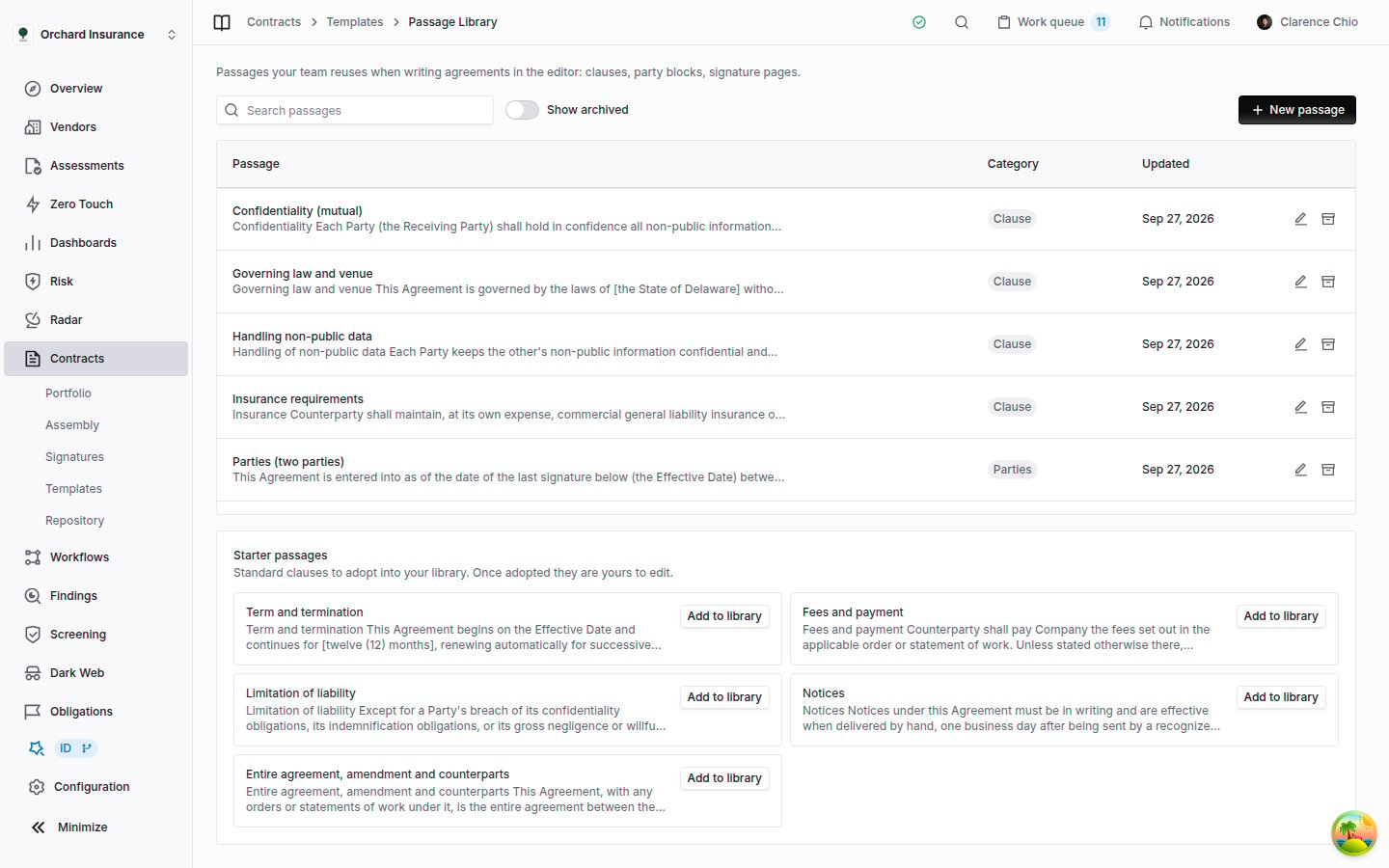
Open **Contracts → Templates** and click **Passage Library**. Your signature templates are the list on **Contracts → Templates** itself.
 | | |
| ------------------------ | --------------------------------------------------------------------------------------------------------------------------------------------------------------- |
| **Passage** | The title, with the start of the text under it. |
| **Category** | **Clause**, **Heading**, **Parties**, **Signature page**, **Cover** or **Other**. A label for the list. It does not change how the text looks or where it goes. |
| **Updated** | When the passage was last saved. |
| Pencil and archive icons | **Edit passage** and **Archive passage**. |
**Search passages** matches any part of a passage's title or text. It filters your passages, not the **Starter passages** below them. **Show archived** adds archived passages to the list, marked **Archived**, each with **Restore**.
Passages belong to the organization. Everyone who can open the page sees the same library, and a change one person saves is what everyone inserts from then on.
## Start from the starter passages
Coverbase ships nine starter passages, written for an agreement between two parties. **Add to library** copies one into your library, where it is yours to edit. The copy is not linked to Coverbase's wording, so nothing in your library changes unless someone in your organization changes it.
| Starter | Category | What it says |
| ------------------------------------------------ | -------------- | -------------------------------------------------------------------------------------------------------------------------------------------------- |
| **Parties (two parties)** | Parties | Names the two parties, "Company" and "Counterparty", and makes the date of the last signature the Effective Date. |
| **Confidentiality (mutual)** | Clause | Each party protects the other's confidential information, with the usual exclusions. Survives five years after termination. |
| **Term and termination** | Clause | A fixed term that renews automatically, notice of non-renewal, and termination for breach or insolvency. |
| **Fees and payment** | Clause | Counterparty pays Company's invoices within a set number of days, pays the taxes on them, and owes interest on late payment. |
| **Limitation of liability** | Clause | No indirect damages, and liability capped at what Counterparty paid or owed Company over a set period before the claim, with the usual exceptions. |
| **Governing law and venue** | Clause | The governing law and the courts that hear disputes. |
| **Notices** | Clause | How formal notices are delivered, including by email. |
| **Entire agreement, amendment and counterparts** | Clause | The agreement is the whole deal, changes must be signed by both parties, and electronic signatures count. |
| **Signature page (two parties)** | Signature page | Starts a new page with signature, name, title and date lines for each party. |
Two things to settle once, in your library copy, before anyone uses the starters:
* **The placeholders that are really your standard position.** Every starter marks what varies in square brackets: `[jurisdiction]`, `[twelve (12) months]`, `[thirty (30)] days`, `[the State of Delaware]`. Replace the ones your organization always answers the same way. Leave the deal-specific ones, such as names and addresses, for each document.
* **Which side you are on.** In **Fees and payment** and **Limitation of liability**, Counterparty pays Company. If your organization is the one paying, swap the two before you rely on them.
Picking a starter from **Insert passage** while you write also adds it to your library. Once added, a starter drops out of **Starter passages**.
| | |
| ------------------------ | --------------------------------------------------------------------------------------------------------------------------------------------------------------- |
| **Passage** | The title, with the start of the text under it. |
| **Category** | **Clause**, **Heading**, **Parties**, **Signature page**, **Cover** or **Other**. A label for the list. It does not change how the text looks or where it goes. |
| **Updated** | When the passage was last saved. |
| Pencil and archive icons | **Edit passage** and **Archive passage**. |
**Search passages** matches any part of a passage's title or text. It filters your passages, not the **Starter passages** below them. **Show archived** adds archived passages to the list, marked **Archived**, each with **Restore**.
Passages belong to the organization. Everyone who can open the page sees the same library, and a change one person saves is what everyone inserts from then on.
## Start from the starter passages
Coverbase ships nine starter passages, written for an agreement between two parties. **Add to library** copies one into your library, where it is yours to edit. The copy is not linked to Coverbase's wording, so nothing in your library changes unless someone in your organization changes it.
| Starter | Category | What it says |
| ------------------------------------------------ | -------------- | -------------------------------------------------------------------------------------------------------------------------------------------------- |
| **Parties (two parties)** | Parties | Names the two parties, "Company" and "Counterparty", and makes the date of the last signature the Effective Date. |
| **Confidentiality (mutual)** | Clause | Each party protects the other's confidential information, with the usual exclusions. Survives five years after termination. |
| **Term and termination** | Clause | A fixed term that renews automatically, notice of non-renewal, and termination for breach or insolvency. |
| **Fees and payment** | Clause | Counterparty pays Company's invoices within a set number of days, pays the taxes on them, and owes interest on late payment. |
| **Limitation of liability** | Clause | No indirect damages, and liability capped at what Counterparty paid or owed Company over a set period before the claim, with the usual exceptions. |
| **Governing law and venue** | Clause | The governing law and the courts that hear disputes. |
| **Notices** | Clause | How formal notices are delivered, including by email. |
| **Entire agreement, amendment and counterparts** | Clause | The agreement is the whole deal, changes must be signed by both parties, and electronic signatures count. |
| **Signature page (two parties)** | Signature page | Starts a new page with signature, name, title and date lines for each party. |
Two things to settle once, in your library copy, before anyone uses the starters:
* **The placeholders that are really your standard position.** Every starter marks what varies in square brackets: `[jurisdiction]`, `[twelve (12) months]`, `[thirty (30)] days`, `[the State of Delaware]`. Replace the ones your organization always answers the same way. Leave the deal-specific ones, such as names and addresses, for each document.
* **Which side you are on.** In **Fees and payment** and **Limitation of liability**, Counterparty pays Company. If your organization is the one paying, swap the two before you rely on them.
Picking a starter from **Insert passage** while you write also adds it to your library. Once added, a starter drops out of **Starter passages**.
 ## Add or change a passage
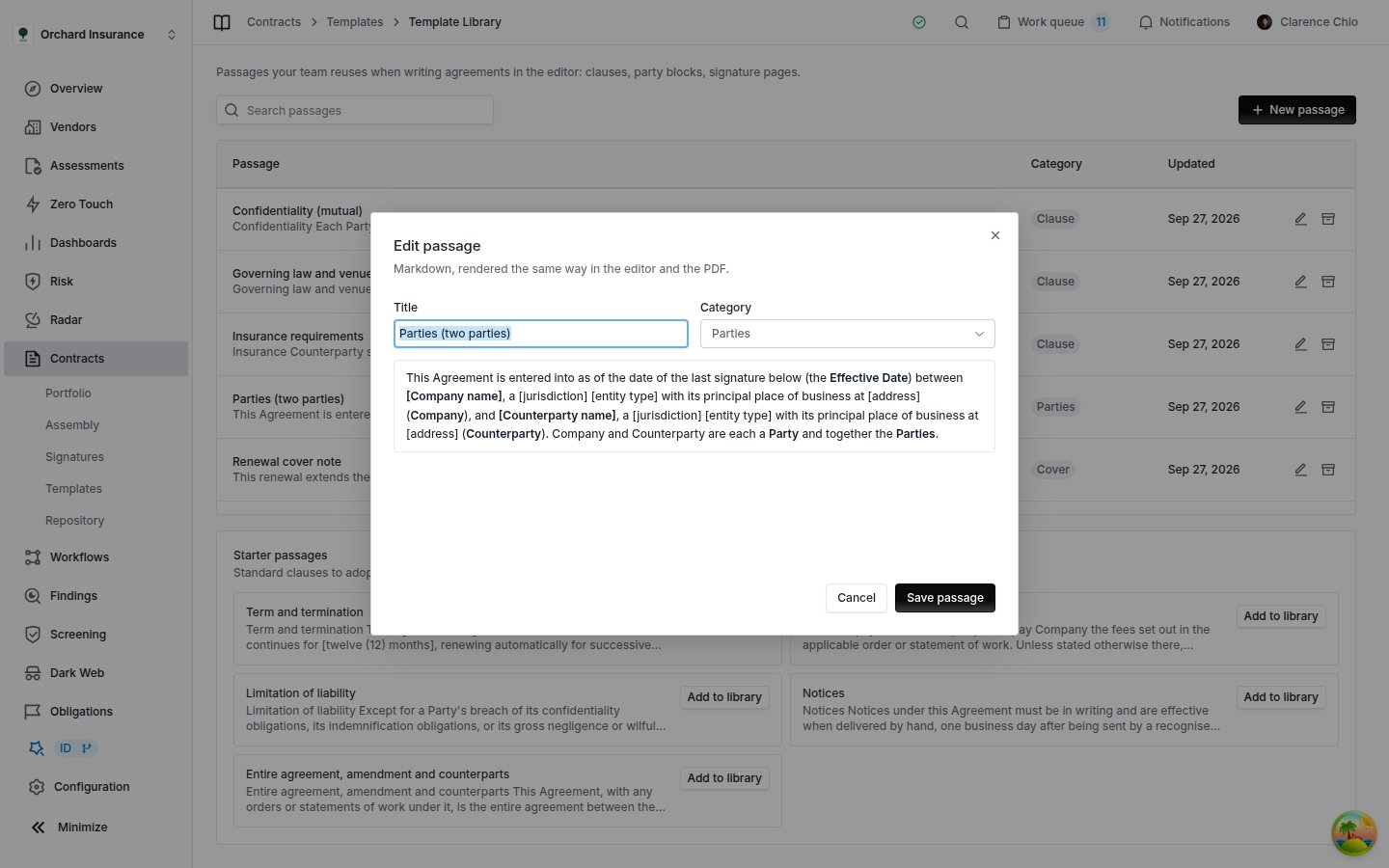
**New passage** opens an empty dialog. The pencil opens the same dialog as **Edit passage**.
The title is the only thing the **Insert passage** menu shows, alphabetically and with no search. Name passages so the right one is easy to spot in a list: "Confidentiality (mutual, 3 years)" rather than "Clause 4".
Type `/` for a heading, a list or a quote, and select text to make it bold or italic. You can also paste Markdown. To start a new page, put `\pagebreak` on a line of its own.
It stays grayed out until the passage has both a title and some text. **Passage saved.** confirms it.
## Add or change a passage
**New passage** opens an empty dialog. The pencil opens the same dialog as **Edit passage**.
The title is the only thing the **Insert passage** menu shows, alphabetically and with no search. Name passages so the right one is easy to spot in a list: "Confidentiality (mutual, 3 years)" rather than "Clause 4".
Type `/` for a heading, a list or a quote, and select text to make it bold or italic. You can also paste Markdown. To start a new page, put `\pagebreak` on a line of its own.
It stays grayed out until the passage has both a title and some text. **Passage saved.** confirms it.
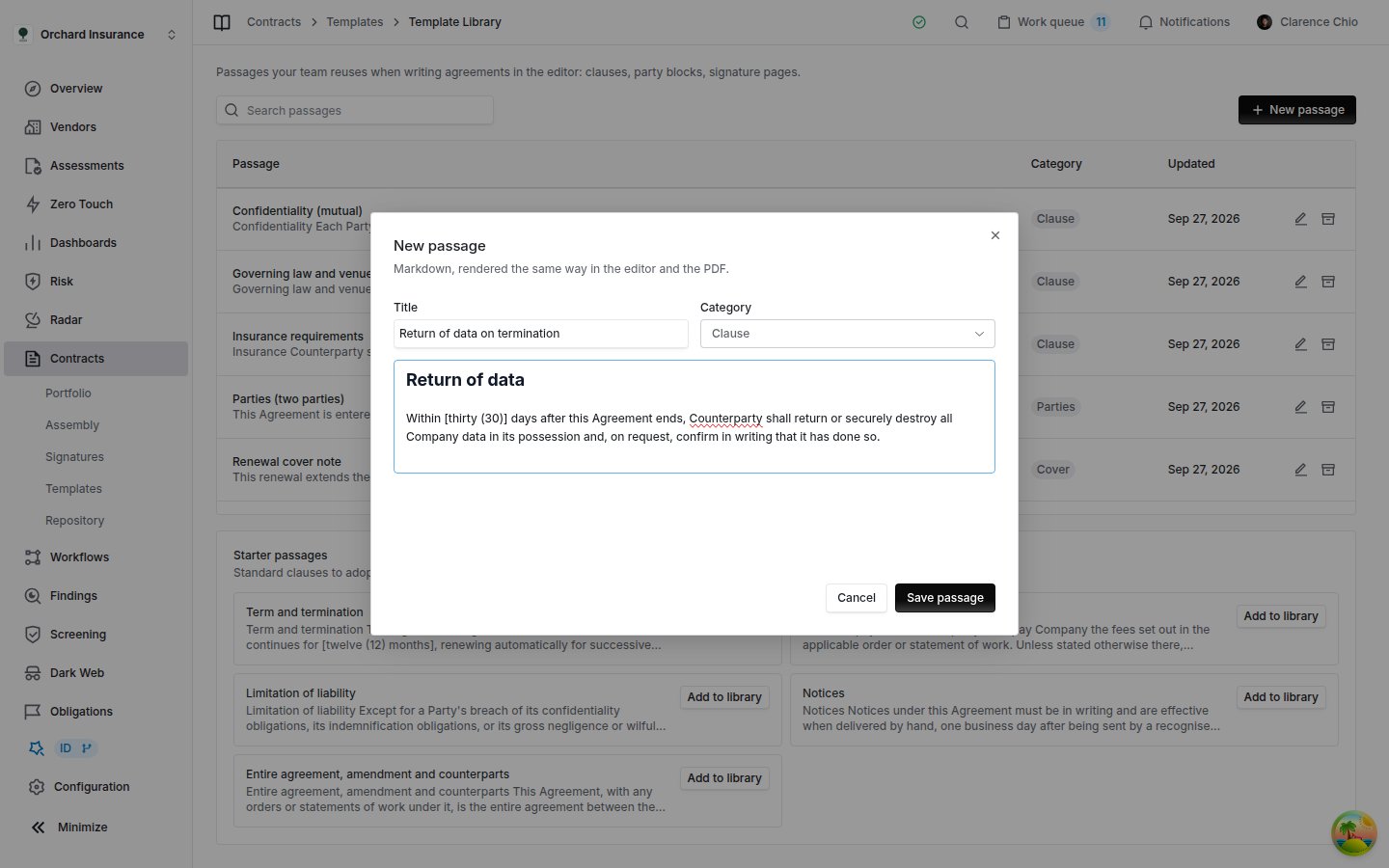 Saving changes the passage for every document written after it. Documents already written keep the text they had, because inserting a passage copies its text into the document rather than linking to it.
The library keeps no history of earlier wording. **Updated** is the only sign that a passage changed, so copy the old text somewhere first if you may need it again.
### What reaches the PDF
| Carries through | Prints as plain text |
| ------------------------------------------------------------------------------------------------------------------------------------------------------------------ | ----------------------------------------------------------------------------------------------------- |
| Headings, paragraphs, **bold** and *italic*, bulleted and numbered lists, block quotes, horizontal rules (`---` on its own line), and `\pagebreak` on its own line | Everything else. A table prints as its raw text, and a link prints its words without the web address. |
The PDF is US Letter size, and the document title is printed at the top of the first page.
## Archive a passage
The archive icon on a row asks you to confirm, then removes the passage from the library and from the **Insert passage** menu. The message that confirms it has **Undo**, which brings it straight back. Later, turn on **Show archived** and click **Restore** on its row. Documents that already used the passage are not affected either way.
Archiving an added starter puts it back under **Starter passages**. Adding it again gives you Coverbase's original wording, not the version you had edited. To get your edited wording back, restore your archived copy instead.
## Write an agreement with passages
**Write** is one of the paper sources in two places, and it works the same way in both:
* Step 1 of the send wizard (**New Envelope** on **Contracts → Signatures**), for a single agreement.
* The **New Template** dialog (**New template** on **Contracts → Templates**), for paper you will send again.
The editor opens below the paper sources.
**Document title** is printed at the top of the first page and names the PDF. It starts as the envelope or template name. If that name is still empty when you render, the title fills it in.
Click where a passage should go, then pick it from **Insert passage**. The menu lists **Your library** first, then the **Starter passages** you have not added. Choosing a starter also adds it to your library.
Use your browser's find (Ctrl+F, or Cmd+F on a Mac) to look for `[`. Anything still in square brackets reaches the signer as written.
Click **Render and use this document** in the wizard, or **Render and use as the template** in the dialog. Coverbase turns the text into a PDF, and that PDF is the paper from then on. In the dialog, **Create template** then opens the template builder on it.
Signature and date fields go on the rendered pages: in step 3 of the wizard, or in the template builder.
Saving changes the passage for every document written after it. Documents already written keep the text they had, because inserting a passage copies its text into the document rather than linking to it.
The library keeps no history of earlier wording. **Updated** is the only sign that a passage changed, so copy the old text somewhere first if you may need it again.
### What reaches the PDF
| Carries through | Prints as plain text |
| ------------------------------------------------------------------------------------------------------------------------------------------------------------------ | ----------------------------------------------------------------------------------------------------- |
| Headings, paragraphs, **bold** and *italic*, bulleted and numbered lists, block quotes, horizontal rules (`---` on its own line), and `\pagebreak` on its own line | Everything else. A table prints as its raw text, and a link prints its words without the web address. |
The PDF is US Letter size, and the document title is printed at the top of the first page.
## Archive a passage
The archive icon on a row asks you to confirm, then removes the passage from the library and from the **Insert passage** menu. The message that confirms it has **Undo**, which brings it straight back. Later, turn on **Show archived** and click **Restore** on its row. Documents that already used the passage are not affected either way.
Archiving an added starter puts it back under **Starter passages**. Adding it again gives you Coverbase's original wording, not the version you had edited. To get your edited wording back, restore your archived copy instead.
## Write an agreement with passages
**Write** is one of the paper sources in two places, and it works the same way in both:
* Step 1 of the send wizard (**New Envelope** on **Contracts → Signatures**), for a single agreement.
* The **New Template** dialog (**New template** on **Contracts → Templates**), for paper you will send again.
The editor opens below the paper sources.
**Document title** is printed at the top of the first page and names the PDF. It starts as the envelope or template name. If that name is still empty when you render, the title fills it in.
Click where a passage should go, then pick it from **Insert passage**. The menu lists **Your library** first, then the **Starter passages** you have not added. Choosing a starter also adds it to your library.
Use your browser's find (Ctrl+F, or Cmd+F on a Mac) to look for `[`. Anything still in square brackets reaches the signer as written.
Click **Render and use this document** in the wizard, or **Render and use as the template** in the dialog. Coverbase turns the text into a PDF, and that PDF is the paper from then on. In the dialog, **Create template** then opens the template builder on it.
Signature and date fields go on the rendered pages: in step 3 of the wizard, or in the template builder.
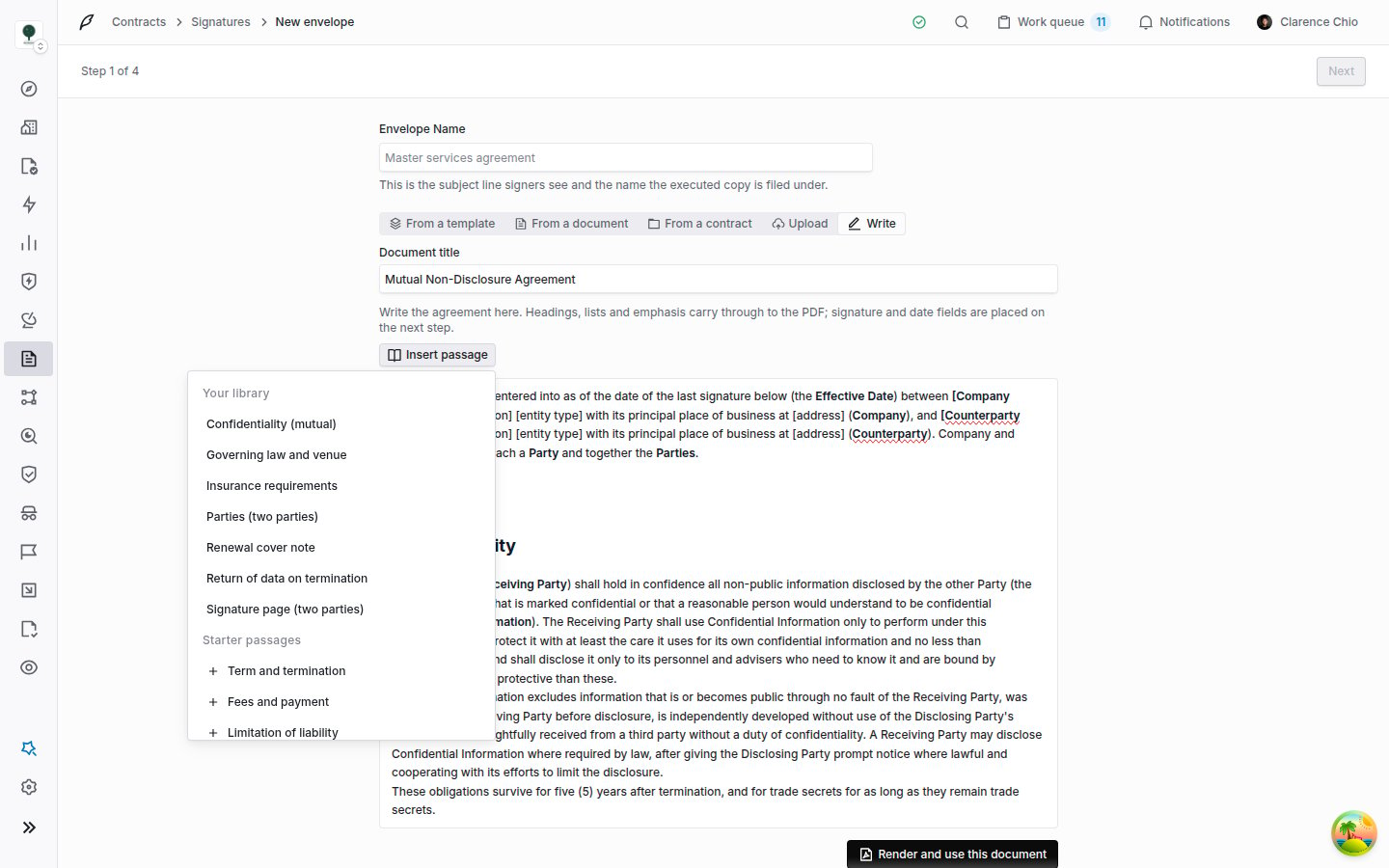 **Signature page (two parties)** draws signature, name, title and date lines as text, and nobody can sign a line of text. Place a **Signature** field over each signature line on the rendered page, and a **Date signed** field if you want the date filled in, or the signer has nothing to sign there. The field types are covered in [Signature templates](/user-guides/signature-templates#what-the-field-types-do).
You can change the text and render again before you move on, and the new PDF replaces the old one. Each render updates the same document, and the line beside the button counts them, as in **Version 2 · 3 pages rendered**. Once you leave the wizard or the dialog, what you wrote cannot be reopened for editing: the envelope or template keeps the rendered PDF. If you expect to send the same wording again, write it in the **New Template** dialog so it becomes a template, or keep its pieces as passages.
## Who can do what
| To | You need | Default roles that have it |
| ------------------------------------------------------ | -------------------------------------------------------- | ----------------------------------- |
| Open the library and see its passages | Read access to contracts | Admin, Member, Siloed Member, Guest |
| Add a passage, add a starter, or render what you wrote | The organization-wide **create** permission on contracts | Admin, Member |
| Edit, archive or restore a passage | The organization-wide **update** permission on contracts | Admin, Member |
The buttons show for everyone who can open the page. Without the permission, saving fails with an error. Custom roles are covered in [Permissions and roles](/user-guides/permissions-and-roles).
## Limits
* A title can be up to 200 characters, and a passage's text up to 200,000.
* A written document can be up to 200,000 characters.
* The library page and the **Insert passage** menu show the first 100 passages by title. **Search passages** still finds one further down, but the menu cannot offer it.
* There is no version history for a passage, and no list of the documents that used one.
## Troubleshooting
| Symptom | Cause | Fix |
| ----------------------------------------------------------------- | --------------------------------------------------------------------------------------------- | ------------------------------------------------------------------------------------------------------------------------------------------------------------------------------------ |
| The page says **No passages yet** | Your organization has no passages, or all of them are archived. | Click **New passage**, or **Add to library** on a starter. Turn on **Show archived** to see archived ones. |
| A starter is missing from **Starter passages** | It is already in your library, added from the card or inserted while writing. | Edit your copy in the list above. |
| An archived passage reappeared under **Starter passages** | It was an added starter. Archiving your copy offers Coverbase's original again. | To keep your edits, turn on **Show archived** and **Restore** your copy. Add the starter again only if you want the original wording. |
| **Insert passage** does not offer a passage | It was archived, or your library has more than 100 passages and it sorts after the first 100. | Restore it with **Show archived**, or archive passages nobody uses. |
| The signer sees `[Company name]` or another bracketed placeholder | Placeholders are plain text and were not replaced before rendering. | Fix the text and render again. If the envelope is already out, use **Correct and resend** ([Sending for signature](/user-guides/signature-envelopes#nudging-correcting-cancelling)). |
| The signature page has lines but nothing to sign | A passage draws lines, not fields. | Place **Signature** fields on the rendered page, in step 3 of the wizard or in the template builder. |
| A table or a link came out as plain text in the PDF | Only headings, paragraphs, bold, italic, lists, quotes, rules and page breaks carry through. | Rewrite the table as a list, and spell the web address out in the text. |
| `\pagebreak` printed as text instead of starting a new page | It shares a line with other text. | Put it on a line of its own. |
| **The passage could not be saved.** or a permission error | You do not hold the create or update permission on contracts. | Ask an admin to change your role. |
| **The document could not be rendered.** | The text is longer than 200,000 characters, or the title is longer than 200. | Shorten the title or the text. |
## Related
Turn written paper into a template: parties, fields, publishing and versions.
The send wizard, where **Write** is one of the five paper sources.
Send one published template to a list of parties, one envelope each.
How templates, envelopes, the portal and the sealed copy fit together.
**Signature page (two parties)** draws signature, name, title and date lines as text, and nobody can sign a line of text. Place a **Signature** field over each signature line on the rendered page, and a **Date signed** field if you want the date filled in, or the signer has nothing to sign there. The field types are covered in [Signature templates](/user-guides/signature-templates#what-the-field-types-do).
You can change the text and render again before you move on, and the new PDF replaces the old one. Each render updates the same document, and the line beside the button counts them, as in **Version 2 · 3 pages rendered**. Once you leave the wizard or the dialog, what you wrote cannot be reopened for editing: the envelope or template keeps the rendered PDF. If you expect to send the same wording again, write it in the **New Template** dialog so it becomes a template, or keep its pieces as passages.
## Who can do what
| To | You need | Default roles that have it |
| ------------------------------------------------------ | -------------------------------------------------------- | ----------------------------------- |
| Open the library and see its passages | Read access to contracts | Admin, Member, Siloed Member, Guest |
| Add a passage, add a starter, or render what you wrote | The organization-wide **create** permission on contracts | Admin, Member |
| Edit, archive or restore a passage | The organization-wide **update** permission on contracts | Admin, Member |
The buttons show for everyone who can open the page. Without the permission, saving fails with an error. Custom roles are covered in [Permissions and roles](/user-guides/permissions-and-roles).
## Limits
* A title can be up to 200 characters, and a passage's text up to 200,000.
* A written document can be up to 200,000 characters.
* The library page and the **Insert passage** menu show the first 100 passages by title. **Search passages** still finds one further down, but the menu cannot offer it.
* There is no version history for a passage, and no list of the documents that used one.
## Troubleshooting
| Symptom | Cause | Fix |
| ----------------------------------------------------------------- | --------------------------------------------------------------------------------------------- | ------------------------------------------------------------------------------------------------------------------------------------------------------------------------------------ |
| The page says **No passages yet** | Your organization has no passages, or all of them are archived. | Click **New passage**, or **Add to library** on a starter. Turn on **Show archived** to see archived ones. |
| A starter is missing from **Starter passages** | It is already in your library, added from the card or inserted while writing. | Edit your copy in the list above. |
| An archived passage reappeared under **Starter passages** | It was an added starter. Archiving your copy offers Coverbase's original again. | To keep your edits, turn on **Show archived** and **Restore** your copy. Add the starter again only if you want the original wording. |
| **Insert passage** does not offer a passage | It was archived, or your library has more than 100 passages and it sorts after the first 100. | Restore it with **Show archived**, or archive passages nobody uses. |
| The signer sees `[Company name]` or another bracketed placeholder | Placeholders are plain text and were not replaced before rendering. | Fix the text and render again. If the envelope is already out, use **Correct and resend** ([Sending for signature](/user-guides/signature-envelopes#nudging-correcting-cancelling)). |
| The signature page has lines but nothing to sign | A passage draws lines, not fields. | Place **Signature** fields on the rendered page, in step 3 of the wizard or in the template builder. |
| A table or a link came out as plain text in the PDF | Only headings, paragraphs, bold, italic, lists, quotes, rules and page breaks carry through. | Rewrite the table as a list, and spell the web address out in the text. |
| `\pagebreak` printed as text instead of starting a new page | It shares a line with other text. | Put it on a line of its own. |
| **The passage could not be saved.** or a permission error | You do not hold the create or update permission on contracts. | Ask an admin to change your role. |
| **The document could not be rendered.** | The text is longer than 200,000 characters, or the title is longer than 200. | Shorten the title or the text. |
## Related
Turn written paper into a template: parties, fields, publishing and versions.
The send wizard, where **Write** is one of the five paper sources.
Send one published template to a list of parties, one envelope each.
How templates, envelopes, the portal and the sealed copy fit together.