

For AI agents: a documentation index is available at https://docs.coverbase.com/llms.txt. This page is also available in markdown by appending .md to the URL.
This guide is part of the User Guides collection. It covers the dates on a contract record and the reminders that fire off them. For pulling those dates out of the paper in the first place, see the Document Insights guide.
The timeline at a glance
Open a contract and look at the Contract timeline card in the sidebar. Six dates can appear:
Three of the six (Notice due to vendor, Internal action, and Audit date) are optional. They appear when they are relevant, and you can turn them off per contract. Effective date, term start, and term end are always shown.
Optional does not mean unimportant. The date makes sense on some contracts and not others, so you decide contract by contract.
Fixed dates versus calculated dates
Most surprises come from this distinction.Fixed date
A date you or the document states outright. It sits there until someone changes it. Renewals do not move it: a date the agreement names is a fact, and Coverbase does not rewrite it.
Calculated date
A date Coverbase works out from other values. Notice due to vendor can be calculated as term end minus your notice period. Internal action is calculated as the notice date minus your lead time. Both update automatically when the contract renews.
What makes a contract renew
A renewal needs two things on the record, and it is the second one people forget.Auto-renews is Automatic
The setting that says renewal happens without anyone doing anything.
Renewal term is filled in
The length each renewal adds. Without it there is nothing to move the term end to.
Where the renewal term comes from
Three paths fill it, so most contracts arrive with it already set:- Document extraction. Coverbase reads the renewal term out of the agreement along with the other dates, with a page citation.
- Spreadsheet import. The contract import template has a Renewal Term column. Fill it in the same shape as the other term columns, for example
1 yearor12 months. - By hand. Type it into Renewal term on the Commercial terms card.
Recording what you intend to do
A renewal date tells you when to decide. It does not record what you decided, which is why renewals get re-litigated in the week they are due. The Renewal decision section of the Commercial terms card takes that answer: Not decided, Renew, Terminate, or Under review, with a note for the reasoning. The decision shows in the renewal runway hover and the runway’s readiness dot, and it is filterable across the portfolio.A renewal clears the decision. When a contract rolls into a new term, the decision and its note go back to empty on purpose. The old answer was about the term that just ended, and the new one deserves its own look.Nothing is lost: every decision is filed in the contract’s activity trail with the note, who recorded it, which term it was about, and that term’s end date. The card shows the current term, the trail shows the history.
Who gets reminded, and when
Reminders are email, and they come from two places:1
Organization-wide rules
Set once for the whole org from the Contracts page. For example: “email 60, 30, and 7 days before the notice due date.” Every contract inherits these unless it has its own rules.
2
Contract-specific rules
Set on one contract from the Notifications card, using the gear icon. These replace the org-wide rules for that trigger on that contract, which is useful for a contract that needs six months of warning instead of one.
Turning off a reminder for one contract
There are two ways, and neither touches any other contract. Use No notice date (above) when the contract has no notice deadline. Use the steps below (hiding the milestone) when the deadline is real but you do not want to be reminded about it here. Hiding works on all three optional dates, whether they are fixed or calculated.1
Open the contract and find the timeline
Go to the contract record and look at the Contract timeline card in the sidebar.
2
Click the date you want to silence
Click Notice due to vendor, Internal action, or Audit date. The editor opens.
3
Choose Hide and stop reminders
At the bottom of the editor, select Hide and stop reminders. The row disappears from the timeline and its reminder emails stop for this contract.
- The reminders stop for this contract only. Your org-wide rules are untouched, and every other contract keeps reminding as before.
- Nothing is deleted. The date, the notice period, and the page citation from the source document all survive.
- It is reversible. Use Add milestone at the top of the timeline card to bring the date back, with its value and reminders intact.
Silencing Notice due to vendor also silences both notice reminders (the notice-due one and the older termination-notice one, which name the same date) and the Internal action reminder when that date is set to Based on notice due, because it is only a lead time on the notice deadline.An Internal action date you have pinned to a Fixed date is a commitment of its own and keeps reminding. Hide it separately if you do not want it.
Which one to reach for
The clearest case is an estimated term end. If the term end is your best guess rather than a date the contract states, a notice deadline calculated from it is also a guess, and being reminded to act on a guess is noise. No notice date is the right choice here: the derived deadline is not real. Keep the estimated term end for planning; switch the notice date back to Based on term end if the term end firms up. Hiding fits when the deadline is real and you do not want to be reminded of it:- A contract that auto-renews on terms you are happy with, where you do not intend to give notice.
- An audit date that belongs to a different team’s process and should not page yours.
- A contract in the middle of renegotiation, where the current dates are about to be replaced.
Seeing every contract’s dates at once
The dates on one contract drive its reminders. To see them across the portfolio, use the renewal runway on the contracts list page.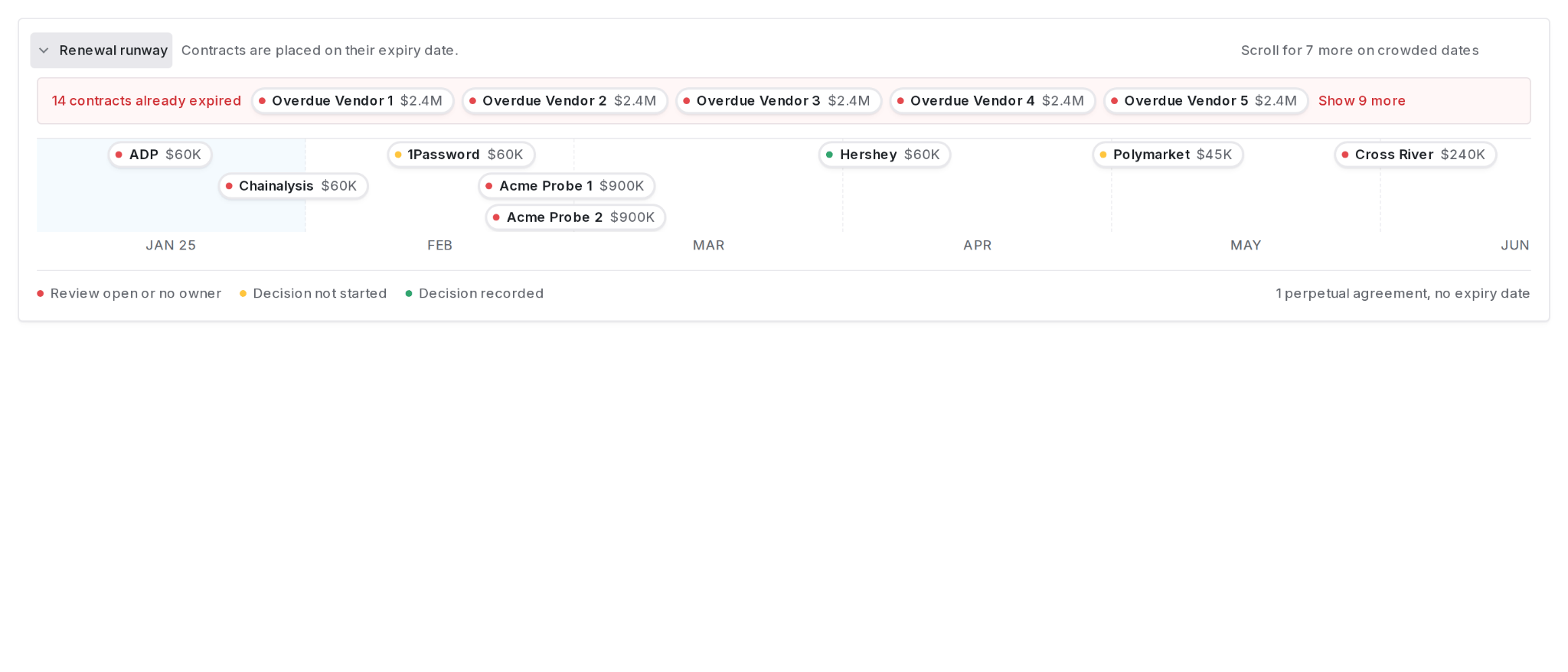
The renewal runway. Each contract sits on its expiry date, and hovering shows the notice deadline behind it.
Troubleshooting
Related
Document Insights guide
Where the dates come from: define the fields Coverbase extracts from every document, each with a page citation.
Contract Guardian guide
The language-level half of contract intelligence: clause sets, risk tiers, and clause reviews.