

The vocabulary
Where things live
Radar in the left navigation opens the Portfolio risk chart and three tabs: Signals, Cases and Reassessments. The Configurations button at the right of the tab bar opens Configuration → Radar, which has its own three tabs: Detectors, Sources and Reassessments (the reassessment triggers). Every vendor page also has a Radar tab. It lists Detectors monitoring this vendor and the vendor’s Recent alerts, with an Edit detector link on each detector.The signal queue
Open Radar → Signals.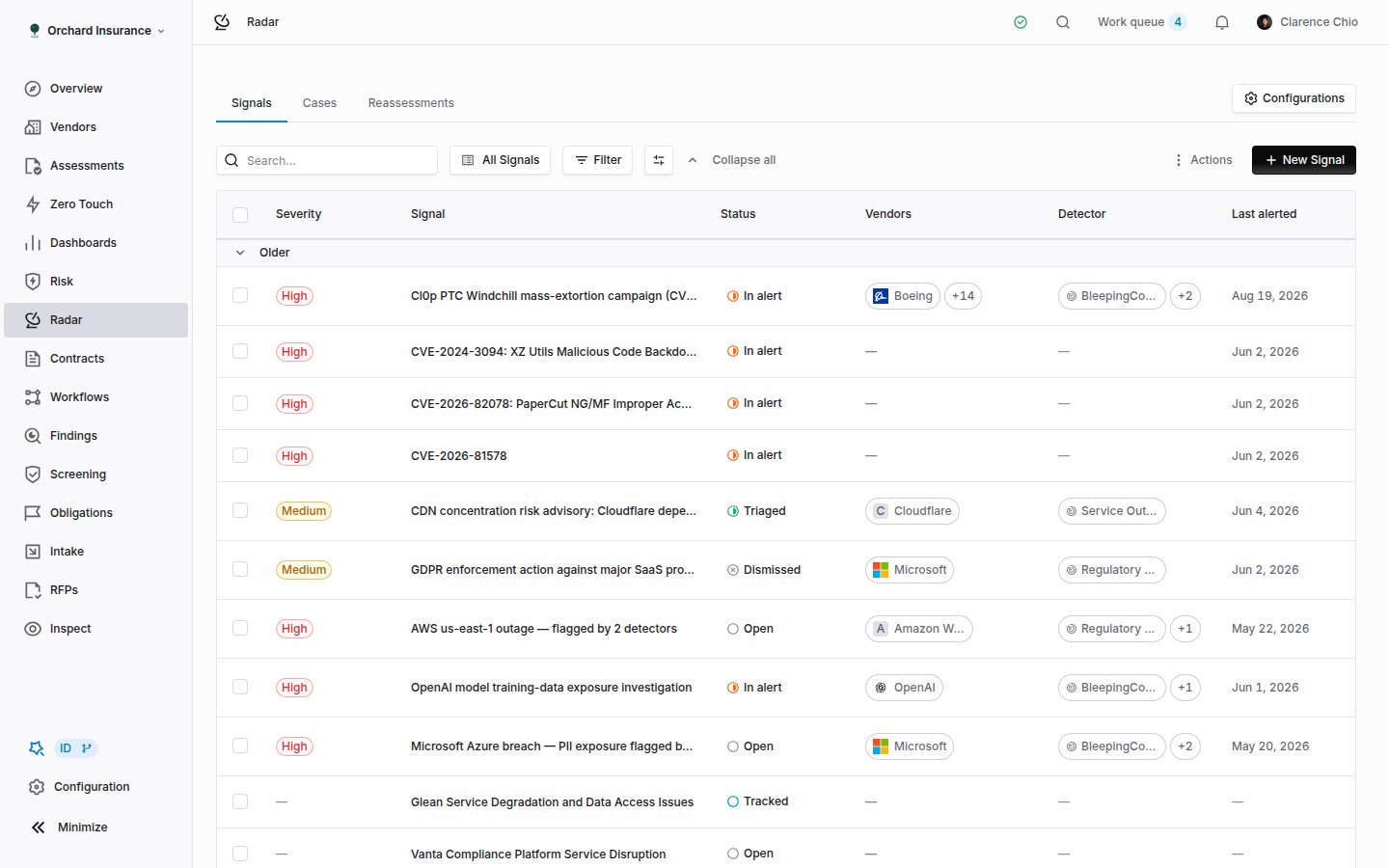
The Signals tab. One row per event, grouped by when it was first seen, with the highest severity any detector assigned and the vendors exposed.
Signal statuses
Acting on several signals at once
Tick rows and a bar appears with Start reassessment, Acknowledge, Dismiss (or Restore (un-dismiss) for dismissed rows), Should have alerted and Clear. Should have alerted is for a Tracked signal a detector missed: pick the detector, and the signal is added to it as a positive example so events like it alert next time.Reading a signal
Click a row. The page opens with the title (click it to edit), the severity badge, a Vulnerability badge when the event is a CVE, and the Actions menu.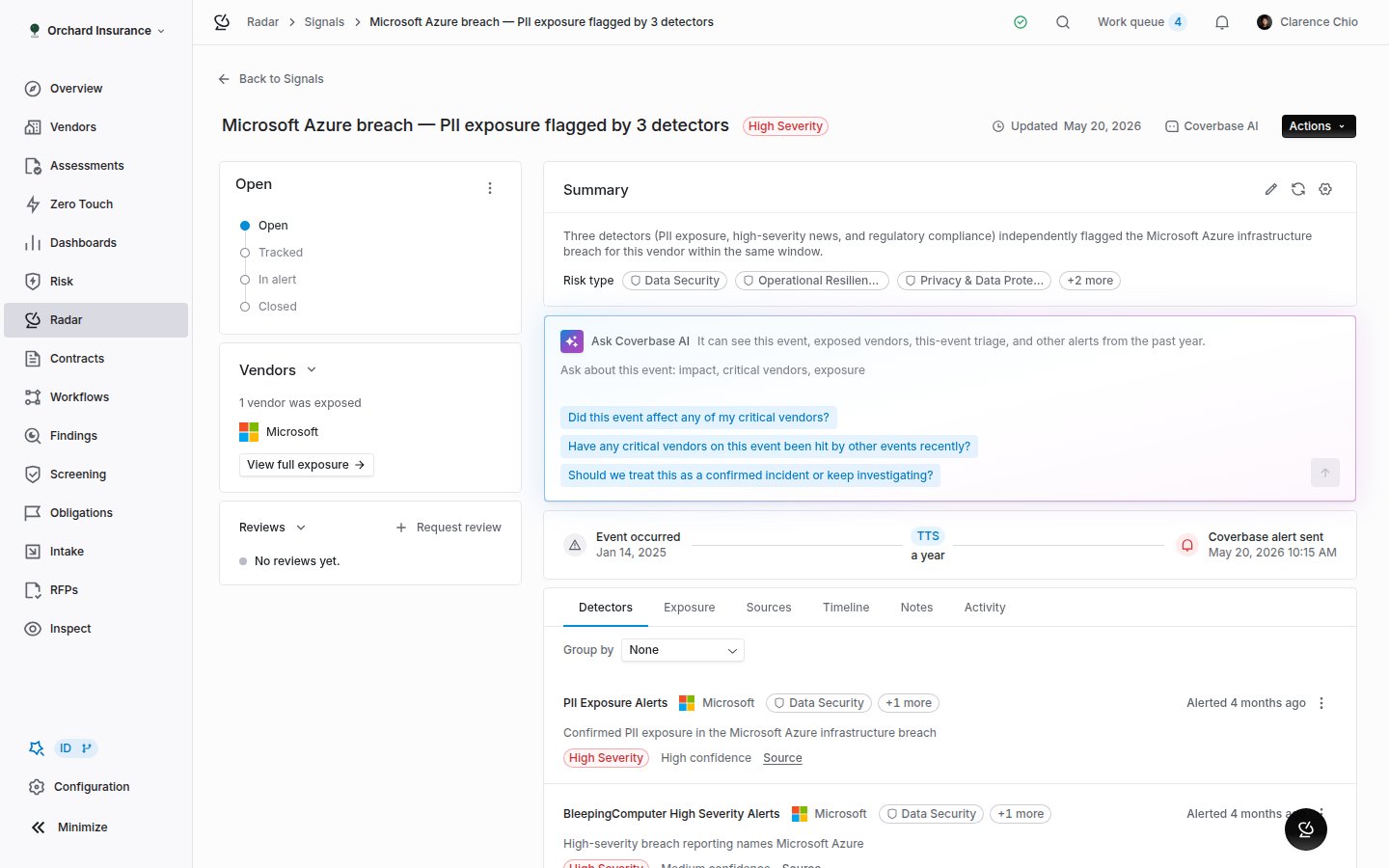
A signal. Status and exposed vendors on the left, the generated summary and time to signal on the right, and the detectors that fired below.
- The status card, named after the current status. Anyone with update permission on alerts can set a different status here.
- Triage actions, once any exist: Marked as acknowledged, and the cases, findings and reassessments raised from this signal, each linking to its record.
- Vendors: how many of your vendors were exposed, with View full exposure opening the Exposure tab.
- Vulnerabilities, on a CVE event: Potential impact (CVSS v3.1), Likelihood of exploitation (EPSS) and Known exploited (KEV). A blank EPSS is common; a blank KEV means no source reported either way.
- Summary, with the Risk type chips. Click the pencil to rewrite it by hand. Regenerate summary rewrites it from what the detectors currently report and discards any hand edit. Custom AI instructions on this card apply to every generated summary in your organization.
- Ask Coverbase AI, which can see the event, the exposed vendors, this signal’s triage, and other alerts from the past year.
- Time to signal: Event occurred, First public disclosure and Coverbase alert sent, with the gaps between them.
Triaging a signal
Open the Actions menu on the signal page. What it offers depends on where the signal stands.Dismissing
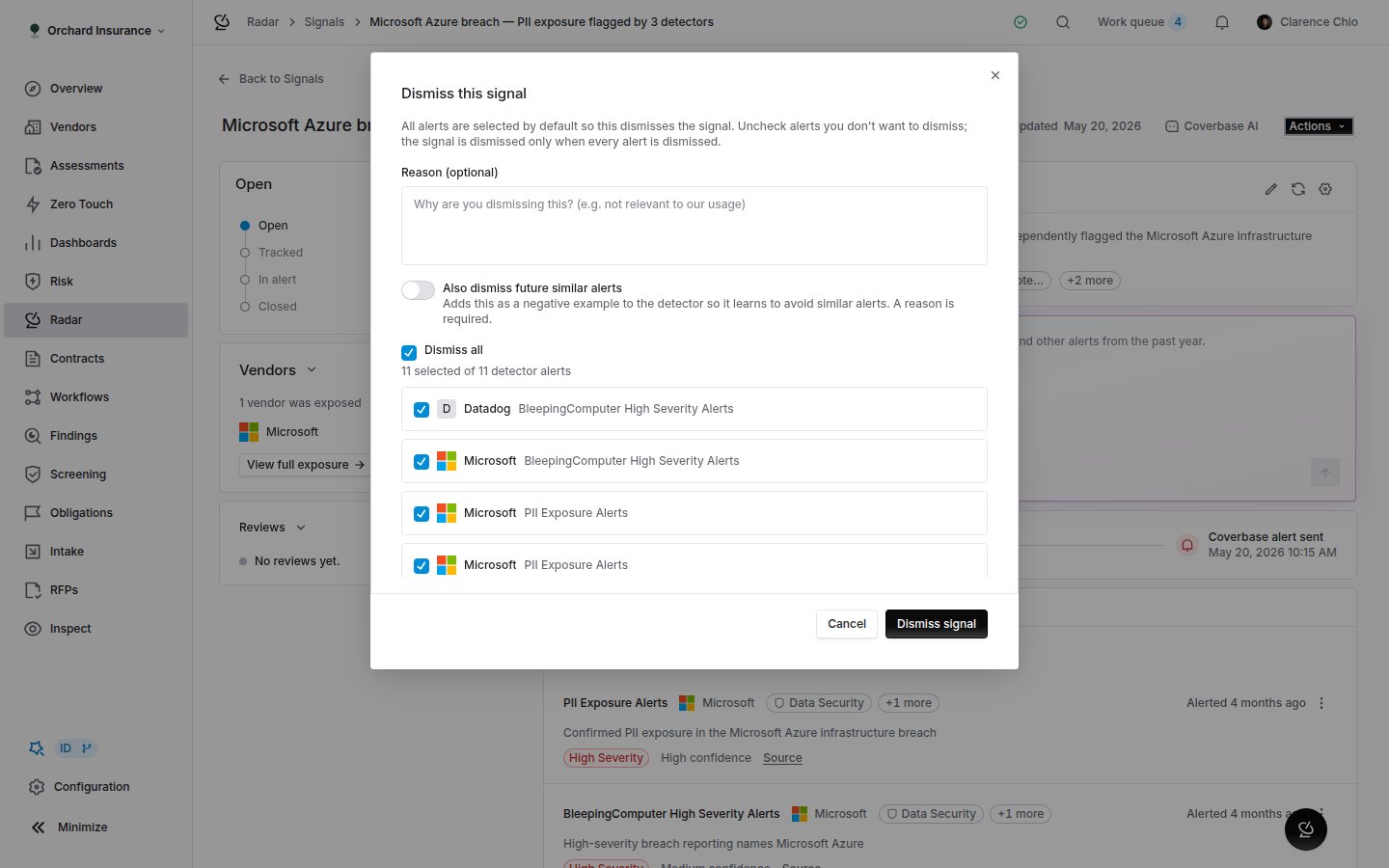
The dismiss dialog. Every active alert is ticked by default; the signal is dismissed only when all of them are.
Opening a case
Create a Case asks for a Case title (prefilled with the signal title), a Case description, and the vendors. Include all affected vendors is the default. Create and Continue takes you to Send Emails, where a Shared Draft Template with placeholders for the vendor name and your organization name can be applied to every pending vendor, edited per vendor, and sent one at a time or with Send all remaining. Skip and Go to Case leaves the emails for later. The case page has Overview, Vendors, Notes and Activity tabs, and Send Emails, Add Vendors and Import Vendors buttons. Each vendor thread carries a status, an assignee, a due date and the vendor’s replies. Close Case asks how it was resolved: Resolved, Won’t fix or False positive. Unresolved threads can be resolved with the case or left as they are. Reopen Case undoes a close. Archive Case is final.Starting a reassessment
The reassessment opens as a draft on Radar → Reassessments with the exposed vendors preselected. Open it, adjust the vendors and the Assessment plan, then Confirm and Run reassessment, which creates one assessment per vendor from the plan. Dismiss closes the draft without running it. Reassessments can also be raised without a person, by the triggers under Configuration → Radar → Reassessments: each trigger names a plan, a vendor scope, and either risk-score conditions or an AI event-type instruction describing the kind of signal that should trigger it.The risk review
When a firing detector has Residual risk impact switched on, acknowledging, creating a finding, starting a reassessment, or closing a case as Resolved or Won’t fix raises the affected vendors’ residual risk. Review vendor risk profile updates opens with the new scores, overall and per domain. Adjust any of them and Save and continue, or Continue to accept. Dismissing never moves risk, and neither does closing a case as False positive. How the size of the move is chosen is on the Supplier Radar page.Sources
Open Configuration → Radar → Sources.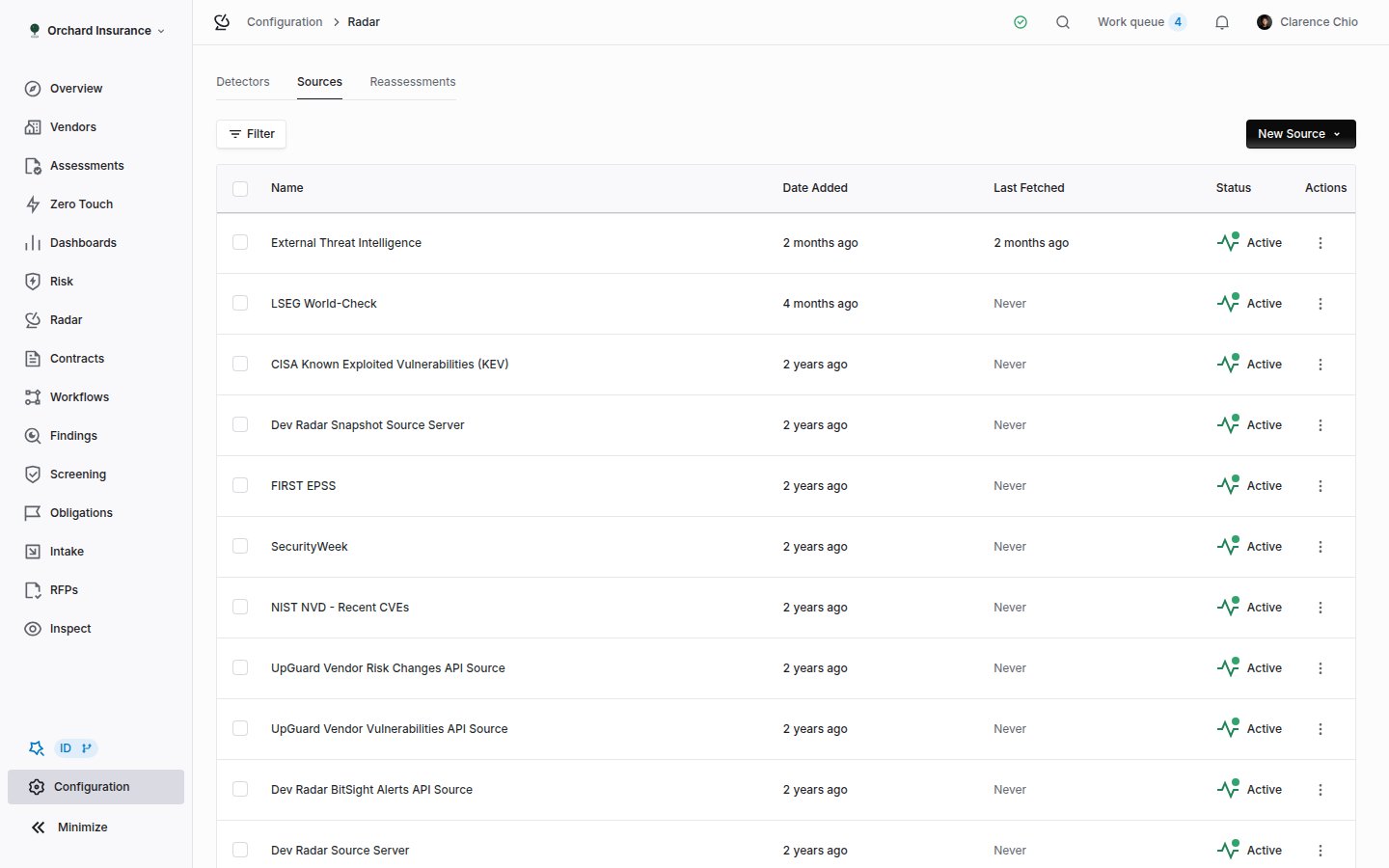
The Sources tab. Library sources and your own, each with its status and when it last fetched.
- From Source Library: pick from the curated catalog, by segment, and Connect. The full list is on the source library page. Library sources are shared and run on a schedule Coverbase sets; you can rename one but not change how it fetches.
- Black Kite portfolio: covered in the Black Kite monitoring guide.
- New Custom Source: your own Article Feed (a news page or RSS feed), API (a JSON endpoint with a request configuration and a response mapping), or Snapshot (a page or a JSON list watched for changes, with a Fetch Schedule of Hourly, Every 4 hours, Daily or Weekly).
A source’s items and runs
Click a source. Besides Configure, it has an Articles tab (Snapshot on a snapshot source) and a Runs tab.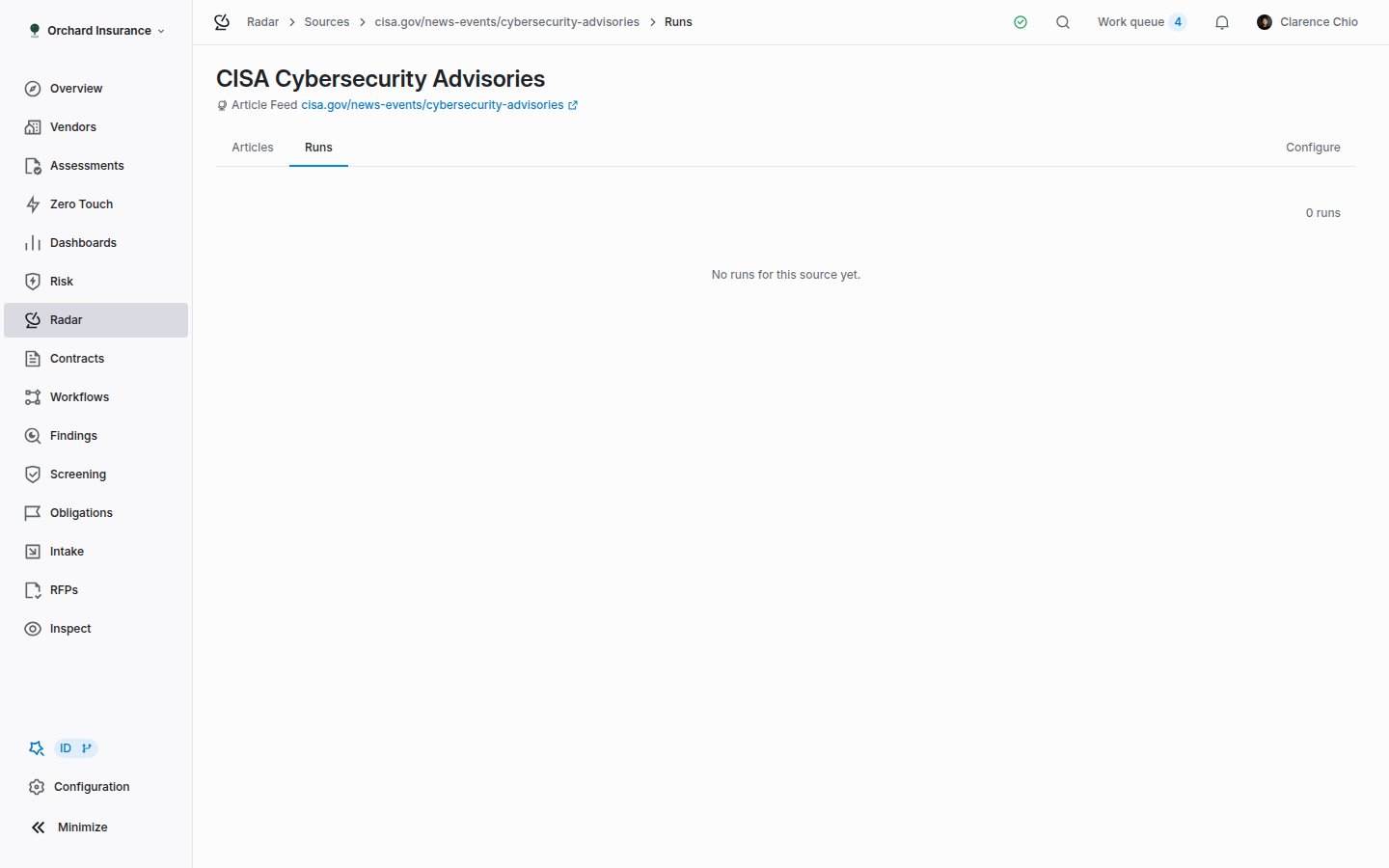
A source's runs. Each row is one fetch, with how many items it fetched, summarized and extracted entities from, and how many detections it produced.
Detectors
Open Configuration → Radar → Detectors.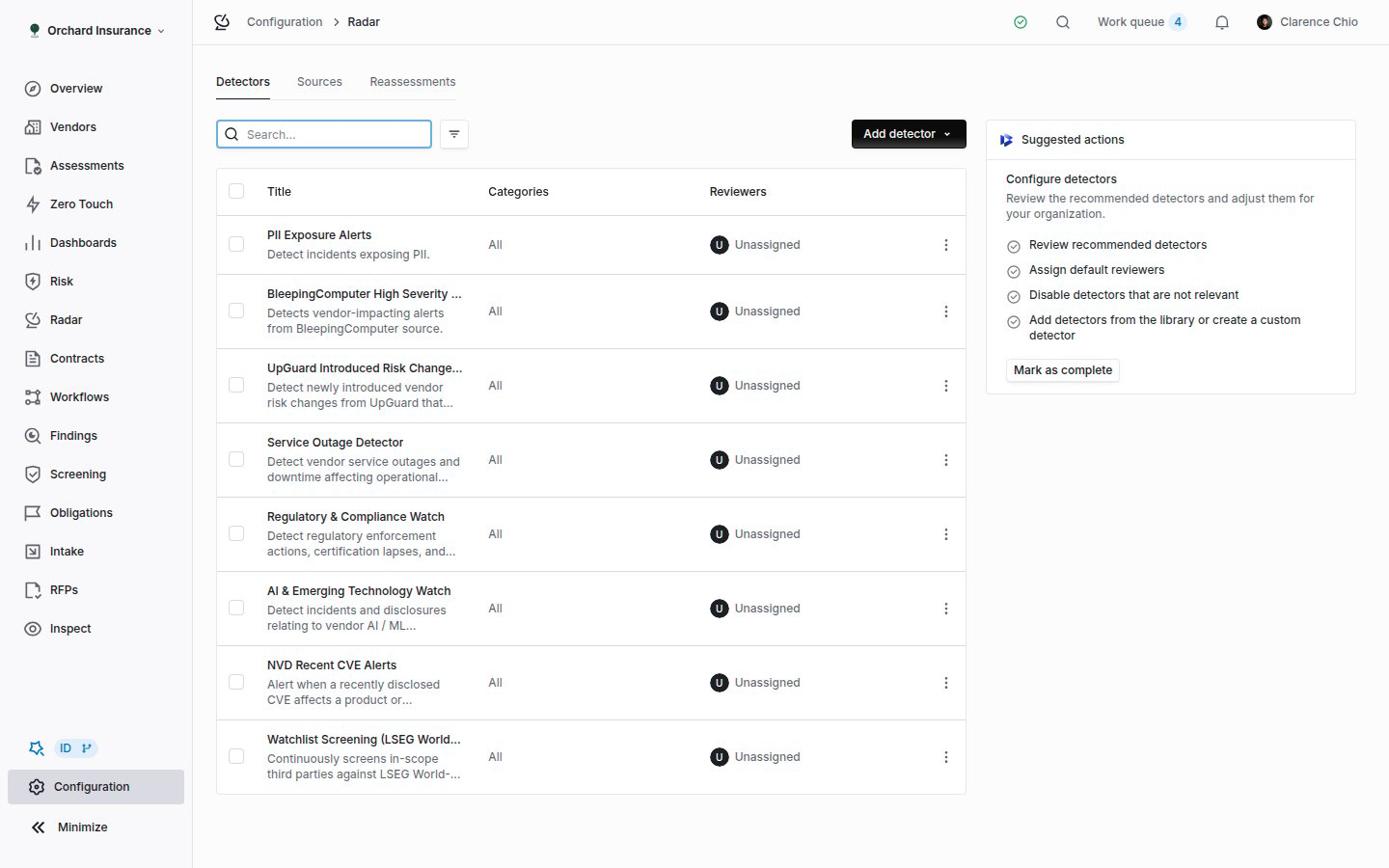
The Detectors tab. Enabled detectors by default, with categories, reviewers and the suggested actions panel for a new organization.
Adding one
Add detector offers From detector library and Create custom detector.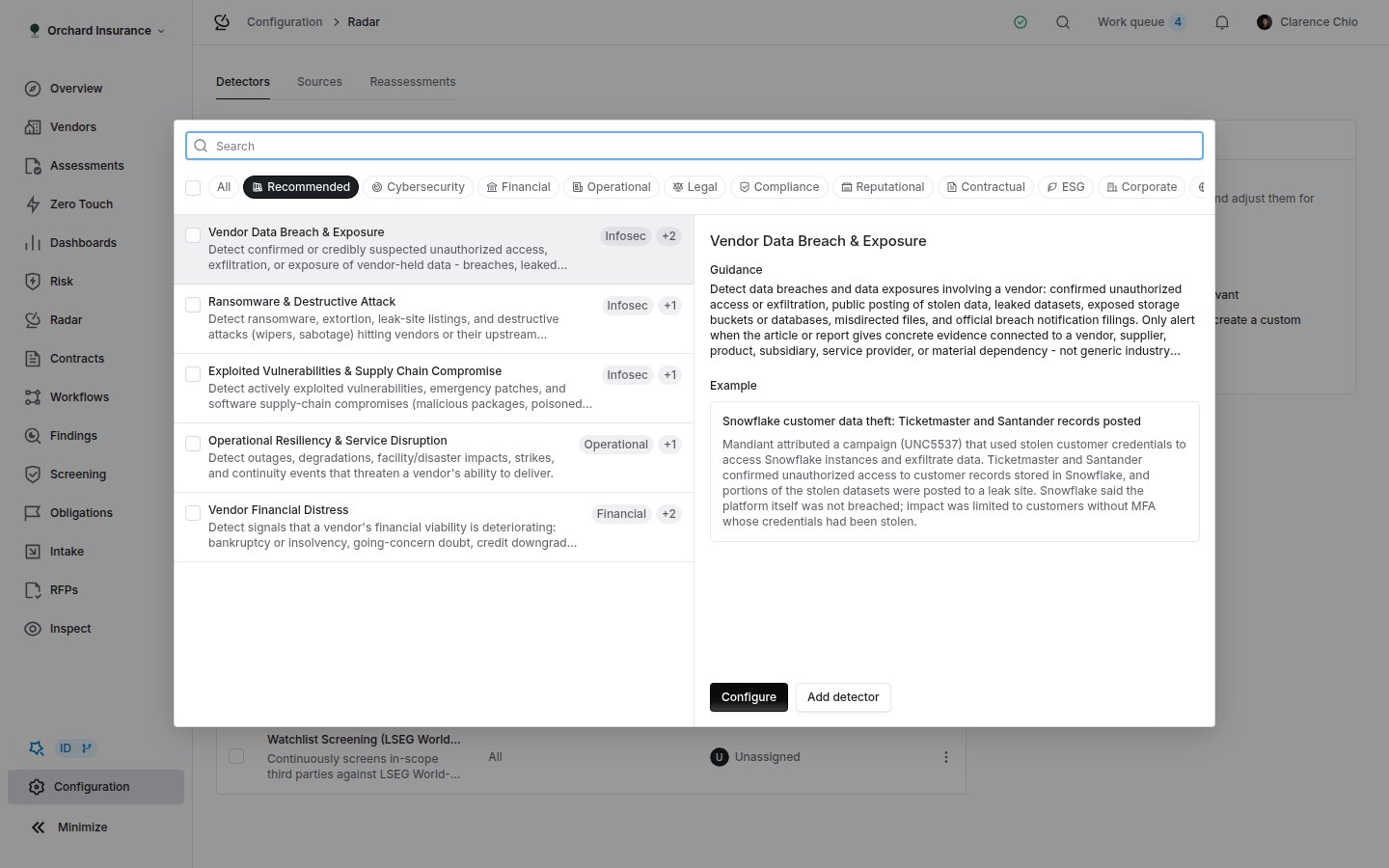
The detector library. Templates by segment, each with its guidance, an example, and how many organizations use it.
The detector form
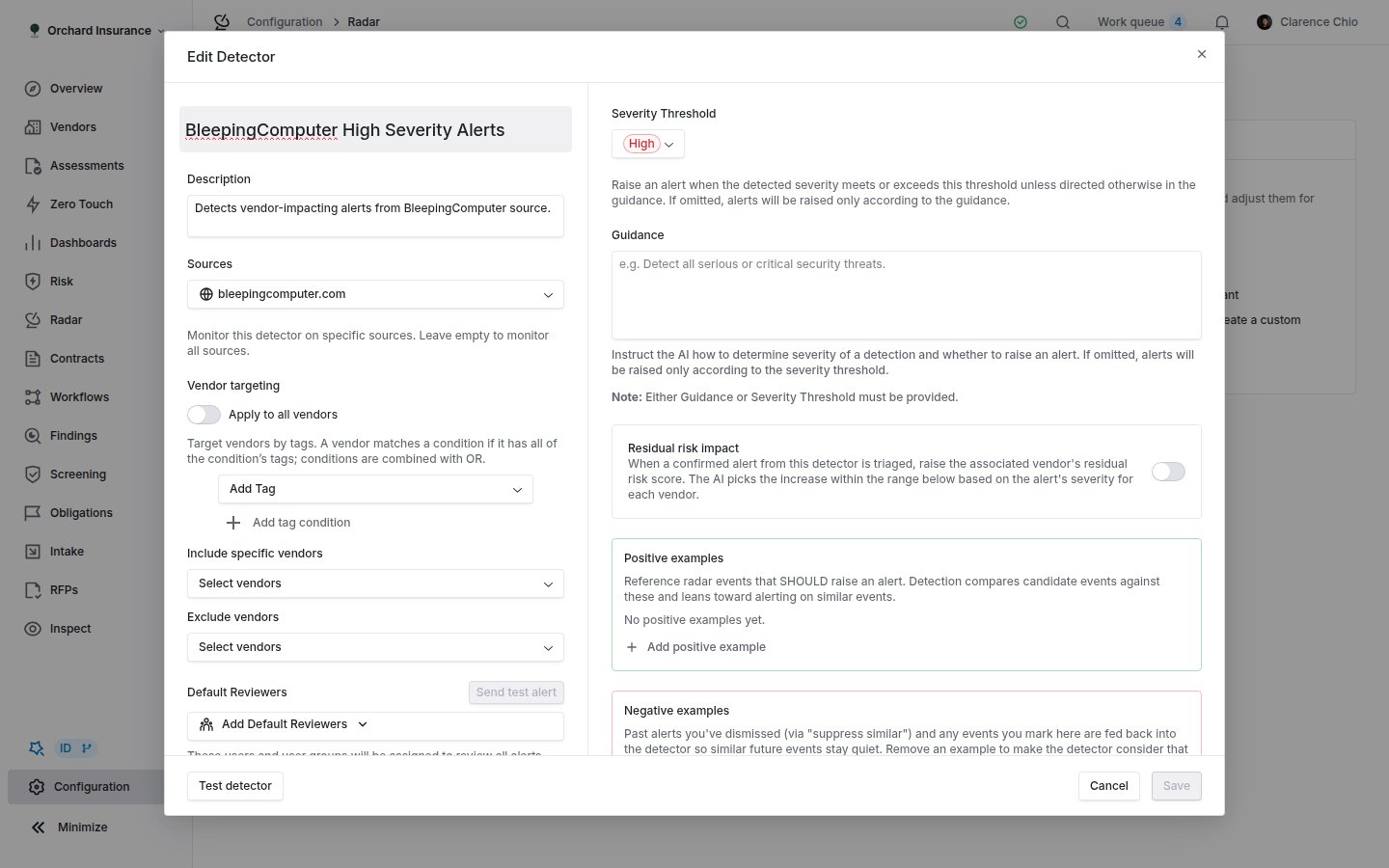
Editing a detector. Targeting and sources on the left, threshold, guidance, risk impact and examples on the right.
Testing before you enable
Test detector on a saved detector re-runs it against your recent events over the Last 7 days, Last 30 days or Last 90 days. Each result reads Will alert or Will not alert. Mark results This should alert or This shouldn’t alert, then Refine with AI proposes a rewrite of the guidance, which you can edit before Apply & re-run. Tick results and Create alerts to turn them into real alerts; a result that already has a live alert is skipped.Which vendors are watched
A vendor is evaluated by every enabled detector whose Vendor targeting includes it. That is the whole rule. The vendor page’s Radar tab lists the detectors that currently apply, so it is the quickest way to answer “is this vendor covered?”. A vendor with no detectors still gets Tracked signals when an event touches it, because tracking needs no detector. Vendors also carry a monitoring flag that the Enrol new vendors in monitoring workflow template turns on at creation. That flag is what the vendors monitored by Radar count on your subscription uses, so it decides what monitoring costs, not what a detector watches.Notifications
Radar sends four notifications. Each person can switch them on or off in their notification settings, where the first three sit in the monitoring group.Where signals go next
- Findings. A finding created from a signal carries the source type Radar alert, opens with the detector name and the alert summary as its title, and links back to the signal from the Triage actions card. From there it is an ordinary finding: see Findings Manager.
- Vendor risk. With Residual risk impact on, triage moves the vendor’s residual score, and the vendor’s risk history records the change and the detector behind it.
- Risk register. The register’s Signal Sources settings can attach Radar signals and Radar alerts at or above a severity threshold to risks, and a risk’s Attach signal button does it by hand. Turning a source off stops new attachments and leaves existing ones.
- Workflows. A workflow can trigger on a Radar signal, condition on its fields, and update it. The Monitoring signal triage template opens a review and a dated task for every new signal.
- Dashboards. The Portfolio risk chart on the Radar page plots signals over time by severity, with a 3M, 6M, 12M or All range and vendor and tag filters; click a point for the affected vendors. Under Configuration → Usage Analysis, Vendor Radar - signal quality shows alert volume, triage, and how much led to action, and Radar per-source signal ratio shows which sources are productive.
- API and webhooks. Events and alerts are readable and dismissable over the Radar API, and
RadarEvent.*andRadarDetectorResult.*webhooks fire as they change.