How to read the contracts list page and the contract record: the key statistics row, the renewal runway, and the cards on a contract.
For AI agents: a documentation index is available at https://docs.coverbase.com/llms.txt. This page is also available in markdown by appending .md to the URL.
The contracts module has two screens: the list page, where you see the whole portfolio at once, and the contract record, where you work one agreement. This guide covers what each part shows and what you can change.
Portfolio value and the four attention queues. Hover a card for what it counts.
Five cards sit in one row. The first is portfolio value. The other four are queues that need someone to act.
Card
What it counts
Portfolio value
Committed value across your contracts, in your base currency.
Notice deadline in 60 days
Contracts whose notice date falls inside the next 60 days.
Clauses need a decision
Clause review results waiting on a human verdict.
Assignment clause needs re-reading
Contracts where Radar reported a change of control at the vendor.
Value disagrees with document
Contracts whose recorded amount does not match the extracted fee.
Hover a card to see what it counts and why it matters. The card does not expand or move on hover.Click any of the four queue cards to filter the table below to exactly those contracts. Click it again to clear the filter.
Portfolio value counts one currency. Contracts in other currencies are excluded unless your organization has pinned exchange rates. Hover the card to see which currencies were left out and how many contracts that covers.
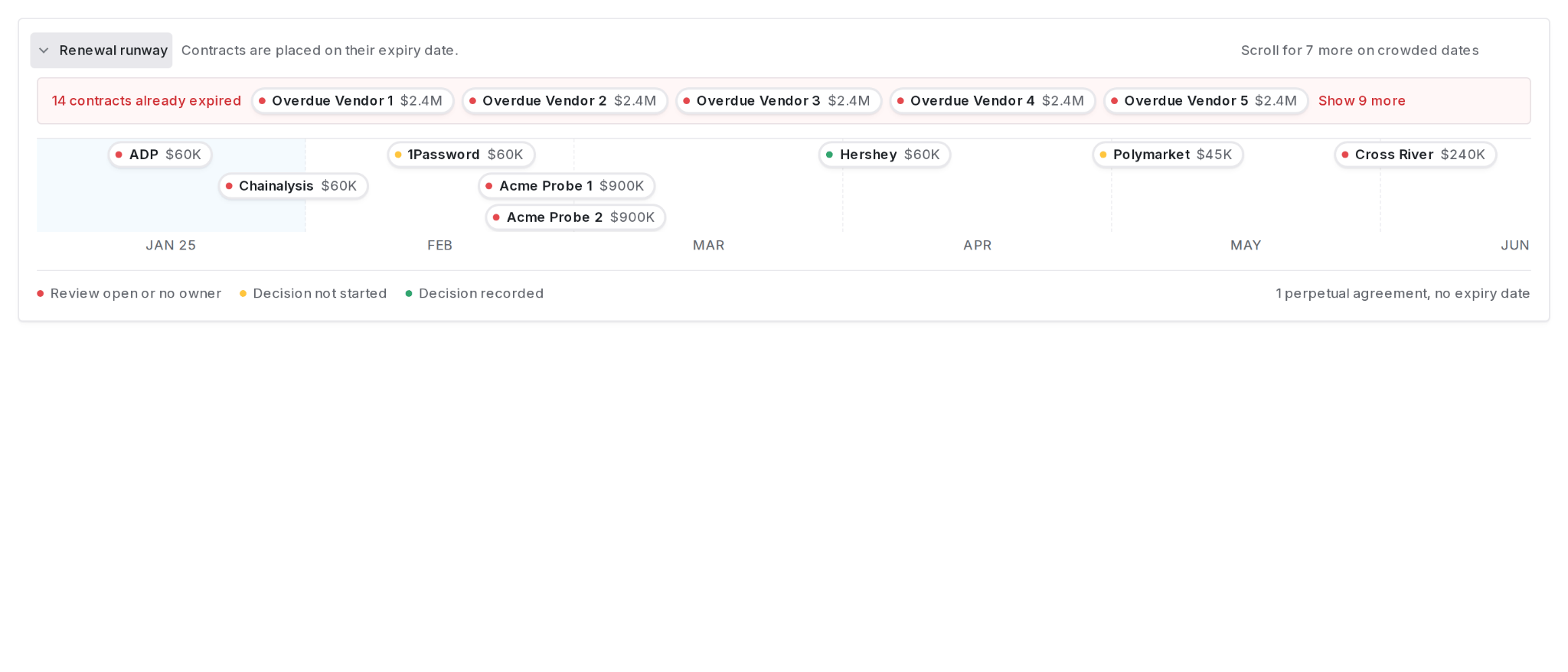
The renewal runway. Each contract sits on its expiry date, with expired contracts in the lane above.
The runway is a twelve month calendar of what expires when. Each contract sits on its expiry date, which is the date most people recognize when they talk about a renewal.Three lanes carry different things:
The band holds contracts expiring inside the next twelve months, placed on the month they expire.
The row above the band holds contracts that have already expired.
The line below the band counts perpetual agreements, which have no expiry date and so cannot be placed.
Hover a chip to see the contract name, its expiry date, its notice deadline, the relationship owner if one is assigned, and where the decision stands. Click a chip to open the contract.The dot on each chip shows how ready that renewal is:
Dot
Meaning
Red
Review open, or nobody owns the contract
Amber
Owned, but no decision recorded yet
Green
Decision recorded
The notice deadline is the last day you can act, and it always comes before the expiry date. The runway places contracts on expiry because that is the date people search for, and carries the notice date in the hover so you still see the real deadline.
Below the runway is the full list, with sorting, filtering, and pagination. Columns marked AI hold values Coverbase extracted from the documents rather than values someone typed.Seven more columns are available from the column picker, so the renewal questions can be answered from the list instead of one record at a time: Notice due date, Auto renewal, Initial term, Renewal term, Renewals applied, Renewal decision, and Contract type.
To find the contracts that cannot renew, filter on Auto Renewal is automatic and Renewal Term is empty. Those are the ones that will be marked expired instead of rolling forward.
The details card shows one row per field that has an answer. A field the contract does not carry is not drawn, so the card stays short on a thin record and grows as extraction fills it in.Eight fields are available: description, contract value, payment terms, services, term start date, effective date, term end date, and auto renewal.
1
Add a field
Click the + in the card header and pick the field. It appears as an empty row you can type into. Only fields not already shown are offered.
2
Remove a field from view
Hover the row and click the X. The row disappears from this contract’s card.
3
See the yearly breakdown
Hover Contract value. An option to add a year-by-year breakdown appears next to it.
Removing a field hides it on that one contract, in your browser. It does not delete the value, does not affect other contracts, and does not change what anyone else sees. Add it back from the + menu at any time.
The editable rows on a contract commit when you click away. There is no Save button, so the confirmation is the toast that appears in the corner: “Description saved”, “Renewal term saved”, and so on.Every confirmation carries Undo. Click it and the field goes back to the value it held before that save.
Undo is offered for one save at a time. Once you edit the same field again, the earlier offer disappears, because putting back a value from two edits ago would throw away the edit in between. Finish an edit, check the confirmation, then move on.
If a save fails, the toast says so and names the field. The value stays in the box, so you can click away again to retry rather than retyping it.
Commercial terms: the term, what it renews into, the notice deadline, the renewal decision, the cost, and the legal summary.
These are the questions people ask together, so they sit in one card rather than across the timeline rail, the details card, and the value card. Four sections stack down it.
Term and renewal
Initial term is how long the first term runs. Renewal term is what each renewal adds. Auto-renews is whether renewal happens by itself, needs a manual step, or does not happen. Notice period (days) is how much warning the vendor is owed.Below them, read-only, are the two dates those values produce: Notice due to vendor and Current term ends.A badge in the card header shows which term you are on. Term 4 means the contract has renewed three times.
Renewal decision
Four buttons: Not decided, Renew, Terminate, Under review. The current decision is the filled one.Under them is a free-text note for why, and who you asked. Both are visible on the renewal runway and filterable across the portfolio, so “which renewals has nobody decided yet” is a question you can answer without opening records one at a time.
Cost
The contract value and its currency, plus the year-by-year breakdown when the spend is not flat across the term.
Legal summary
The AI read of the agreement, shown here so you do not have to scroll to it while you are confirming the terms above. It is read-only in this card. Edit or regenerate it from the Summary card below.
A contract set to auto-renew with no renewal term cannot renew. Renewal needs both: the setting that says it renews, and a term to renew into. With only the first, the contract is marked expired on the term end its paperwork names, which can be years in the past.The card says so at the top when it applies, and filling in Renewal term clears it. The next nightly run then renews the contract and puts its status back to active.
The warning shown on a contract set to auto-renew with no renewal term recorded.
If a contract renews while you are recording a decision about the term that just ended, the save is refused and the card tells you the term moved. That is deliberate: the decision was about the old term, and the new one deserves a fresh look. Read the new term, then record the decision again.
The vendor card. Who the counterparty is, what else they are paid, and how they were rated.
The top of the right rail answers the questions that decide how carefully the rest of the page should be read. The same 90 day notice period is routine on a design tool and a board-level problem on the vendor holding your customer data.
Row
What it tells you
Other contracts
How many other live agreements you have with this vendor, and what they are worth. Click through to see them.
Relationship owners and Risk analysts
Who to ask.
Risk tier
The vendor’s inherent risk rating.
Last assessment and Next assessment
When you last looked at them, and when you look again.
Click the vendor name to open the full vendor record.
Unavailable in the risk tier or last assessment row means the lookup failed, not that the vendor is unrated or never assessed. Reload the page. If it keeps saying Unavailable, the vendor record itself will tell you.
The Documents tab: the document table, then key documents, the family tree, components, and insights.
The Documents tab opens on the document table. Below it sits the same document block you see on the Overview tab: key documents beside the document family, then contract components, then document insights.Both tabs render the same block, so the two views cannot disagree about the same files.