

For AI agents: a documentation index is available at https://docs.coverbase.com/llms.txt. This page is also available in markdown by appending .md to the URL.
This guide is part of the User Guides collection. Screening is a tab in every vendor’s Vendor Intelligence section, plus a queue of its own.
Where it lives
Screening appears in two places, and they are for two different jobs. On a vendor: open a vendor, go to Vendor Intelligence, and pick the Screening tab. This is the view when you already care about one supplier.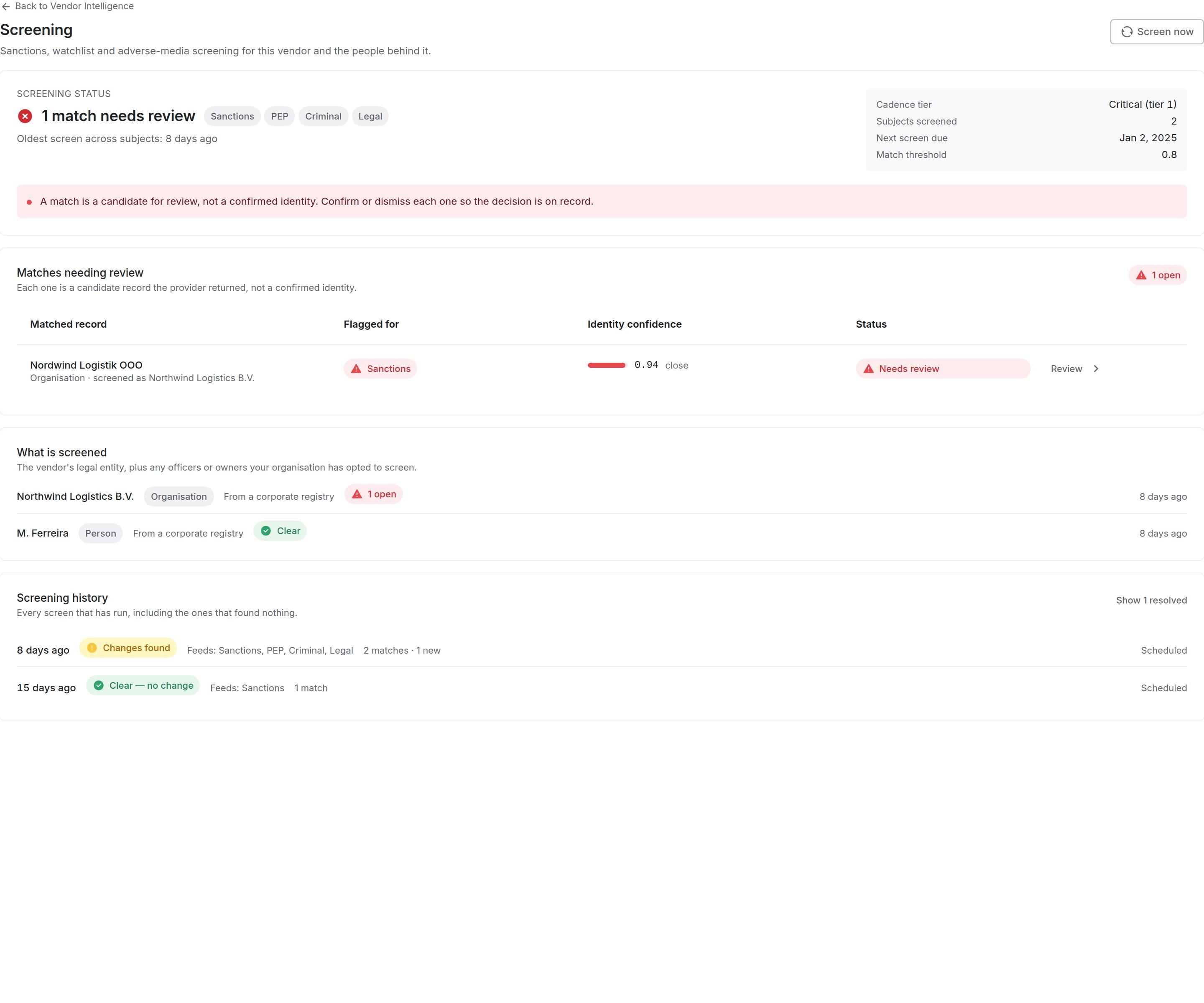
1 Open matches, worst source first. 2 Identity confidence. 3 The run history, including clear screens.
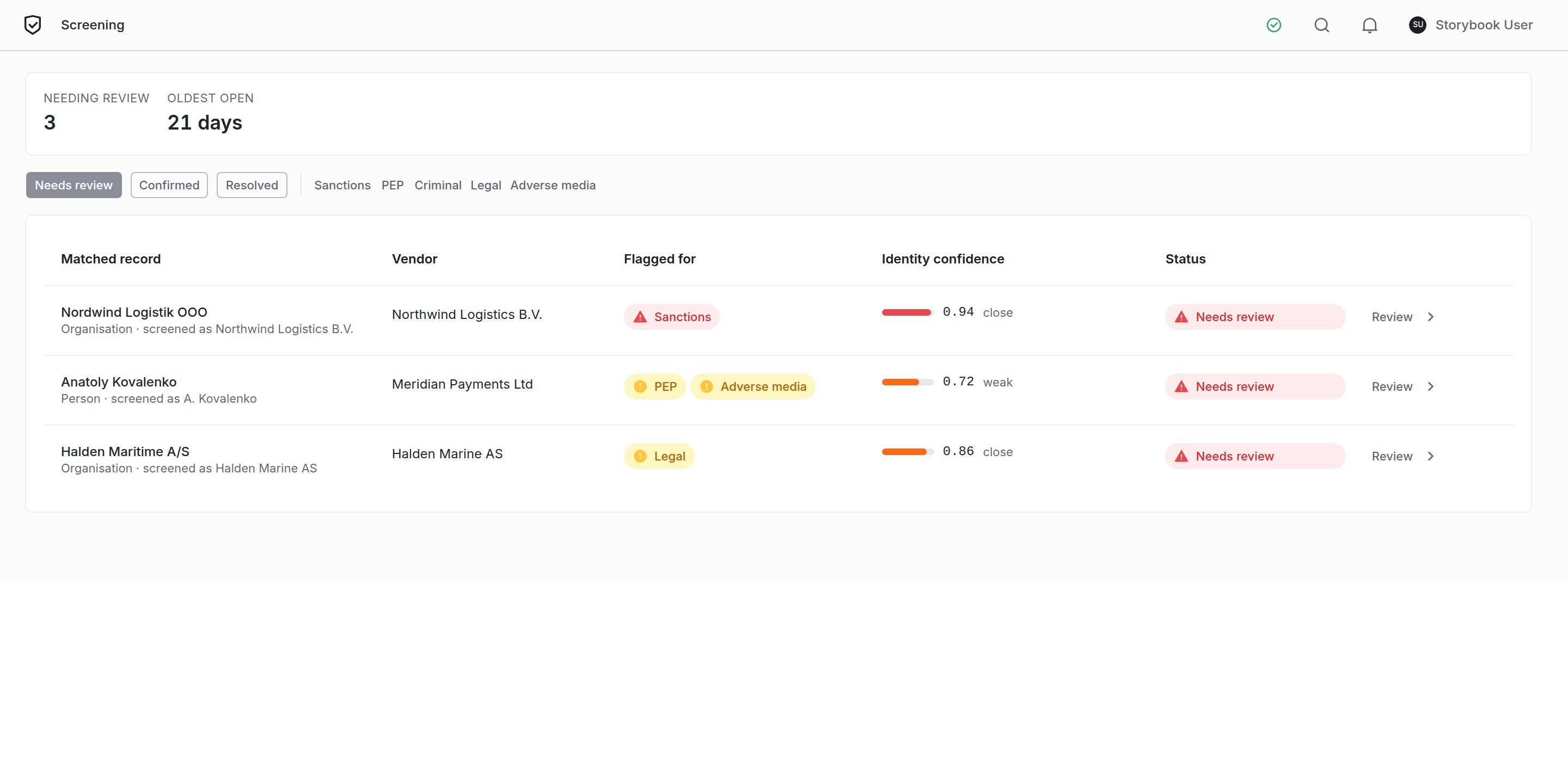
The org-wide queue. Matches from different vendors in one list, oldest first.
Identity confidence is not severity
Every match carries a score. It answers one question: how confident are we that this listed record is this vendor? It does not tell you how serious the listing is. A match at 0.95 against an adverse-media article means we are confident the article is about this subject, not that the article is damning. A confirmed sanctions listing at 0.72 is far more urgent than a high-confidence mention in a news story. Screening runs on thin identity data: a name, usually a country, sometimes a registration number, almost never a date of birth. That is not much to match on, so false positives are expected and are not a defect. A common surname or a generic trading name will produce candidates that are not your vendor. Clearing those is the job, which is why the queue exists.Reading a match
Open any match to get the full record.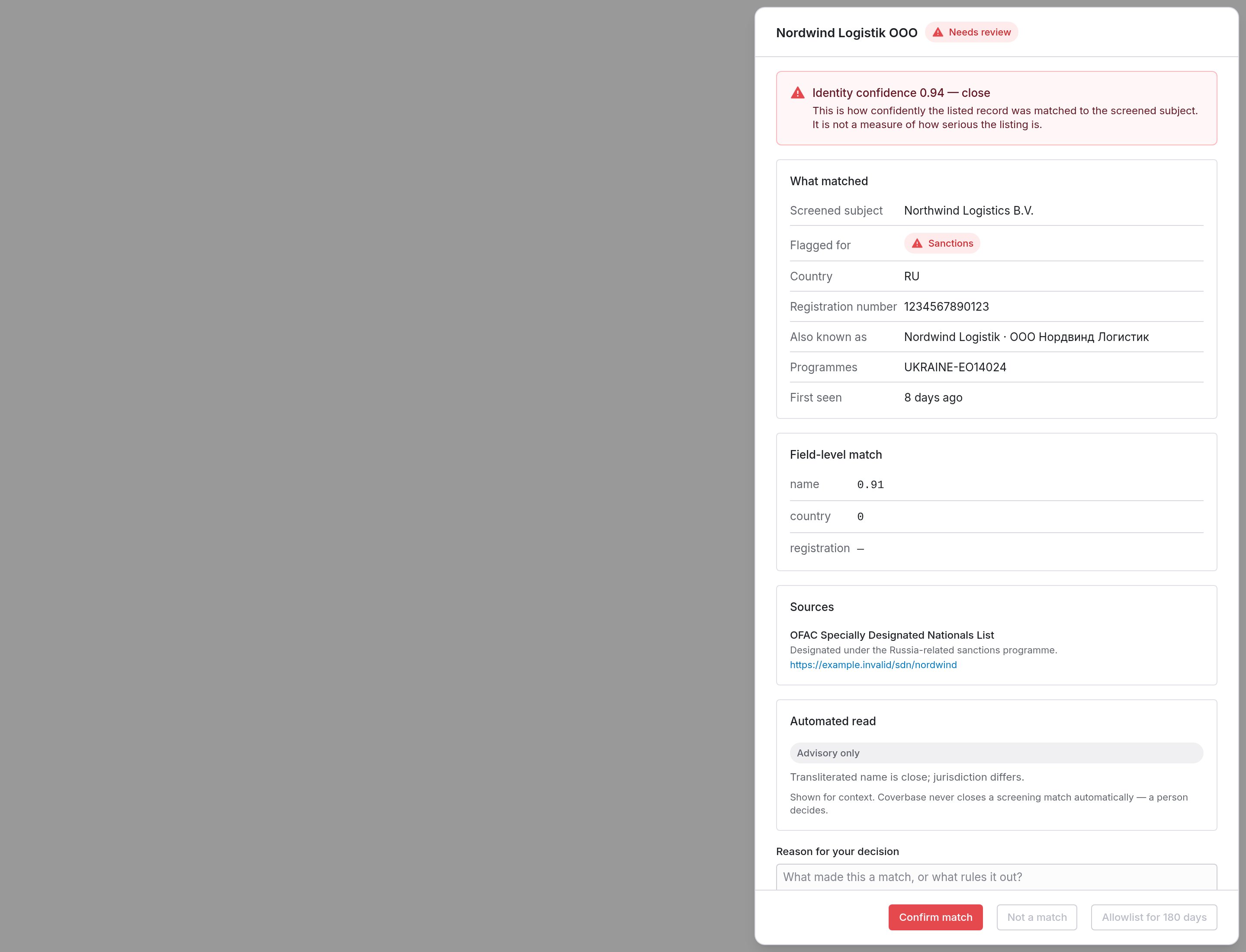
The review drawer: what matched, field by field, with the sources behind it.
- Screened subject vs matched name. The two names side by side. This is usually enough to rule out an obvious mismatch.
- Country and registration number. The strongest discriminators available. A registration number that matches is close to conclusive; a country that does not match is a strong signal it is a different entity.
- Also known as. Transliterations and former names. A vendor that looks unrelated in English can match exactly in its own script.
- Field-level match. Which attributes agreed, and how strongly. A high overall score built only on the name is weaker than a lower score built on name and registration.
- Sources. The listing itself. Follow it before you decide.
Deciding
Three outcomes, and a written reason is required for all of them. The reason becomes part of the audit trail, so write it for someone reading it in a year with none of your context.An allowlist expires so the match gets a fresh look. Circumstances change, and a permanent suppression can leave a real listing unnoticed for years.
What “clear” looks like
A vendor with nothing to review still shows its run history.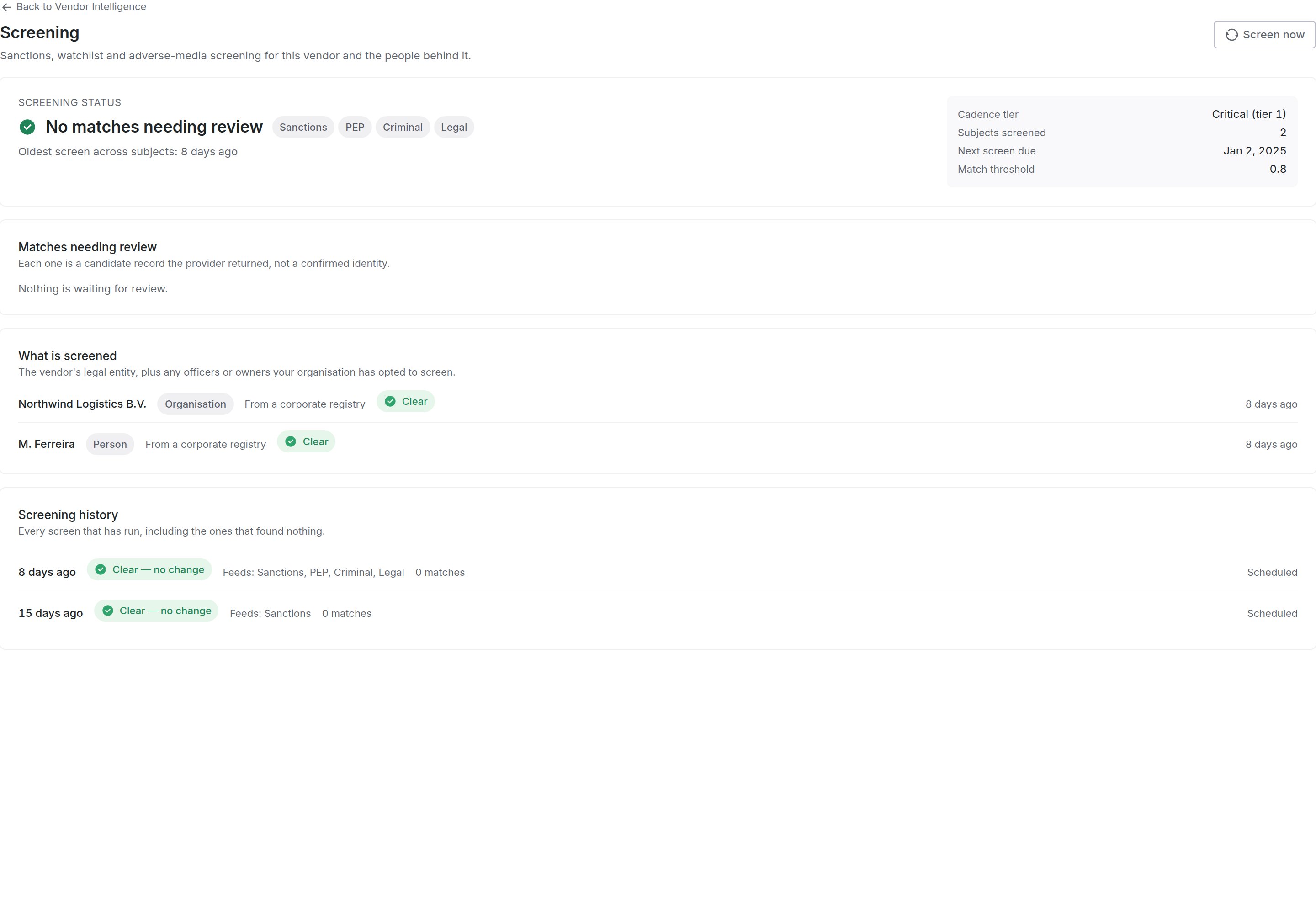
No open matches. The screens still show, with their dates and sources.
Settings
An administrator configures screening once, under Configuration → External integrations → Screening. It needs theintegration permission, not the screening one.
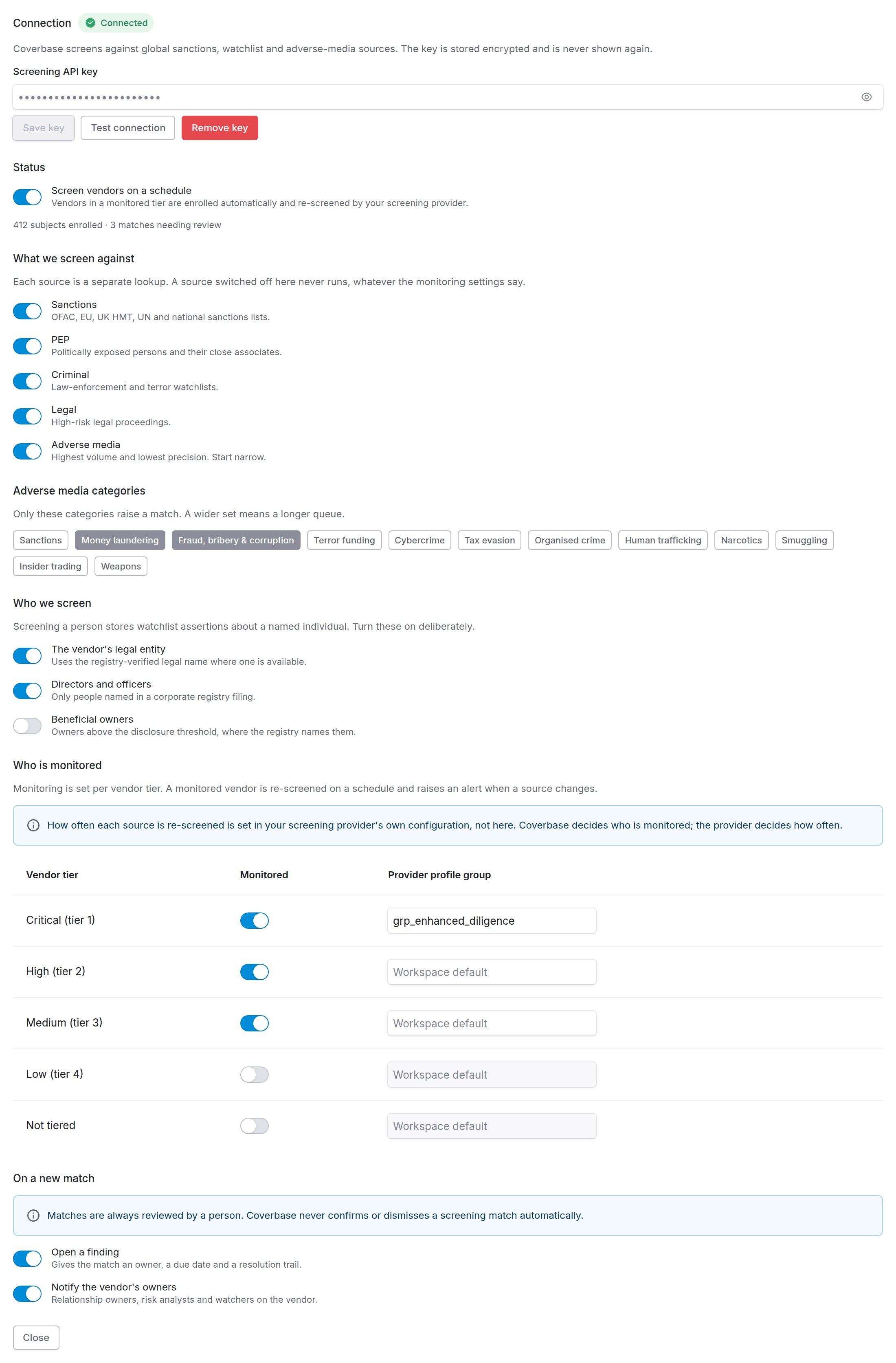
The policy: which sources, who gets screened, and which vendor tiers are monitored.
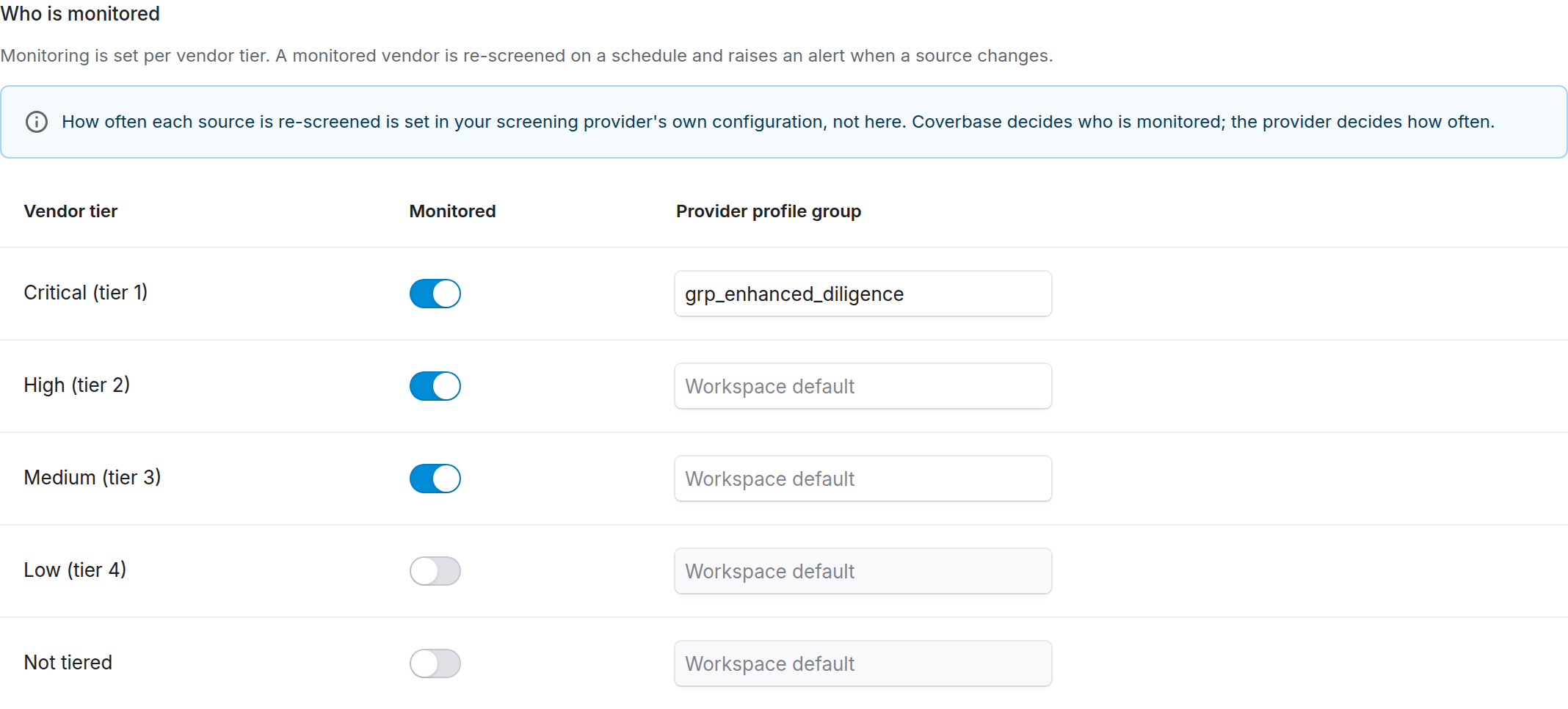
Monitoring is per vendor tier. The profile group is optional.
How often each source is re-screened is set in your screening provider’s own configuration, not in Coverbase. Coverbase decides who is monitored; the provider decides how often. If you need a tighter or looser schedule for a group of vendors, set up a profile group with your provider and name it in the table. Leaving it blank uses the provider’s workspace default.
A source switched off at the top level never runs, whatever the monitoring table says. One switch turns a source off everywhere, rather than making you clear a row per tier.
Who can do what
Screening has its own permission, separate from the vendor record, so the person who reviews matches need not be the person who administers vendors.
There is no create or delete. Matches come from the provider and are closed by decision, never removed.
Related
Corporate registrations guide
The legal entity that is screened.
People intelligence guide
The directors and officers who can be screened alongside it.
Zero Touch Assessments
Open watchlist matches as an input to the score.