How to keep a risk register in Coverbase: score a risk on the 5x5, let findings, contracts and Radar feed it as signals, decide on what the agent proposes, trace the dependency chain, run a what-if scenario, and produce the board pack.
For AI agents: a documentation index is available at https://docs.coverbase.com/llms.txt. This page is also available in markdown by appending .md to the URL.
This guide is part of the User Guides collection. It covers the Risk entry in the left navigation: the register, the chain, scenarios, exposure and the board report. The Geography tab has its own guide, Risk geography map. Vendor-level risk scores and how services roll up into them are in the Admin and setup guide.
Risk is an optional module. If you do not see Risk in the left navigation, ask your Coverbase representative to turn it on.
The register is a list of statements about what could hurt your organization, each scored on a 5x5 of likelihood and impact. It does not hold evidence of its own. A risk points at records in the other modules (an open finding, a contract without a DPA, a Radar alert, a sanctions match) through signals, and those signals open and close as the source record changes.An agent reads the same modules, proposes risks and re-scores, and files stale ones for review. It never closes or deletes a risk on its own. Everything it wants changed waits in an inbox for a person.The mistake to avoid: leaving the residual score empty. An unscored residual falls back to the inherent score, so a risk you have treated keeps reading Outside appetite until you score the residual likelihood and impact.
Two buttons sit to the right of the tabs. Ask the register opens a question box that answers from the register, the chain and the signals, and cites the records it used. Configuration opens Configuration → Risk, covered below.
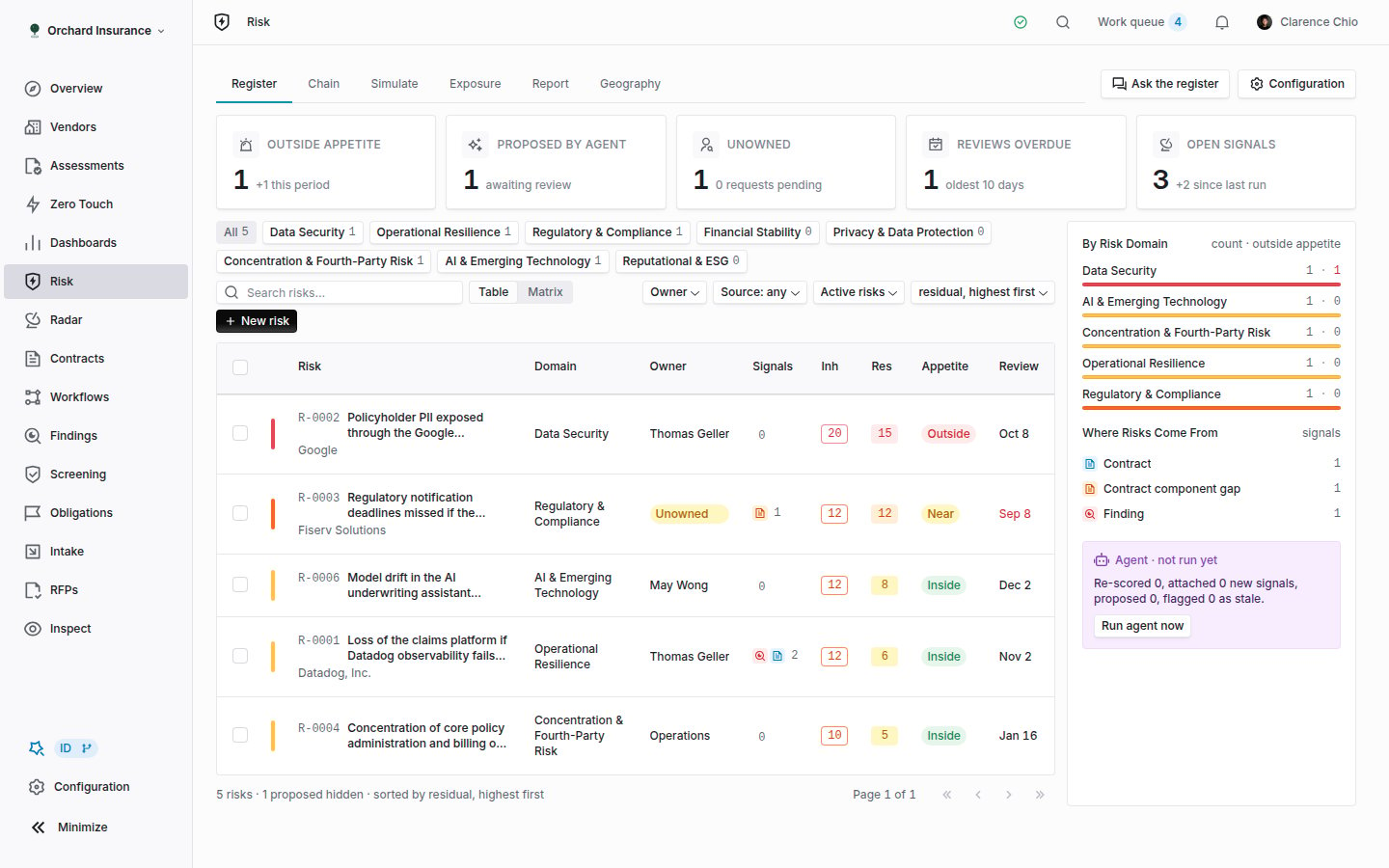
The Register tab. Summary tiles across the top, the table with its filters, and the side panel with domains, sources and the last agent run.
The five tiles at the top are filters. Click Outside appetite, Unowned or Reviews overdue to narrow the table to those risks; click again to clear. Proposed by agent opens the agent inbox. Open signals shows the count and the change since the last run.The line under the filters reads, for example, “12 risks · 3 proposed hidden · sorted by residual, highest first”. Proposed risks never appear in the table; they wait in the inbox.
Column
What it shows
Risk
The R-XXXX label, the statement, and the scope (vendors, services, business units, regions)
Domain
The risk domain, or none
Owner
A person or a department. Unowned if neither. An accepted risk shows “accepted risk · until date”; a risk with a commitment shows its state and due date
Signals
Open and closed signal counts, with an icon per source module
Inh
Inherent score: likelihood x impact before treatment, 1 to 25
Res
Residual score after treatment. Equals the inherent score while the residual is unscored
Appetite
Outside, Near, Inside or Unscored, evaluated against the domain’s tolerance
Review
The next review date, flagged Review overdue once it passes
Appetite is read from the domain’s Max Residual (default 12). A residual above it is Outside, a residual within two points of it is Near, and anything lower is Inside. A risk without a domain uses the default and rolls up as “No domain”.The filter bar narrows by domain, owner, institution, signal source, status scope (Active risks, Closed risks, All risks) and free text, and sorts by residual, inherent, review date or last updated. Matrix switches the table to the 5x5 heat map, with inherent and residual dots and the tolerance line drawn on it. Every filter is in the URL, so a filtered view is a link you can send.The side panel lists By Risk Domain (count and how many are outside appetite) and Where Risks Come From (signals per source module). Clicking a row filters the table. Underneath, the panel shows when the agent last ran and what it did, with a Run agent now button.
Click New risk in the filter bar. From a vendor, service, contract or finding page, the Risks card has Add risk, which opens the same form with that record already in scope.
2
Write the statement
Statement is what a board reader sees. The placeholder asks the right question: what could hurt the organization, and how?
3
Classify and assign
Pick a Risk Domain (its appetite decides the tolerance), a Category, an Owner (a person or a department) and, if your org has institutions, an Institution or Group.
4
Score it
Pick Likelihood and Impact from your org’s five levels; the inherent score updates as you choose. Then pick Residual Likelihood and Residual Impact for the position after treatment. Leave them at Unscored only if you have not treated the risk yet.
5
Treatment and scope
Choose a Treatment (No treatment, Mitigate, Accept, Transfer, Avoid), a Review Date, and write the Treatment Plan: what is being done, by whom, and the residual target. Add the vendors in scope. Click Create risk.
When you edit a risk later, the same form adds a Note field. Whatever you write there is recorded in the risk’s history alongside the change.
Click a row to open the record. The URL becomes /risk/register/<id>, so it is a link too.
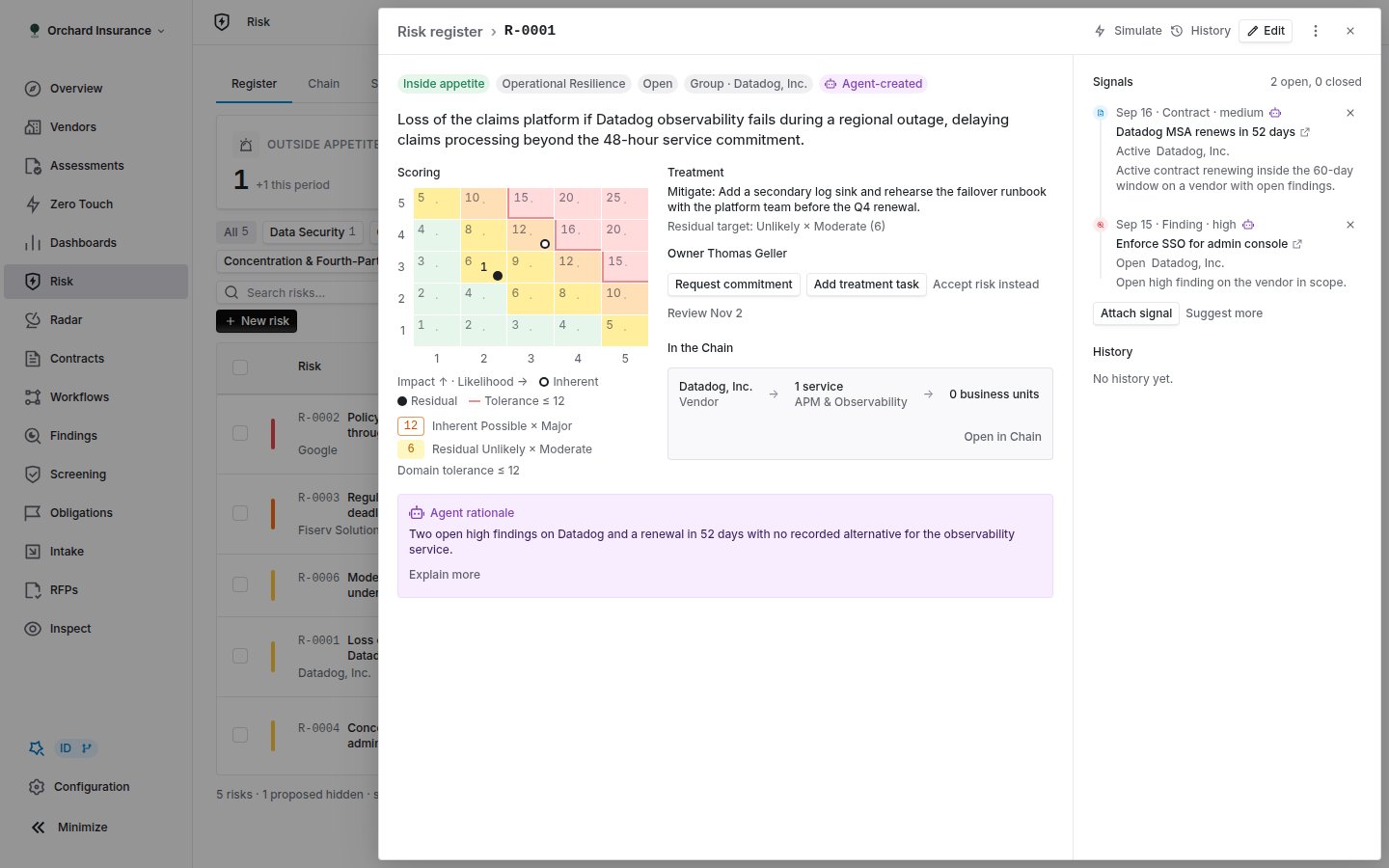
A risk record. Scoring against the domain tolerance, the owner and treatment actions, the chain position, the agent's rationale, the signals and the history.
The header carries Simulate (opens the Simulate tab with this statement as the question and runs it), History, Edit, and Archive. Below it, the appetite pill, the status pill and where the risk came from: “Agent-created · accepted by name, date” or “Created by name, date”.Scoring shows the inherent and residual lines as likelihood x impact and the domain tolerance they are read against. Treatment shows the chosen treatment, the plan and the residual target.Owner carries the actions that move a risk:
Action
What it does
Request commitment
Asks the owner to commit to treating the risk by a date. Coverbase creates a finding with the risk as its source and a commitment assigned to the owner, attaches it to the risk as a Commitment signal, and moves an Open risk to Mitigating. If the risk is unowned, the request goes to the domain owner
Add treatment task
Opens the edit form on the treatment, plan and review date
Accept risk instead
Asks you to confirm, then sets the treatment to Accept and the status to Accepted. Accepting records that the organization carries the risk as scored
Set review date
The risk reappears in the Reviews overdue tile when this date passes without a review
In the Chain shows how many business units and customer channels sit behind the risk’s vendor, with Open in Chain. A risk not tied to a chain node says so.Agent rationale appears on agent-created risks and on any risk the agent re-scored. Explain more expands it. If the agent applied a re-score, Undo restores the previous levels and journals the reversal.
Signals lists every attached record with its source icon, its severity, and its status. A status that changed since attachment reads “from → to”. A signal that closed says Closed, a dismissed one Dismissed, and one whose source was archived Source removed. Nothing is ever deleted from this list, so a finding that was open when the risk was raised still shows on the timeline after it resolves.
Attach signal opens evidence the agent found in other modules but did not attach. Attaching keeps a reference, never a copy. Suggest more asks the agent to look again.
The x on a signal dismisses it. The source record is untouched.
History is the append-only journal: created, proposed, accepted, re-scored, owner changed, status changed, signal attached or closed, merged, edited, scale remapped, closed, reopened. Each row names the person or the agent and shows the scores after the change.
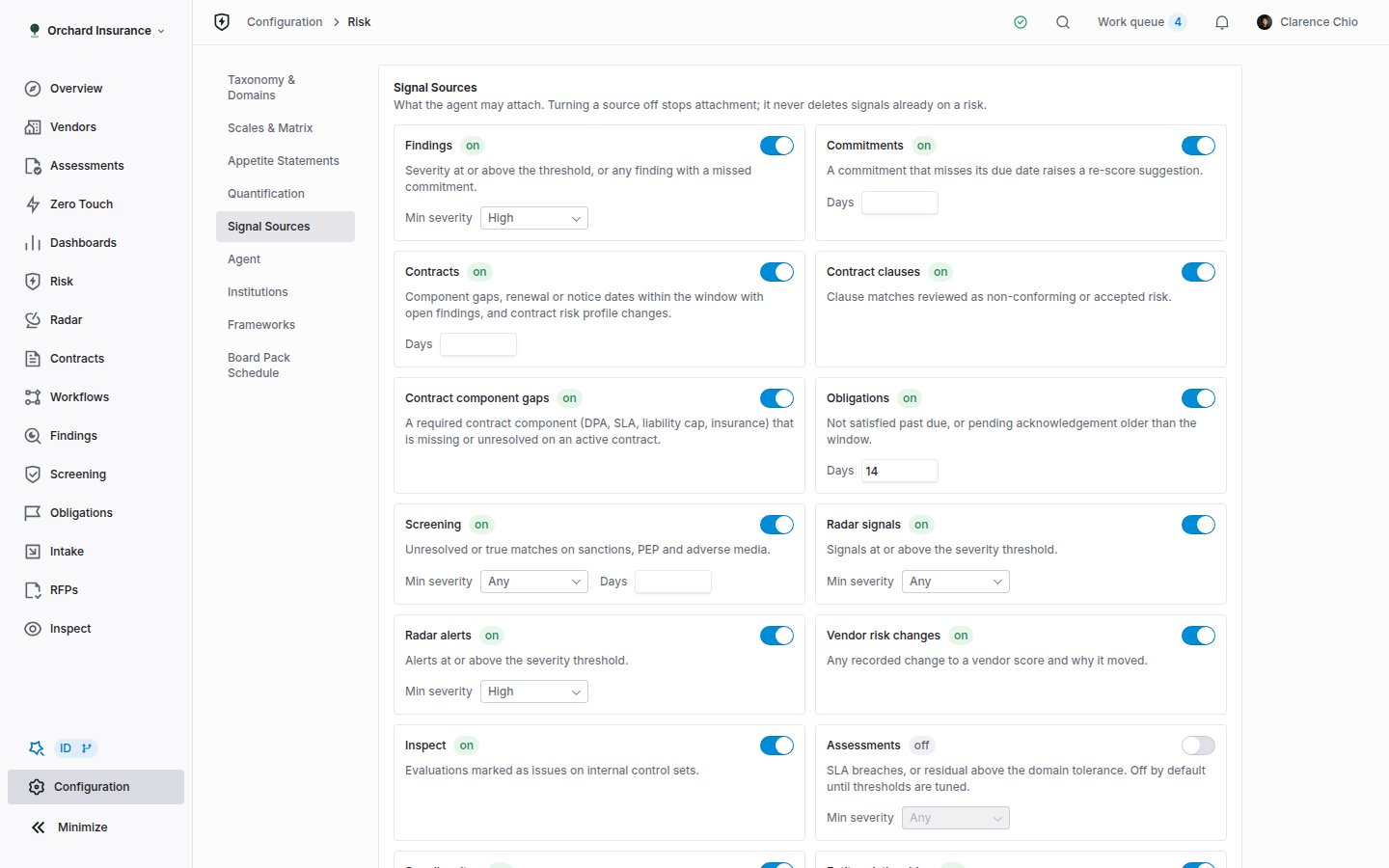
A signal is attached only when its source is enabled under Configuration → Risk → Signal Sources and the record clears the threshold set there. Every source is on by default except Assessments.
Source
Becomes a signal when
Closes when
Findings
An open finding at or above Min severity (default High), or any open finding with a missed remediation commitment
The finding is resolved or archived
Commitments
A commitment misses its due date. This also raises a re-score suggestion (likelihood up one step)
The commitment is met
Contracts
An active contract renewing within the window (60 days) on a vendor with open findings
The contract stops being active
Contract clauses
A clause match reviewed as non-conforming or accepted risk
The match leaves an open status
Contract component gaps
A DPA, SLA, security addendum, SCC, subprocessor list or AI addendum slot is missing or expired on an active contract
The slot is present or not required
Obligations
Not satisfied past its due date, or pending acknowledgement older than Days (14)
Satisfied or archived
Screening
An unresolved or confirmed sanctions, PEP or adverse media match
Reviewed as not a match
Radar signals and Radar alerts
At or above Min severity (High). An alert counts once a reassessment has cited it
Resolved, dismissed or archived
Vendor risk changes
A vendor score rose within the last 30 days
The change is older than 30 days
Inspect
An evaluation marked as an issue in the latest run
No longer an issue
Assessments (off by default)
An SLA breach, or a domain residual above the domain’s appetite
Neither holds
Supplier sites
An active site in a sanctioned country, or in the EU/EEA/UK while a DPA slot on the vendor’s contracts is missing or expired
The site is retired or a DPA appears
Chain single points of failure
A node several services or business units depend on, with no recorded alternative
The node gains an alternative or leaves the chain
Financial health
The vendor’s financial health score fell by Min score drop (15) since the previous reading, or a submitted statement failed validation
The latest score is no longer a drop
Turning a source off stops new attachments. It never removes signals already on a risk. Signal statuses refresh when the source module changes and again in a nightly pass.
The agent runs every night, about five minutes after a qualifying change in another module, and whenever someone clicks Run agent now (on the register side panel or under Configuration → Risk → Agent). One pass refreshes signal statuses, scans the sources, attaches new evidence to the open risk on the same vendor and category (or proposes a new risk), suggests re-scores, and flags stale risks.Two settings under Agent decide how much it does on its own:
New risks: Propose for review (default) files each new risk as Proposed for a person to accept. Create directly opens them as Open risks.
Re-scoring: Suggest files a re-score suggestion. Apply and notify writes the new levels and journals the change; you can still Undo on the record.
Stale after (default 120 days without a signal change) and free-text Instructions (for example, “treat any vendor with access to the core ledger as Tier 1”) complete the settings.
The agent never closes, archives or deletes a risk. When every vendor in scope is retired, or every signal has closed, it files a stale proposal with a suggested close. A person applies it or keeps the risk open. A risk you edited or dismissed is never re-proposed by a later scan.
Click the Proposed by agent tile. The inbox has four tabs.
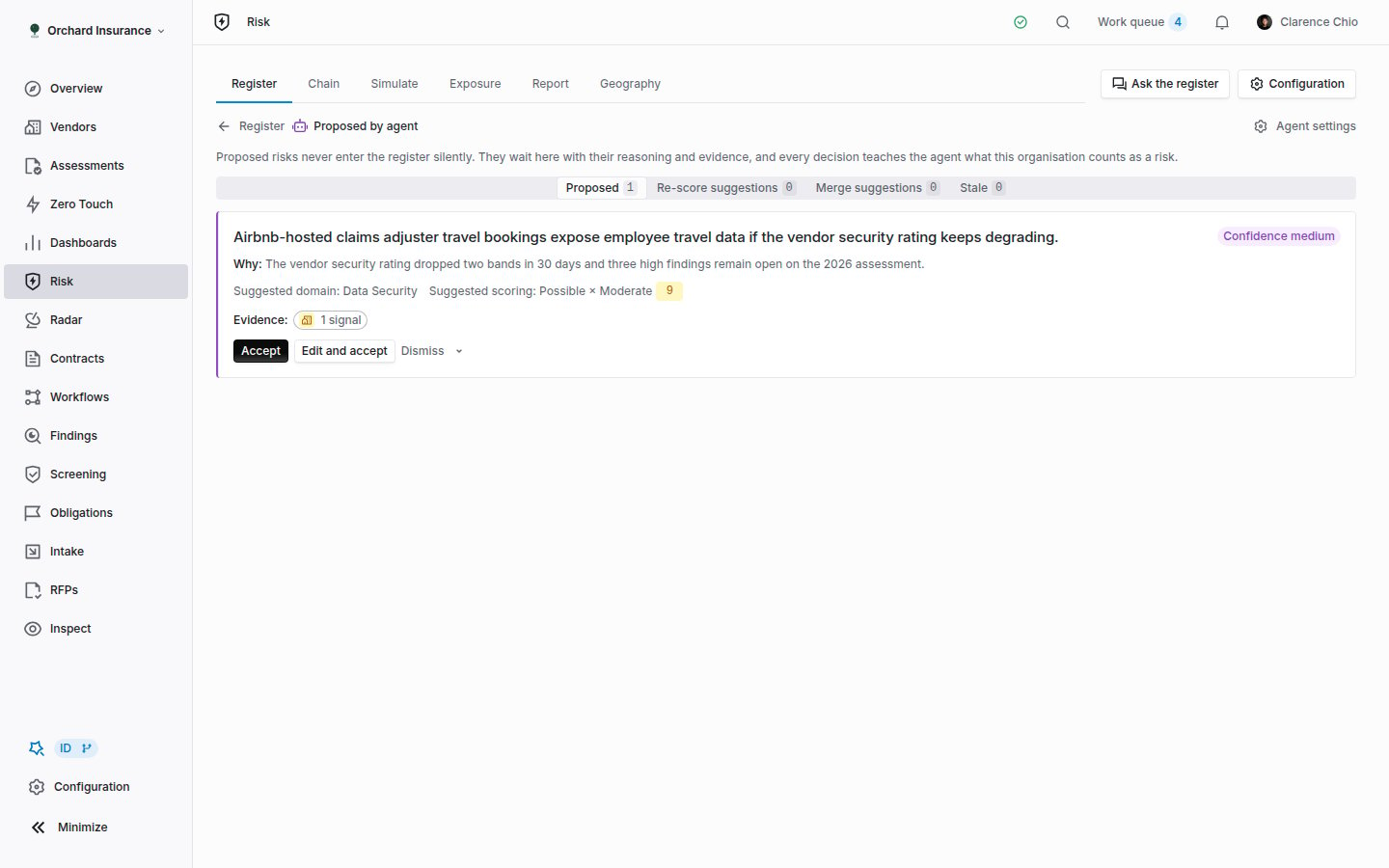
The agent inbox. Each card carries the reasoning, the suggested scoring and owner, and the evidence, with the decision buttons underneath.
Tab
Decisions
Proposed
Accept opens the risk as scored. Edit and accept opens the form first. Merge into… folds it into a similar existing risk, moving its signals and scope across. Dismiss archives it
Re-score suggestions
Apply writes the suggested levels and journals a re-score. Keep current dismisses the suggestion
Merge suggestions
Merge or Keep separate
Stale
Close as treated closes the risk. Set review date keeps it open with a new date (90 days out unless you pick one). Keep open dismisses the flag
Dismiss asks why: Not a risk for us, Duplicate, Wrong scoring, Already treated or Other. The reason is fed back to the agent and recorded in history.Each card shows the agent’s confidence, its rationale under Why, and the signals under Evidence. A proposal the agent files with no signals of its own still cites the records it read.
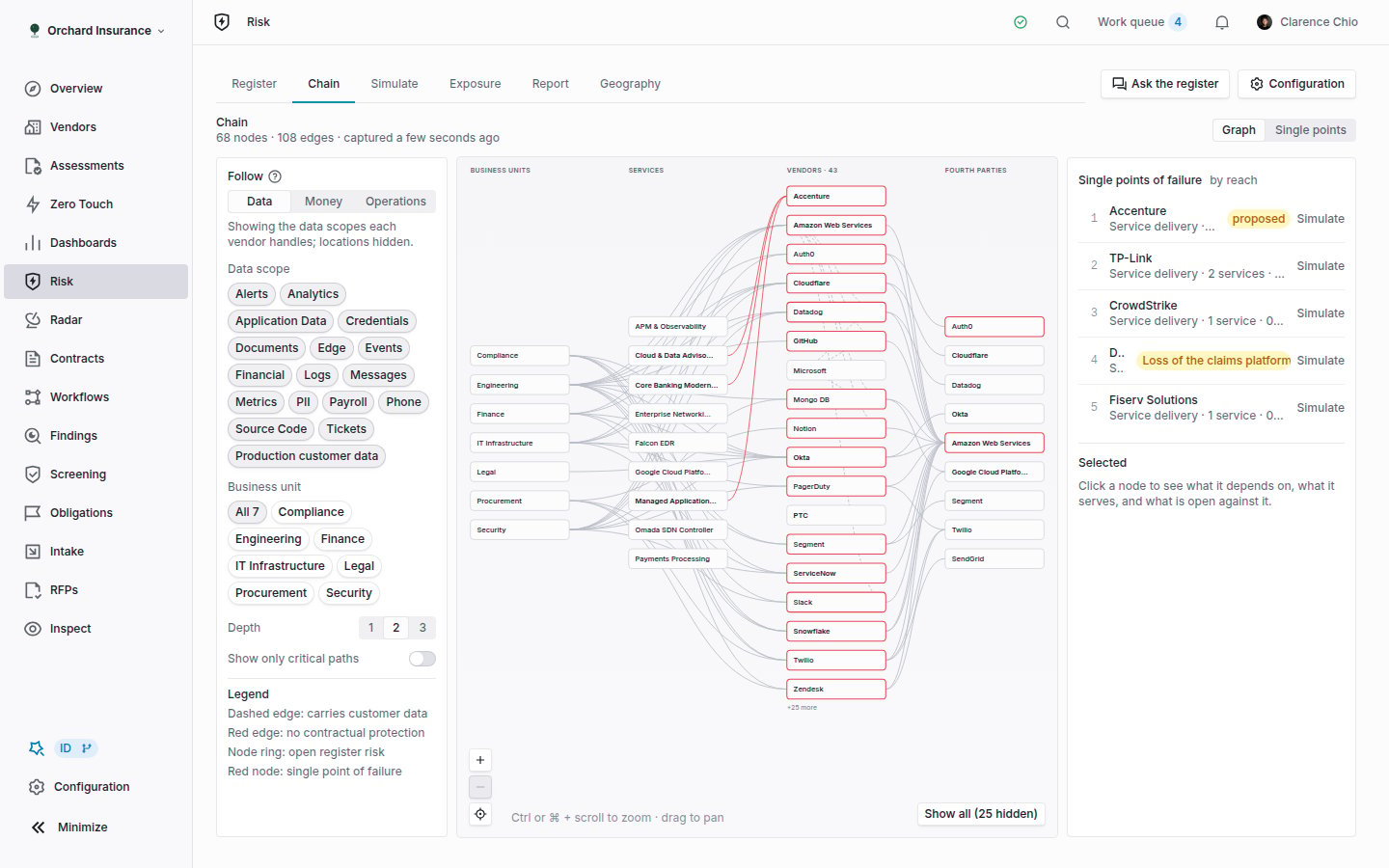
The Chain tab following Operations. Business units on the left, services, vendors, fourth parties and regions to the right. Red nodes are single points of failure.
The chain is rebuilt nightly from business unit dependencies, services, active contracts, each vendor’s fourth parties (subprocessor lists where there is no entity), supplier sites and vendor risk profiles. The header names the snapshot and its date, so a scenario always says which chain it ran on.Follow picks which chain the graph traces:
Mode
Shows
Ordered by
Data
Data scopes each vendor handles; locations hidden. A dashed edge carries customer data
Build order
Money
The same chain without data scopes or locations
Annual contract value, so the largest vendors survive the node cap
Operations
Regions and sites vendors operate from
The criticality recorded on each business unit dependency
Narrow with Data scope, Business unit, Depth and Show only critical paths. A column with too many nodes collapses the rest behind +N more; Show all expands it. In the legend, a red edge has no contractual protection, a ring marks a node with an open register risk, and a red node is a single point of failure.Click a node to see what it depends on, what it serves, its contract (liability cap, SLA, DPA in place or not), and what is open against it (findings, obligations). Simulate outage runs an event scenario on it. Single points lists every single point of failure by reach, with how many alternatives are on record.
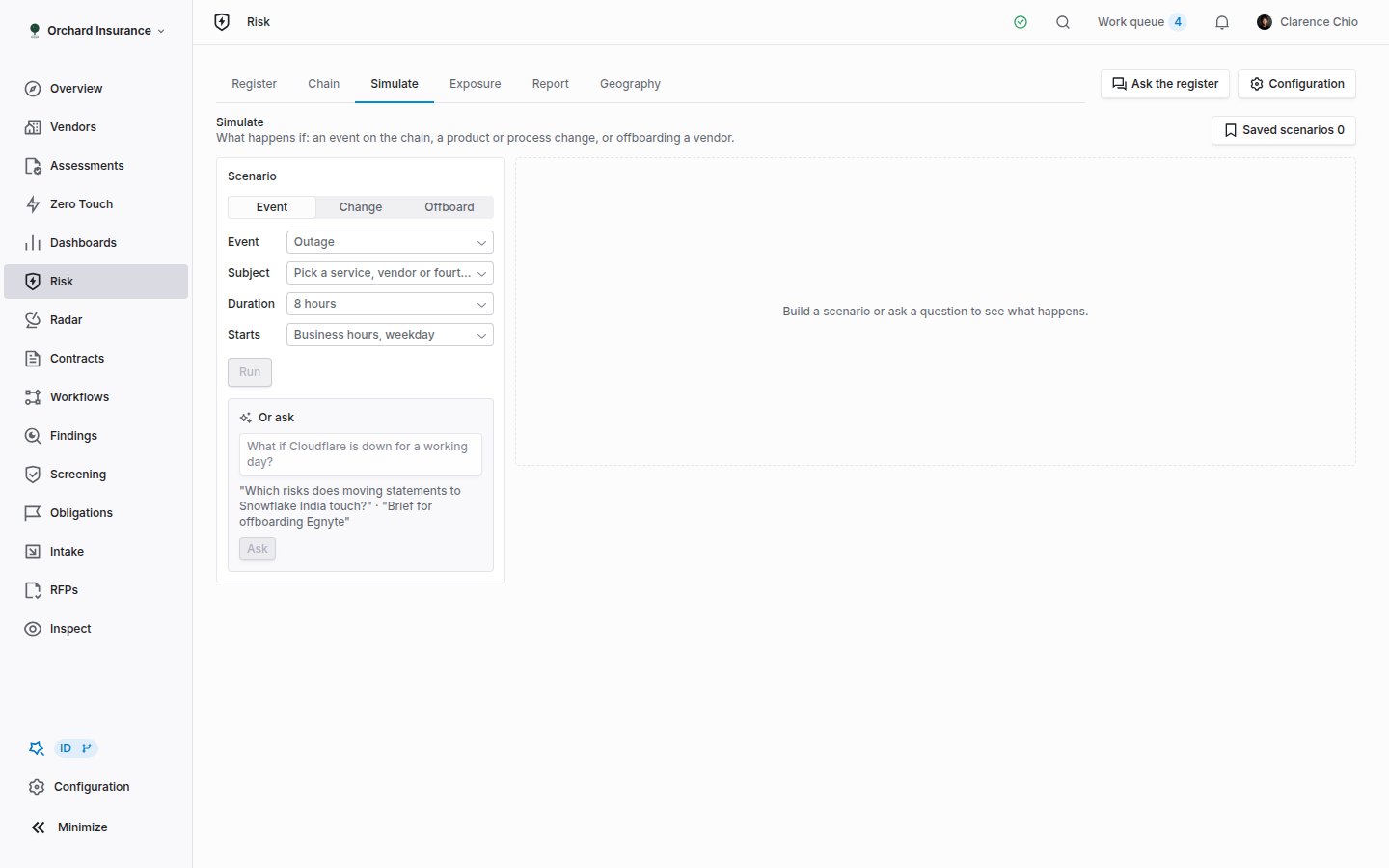
The Simulate tab. Build an event, change or offboarding scenario on the left, or type the question under Or ask. The result fills the panel on the right.
Pick a Scenario kind:
Event: an Outage, Breach, Insolvency, Sanction or Market exit on a Subject from the chain, for a Duration, starting in Business hours, weekday, Overnight or Weekend.
Change: Describe the change in a sentence and name the Vendors involved and Business units involved. The result lists what it touches: control sets, register risks, obligations and open questions for stakeholders.
Offboard: a Vendor to offboard. The result is a brief: termination terms on file, dependencies, open findings and obligations, and alternatives.
Or type the question under Or ask (“What if Cloudflare is down for a working day?”) and click Ask. The form adopts the inputs the model understood, so you can adjust and re-run.
The engine never fills in a number you have not recorded. If an estimate needs an input the org does not hold (a liability cap, a business unit’s revenue), the loss reads Estimate withheld with the reason, and Improve it lists what to record. Confidence is derived from how many inputs are present, never asserted.
A result shows services down, items touched, business units and customer channels, obligations triggered (regulatory and contractual), open findings on the path, the estimated loss, contractual protection per contract, and the Blast radius table: each business unit, the services affected, whether the channel is customer-facing, whether a workaround is on file, and the owner.Under the result: Save scenario, Attach to risk (the scenario is recorded against that risk and listed as attached to it under Saved scenarios), Create risks from gaps (each selected draft becomes a proposed risk with the scenario as its first signal) and Export brief (a Markdown file). Saved scenarios reopens any earlier run with its result.
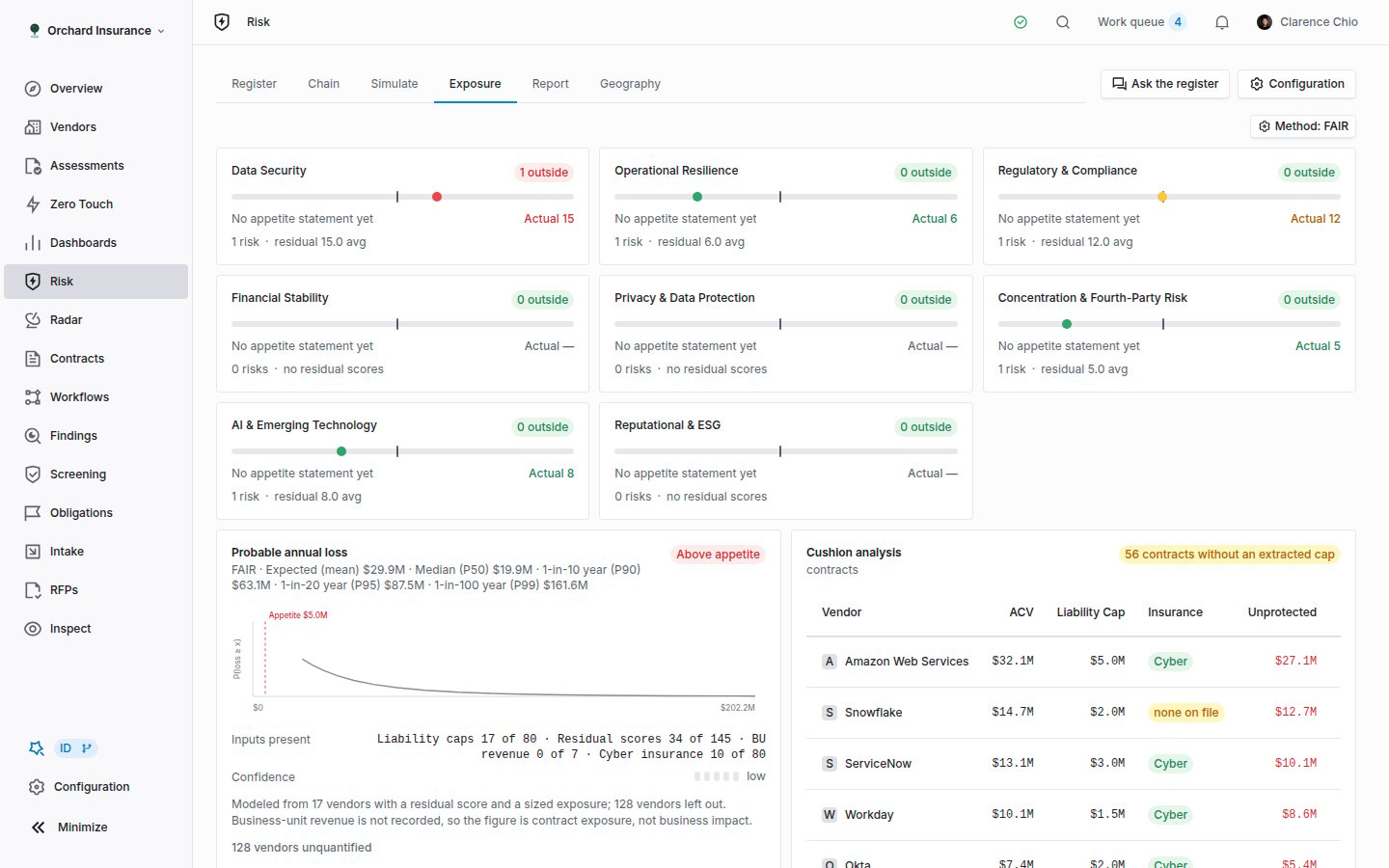
The Exposure tab. One gauge per domain, the loss curve with its inputs coverage, the cushion table and the concentration bars.
Appetite by domain: one gauge per domain plus “No domain”, with the count outside appetite, the appetite statement, the average residual and a 90-day trend (rising, flat, falling). Click N outside to open those risks in the register.
Probable annual loss: the loss curve with the appetite line, the Method chip (change it under Configuration → Risk → Quantification), Inputs present per input type, the confidence, and Vendors without inputs. Only vendors with a residual score and a sized exposure are modeled; the rest are named, not defaulted.
Cushion analysis: per contract, the ACV, liability cap, insurance (none on file or not extracted) and the unprotected amount. Extract from contract runs clause extraction on rows missing a cap. Unknown stays unknown.
Concentration: shared fourth parties, business units on one vendor, and geography, each linking into the chain.
The line at the bottom names how fresh the assessments, contracts and Radar data are. Institution switches between Group and one institution.
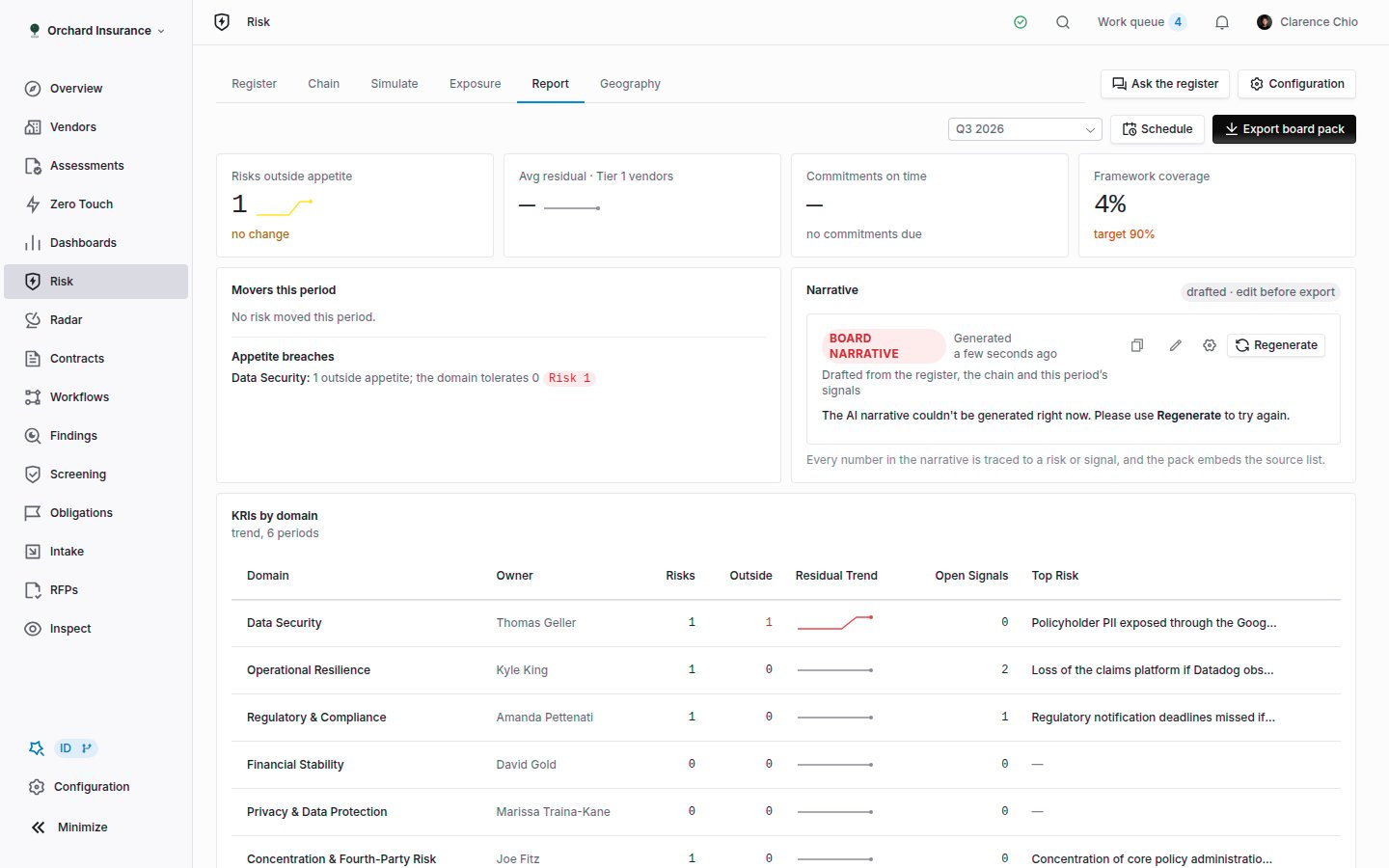
The Report tab for a quarter. The four indicator tiles, movers and appetite breaches, the KRI table by domain, and the narrative.
Choose a Period (the last six quarters). Four tiles carry a six-quarter sparkline: Risks outside appetite, Avg residual · Tier 1 vendors, Commitments on time and Framework coverage (against the frameworks chosen in configuration). Movers this period lists re-scored, new and closed risks; Appetite breaches lists the domains over their Max Outside; KRIs by domain gives each domain its owner, risk count, outside count, residual trend, open signals and top risk. All of it is read from the journal, so a re-score that later reversed still shows as a move in its period.Narrative drafts the board text from the register, the chain and the period’s signals. It is marked “drafted · edit before export”; click Edit, change it, Save. Every number in it traces to a risk or signal. Pinned Chart shows one chart from an org dashboard (see the Dashboard library); the PDF names it but cannot embed the live view.Export board pack builds the PDF in your browser. Schedule emails the report monthly or quarterly on a chosen day to the recipients you list, for one institution or the whole group. The same schedule is editable under Configuration → Risk → Board Pack Schedule.
Open Configuration → Risk, or click Configuration on the Risk page. Each section saves on its own.
Section
What it holds
Taxonomy & Domains
Your risk domains with their owner, control sets, Coverbase category mapping and whether an appetite is set. Manage domains opens Configuration → Risk Domains, where domains, their reviewers and their control sets are created
Scales & Matrix
Five levels per axis with a label and criteria, and a preview of the 25-cell matrix
Appetite Statements
Per domain: a Statement in your words, Max Residual (the tolerance, default 12) and Max Outside (how many risks over it the domain tolerates before it breaches). Portfolio Thresholds are the numeric tolerances the quantification model checks
Quantification
The method behind Probable annual loss and its parameters. Switching method resets the parameters to that method’s defaults
Signal Sources
The on/off switch and threshold per source (above)
Agent
New risks, Re-scoring, Stale after, Instructions and Run agent now
Institutions
A Key and Label per institution. A holding company sees Group; each institution sees its own rows. A risk is scoped to one institution or shared
Frameworks
The frameworks the board pack reports coverage against
Board Pack Schedule
The scheduled send: cadence, day of month, institution, recipients
Editing a scale re-maps existing risks by level name; it never re-scores them. A label you move from level 2 to level 3 takes its risks with it, and a name you remove leaves its risks at their number. Each moved risk gets a Scale remapped row in its history.
Signal Sources in configuration. One switch and threshold per source module.
The 5x5 here is not the vendor risk scale. Vendor and service scores (0 to 100, with bands and service roll-up) are configured under Configuration → Scales and described in the Admin and setup guide. A vendor score that rises reaches the register as a Vendor risk change signal.
Vendor, service, contract and finding pages each carry a Risks card listing the register entries scoped to that record, with their residual score and appetite state, Add risk, and View in register, which opens the register filtered to that record (“Scoped to this vendor”). Proposed risks show as Proposed by agent on the card.The reverse direction is the signal table above: findings and their commitments, Radar signals and alerts, contract components and clause reviews, obligations, sanctions screening, the financial health score, supplier sites, Inspect evaluations and assessments all reach the register as signals on the risks that cover them. Charts on your dashboards can slice the register by domain, status, appetite, owner and institution. Workflow automations have Create risk and Update risk actions (see Workflow templates).A risk that needs a person (a proposal, an overdue review, or an unowned risk outside appetite) also appears once in the work queue, assigned to its owner, or failing that the owning department’s lead or a domain reviewer.
Risk has its own permission resource, Risk register, with these grants. Members hold them by default; a missing button means the grant is missing from your role.
Grant
What it unlocks
Read
Every tab, the record, and viewing the configuration page
Create
New risk, Add risk, Create risks from gaps, saving a scenario
Update
Edit, Accept risk, Request commitment, Set review date, attaching or dismissing a signal, every inbox decision, Attach to risk, editing the narrative
Archive
Archive on a risk, deleting a saved scenario
Run
Run agent now, running a scenario
Export
Export board pack
Saving anything under Configuration → Risk needs the organization settings permission, which Admins hold. Roles are managed as described in Permissions and roles.
Its residual is unscored, so it falls back to the inherent score. Edit the risk and set Residual Likelihood and Residual Impact.
The count line says “3 proposed hidden” but the table shows nothing new.
Proposals never enter the table. Click the Proposed by agent tile to decide on them.
A finding I expect is not a signal.
Its severity is below Min severity for Findings, or the source is switched off. Check Configuration → Risk → Signal Sources, then Attach signal on the risk to add it by hand.
A signal closed but is still listed on the risk.
Closed signals stay on the risk as the evidence trail and count under “closed” in the signal counts.
Estimate withheld on a scenario.
An input the estimate needs is not on record. The Improve it line names it (usually a liability cap or ACV on the contract, or a business unit’s revenue).
The chain shows Showing 40 of 180 nodes.
Each column caps at 18 rows. Use Depth, Data scope or Business unit to narrow, or Show all on a column.
Run agent now did nothing visible.
The toast reports what it did: signals attached, proposed, re-scored, flagged stale. Zero across the board means no source cleared its threshold since the last run.
I renamed a scale level and the scores changed.
They did not; the risks followed their level name to its new number. Check the Scale remapped rows in the history.
I cannot see Risk at all.
The module is not enabled for your organization. Ask your Coverbase representative.