Raise a contract request from a vendor, confirm what the AI read off the draft, route it through your approval chain, and send the approved agreement to DocuSign.
For AI agents: a documentation index is available at https://docs.coverbase.com/llms.txt. This page is also available in markdown by appending .md to the URL.
This guide is part of the User Guides collection. It covers a contract from the first request to the filing of the signed copy. For the screens you work in afterwards, see the Contracts workspace guide. For the DocuSign connection itself, see the DocuSign integration guide.
A new contract goes through four stages: somebody raises a request, a person confirms the values read off the draft, the request walks an approval chain, and the approved agreement goes out for signature. Each stage has its own screen, and a contract cannot skip one.
Contracts that predate this flow are unaffected. Every historical and bulk-imported contract sits in Draft and stays there. Nothing about a draft implies it is unsigned. If you are migrating a back catalog, keep using bulk import; it does not route anything through approvals.
From the vendor’s Contracts tab, click New Contract. Fill in what you know and attach the draft agreement.
2
Confirm the metadata
Coverbase reads the draft and fills in what it can. Open the contract’s Approval section and confirm the values are right. The request cannot proceed until somebody does.
3
Approve
The request enters the approval chain your organization configured. Each approver is emailed in turn and records a decision.
4
Send for signature
Once the chain clears, the contract’s Execution section offers Send to DocuSign. The signed copy comes back and is filed on the same contract.
Start from the vendor, not the contracts list. The vendor’s Contracts tab already knows which vendor you mean, and it shows what else you hold with them. That is usually what tells you whether this is a new agreement or an amendment.Click New Contract and fill in:
Field
What it is
Title
What people will call this agreement.
Contract type
MSA, SOW, order form, amendment, NDA, DPA, and the rest.
Total value
What the agreement is worth. Enter the committed floor separately if it bills on usage.
Start and end dates
When it takes effect and when it lapses.
Renewal and notice dates
When it renews, and the last day to give notice if you do not want it to.
Parent agreement
The governing paper: an order form’s MSA, an amendment’s master.
Attach the pre-execution draft on the same screen. You can attach more documents later from the contract’s Documents section.
Name the parent agreement now, not later. An order form with no MSA behind it reads as a standalone commitment in every report that follows.
Most requests are raised from a document you already have in front of you, and you can fill the record in one sitting. Some are not. When you are raising the record before the terms are settled, tick Hold for intake review on the create form.
A held contract. It cannot enter approval routing until someone releases it.
While the hold is on:
No approver is emailed. Approval routing is what puts this record in front of other people, and it cannot start.
It cannot be submitted for approval. The attempt is refused, not merely hidden, so the hold cannot be worked around by a direct link.
You can still edit everything. That is the point: finish entering the terms, attach the draft, fix the dates.
A banner at the top of the contract says it is held. Click Release for routing when the record is ready to be looked at. Approval routing is then available in the normal way, and the release is recorded in the contract’s activity trail with who did it.
Releasing says the record is ready to read, not that it is approved. It is a separate statement from confirming the metadata, which still happens afterwards. Any colleague who can edit contracts can release the hold, so a request does not stall when the person who raised it is away.
A held contract still shows in the contracts list. Filter on Held For Intake Review is Yes to find drafts that have been sitting unreleased.
Coverbase analyzes the attached draft and fills in the values it can read: dates, amounts, notice periods, term length. Scanned PDFs are put through OCR first, so a photographed signature page is read the same as a native one.Everything the AI writes is a draft value. It is never treated as confirmed, and a contract whose values nobody has confirmed cannot be submitted for approval.Open the contract and go to its Approval section. The Metadata sign-off card shows:
Which required values are still empty. The card lists them by name, and submission stays blocked until each has a value.
Whether anybody has confirmed the set, and who.
The metadata sign-off card. The required values still empty are listed by name, and submission stays blocked until each has one.
Fix anything that is wrong, then click Confirm metadata. Coverbase records who confirmed it and when.
Editing a confirmed value clears the sign-off. If you change the total value, the dates, the type, or the vendor after confirming, the confirmation is withdrawn and somebody has to confirm again. Approvers decide on the values they were shown, so a request that changed after the sign-off has to be confirmed again.
Each field records whether it was entered by a person or suggested by the AI. The contract’s Properties section shows the source per field. A reviewer can see which numbers a person typed and which came off the paper.
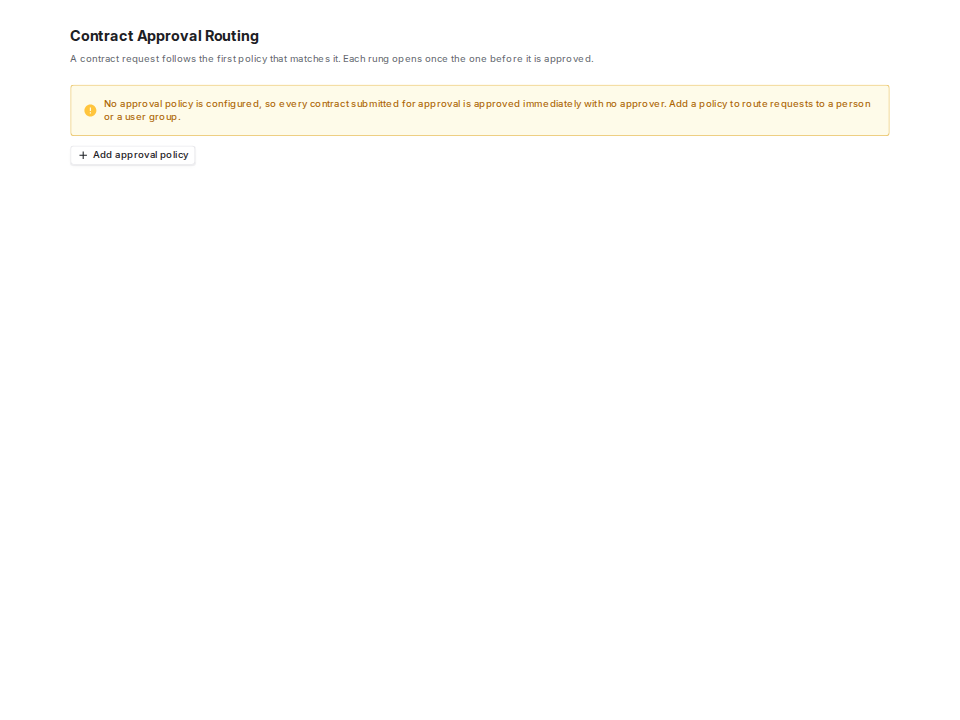
Approval policies live under Settings → Organization → Contract Approvals. Reading them needs permission to read organization settings, and editing them needs permission to change organization settings. Being able to read contracts is not enough for either: the list names every approver and every value threshold in your organization, and it is not tied to any one contract.Until there is at least one policy, the page says so, and every contract submitted for approval is approved on the spot with no approver.
A brand-new organization. Nothing routes contracts yet, so the page says what that means.
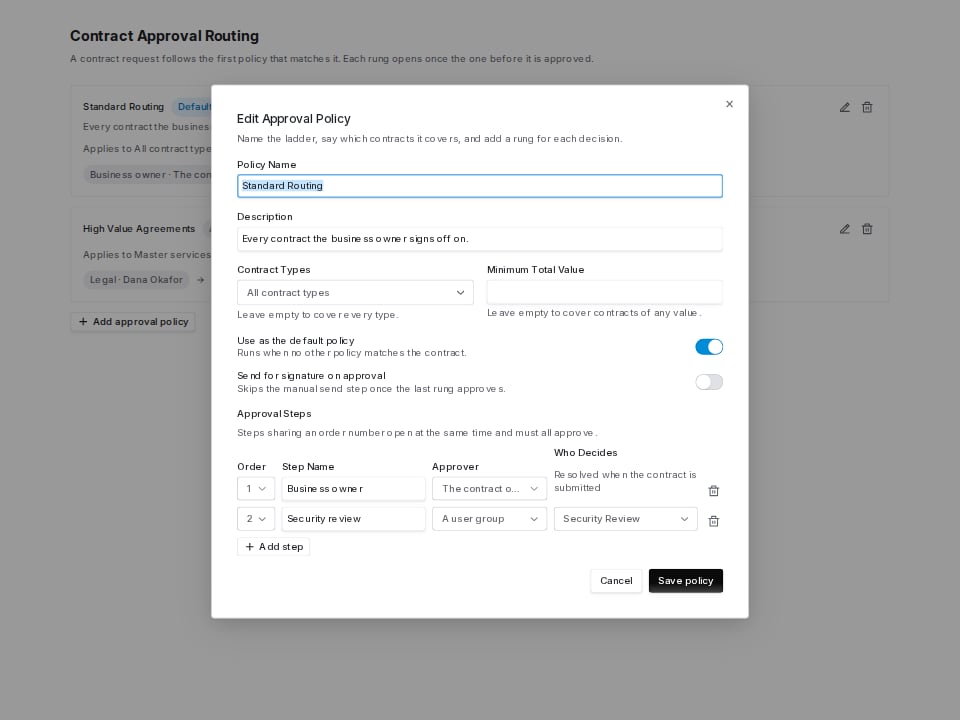
Add approval policy opens the editor. Give it a name, say which contracts it covers, and add a row for each decision.
Field
What it does
Contract types
Only applies to the types listed. Empty covers every type.
Minimum total value
Only applies at or above this amount. Empty covers any value.
Use as the default policy
Runs when no other policy matches.
Send for signature on approval
Sends the agreement out automatically once the last approver signs off. See Sending automatically.
Approval steps
One row per decision: the order number, a name, and who decides.
The policy editor. Two rungs: the business owner, then the security group.
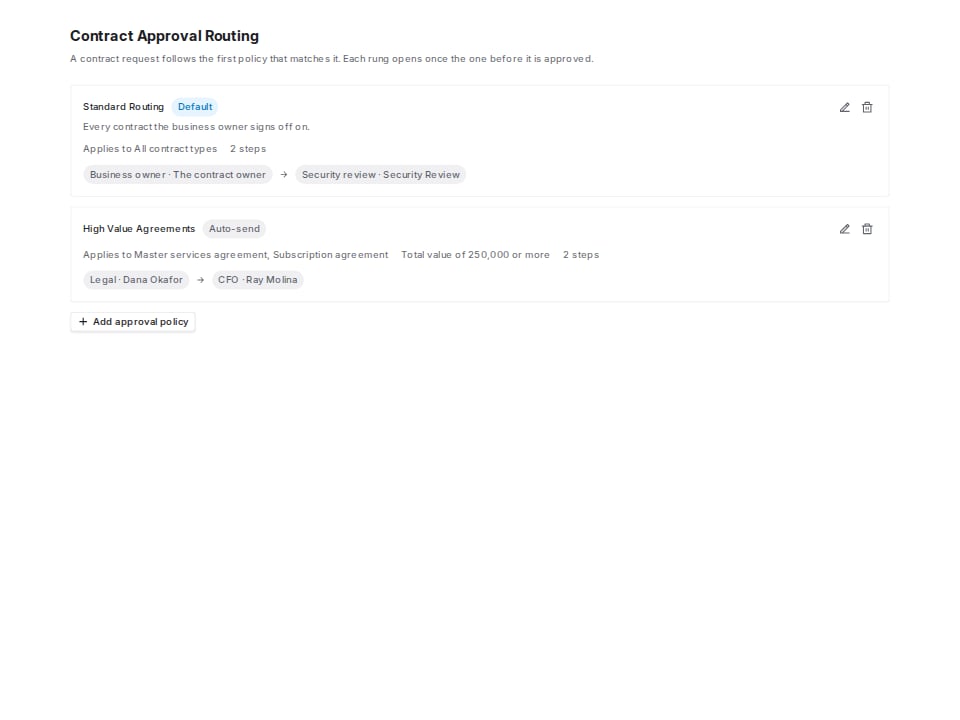
Saved policies read back as a ladder, which shows the order a contract will go through.
Two configured policies. The default covers everything; the second only covers high-value master agreements and sends automatically.
Editing a policy does not change an approval already running. A contract copies each step’s name and approver when it is submitted. Changing the policy afterwards does not change a decision already recorded.
Your organization configures approval policies. Each policy has conditions and an ordered list of steps.When you submit, Coverbase picks the policy that fits, most specific first: a policy naming your contract’s type beats one that names none, and among equals the higher value floor wins. Default breaks whatever tie is left.You cannot choose the policy yourself. Submission takes no arguments, and the conditions above are the only thing that decides. Otherwise a requester could pick the shortest chain.
A user group. Any active member of the group may decide, and Coverbase records which one did.
The contract owner or the vendor owner. Resolved when you submit, from whoever holds that role at that moment.
Steps are numbered. Steps sharing a number decide together, and the chain does not advance until all of them have. Increasing numbers run one after another.Two steps sharing a number cannot name the same approver, and the editor refuses to save that. One person clearing both would count as two approvals while being one decision. This applies to user groups too: the same group twice at one number is refused, though two different groups at one number is fine and is the normal way to ask legal and security together.
Every policy needs at least one step. A policy that matches contracts and then approves all of them has the same effect as no policy, while looking in settings like routing is configured. The editor will not save one.A step that resolves to nobody refuses the whole submission. Coverbase does not skip the step and run the rest, because a chain missing a rung still reports itself as approved. Two ways a step reaches nobody:
The policy asks for the contract owner or the vendor owner, and there is none.
The policy names a user group that has no active members. An empty group would open a step that nobody can approve and that sends no mail, leaving the request stuck until somebody withdrew it.
The refusal names the step it could not fill. Give the contract an owner, add somebody to the group, or point the policy at approvers it can reach, then submit again.A contract submitted when your org has configured no policy at all is approved immediately, and its Approval section says so rather than showing a bare Approved badge. If that is not what you expect, configure a policy.
From the Approval section, click Submit for approval. The button appears only when the metadata is confirmed and no required value is empty.Coverbase emails the approvers on the first step. Later steps are emailed as the chain reaches them, so nobody is asked before it is their turn.
An approver opens the contract’s Approval section and sees Approve and Reject on the step waiting on them. The buttons appear only for the person being asked, so an approver who is not on this step sees the chain but no controls.
Approving does not require permission to edit the contract. An approver is frequently somebody who would never otherwise edit a contract record, such as a finance reviewer signing off on spend. Being named on the step is what authorizes the decision.
An approval chain mid-flight. Legal has cleared, the CFO is being asked, and the decide buttons appear only on the step waiting on the reader.
A comment can go with either decision and is shown on the step afterwards.A rejection ends the round. Every step after it is canceled rather than left open, and the requester is emailed with the reviewer’s comment. Fix what was raised, confirm the metadata again, and submit. That starts a new round; the previous round’s decisions stay readable.
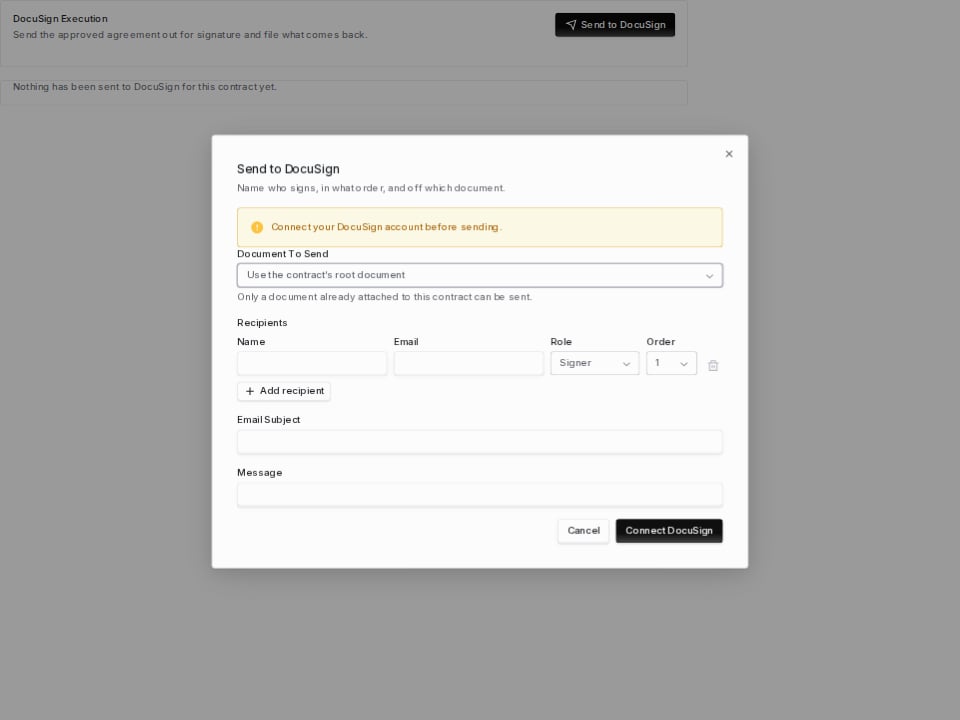
Once the chain clears, the contract’s Execution section offers Send to DocuSign. Before then the button is disabled and the section says why.You need a connected DocuSign account. See connecting DocuSign if you have not done that.On Send to DocuSign you choose:
The document to send. Only a document already attached to this contract can be sent. This is the approved draft, not a fresh upload.
Recipients, each with a name, an email, a role, and an order.
Subject and message for the DocuSign email.
The send dialog. Until you connect a DocuSign account the primary action is Connect DocuSign rather than Send.
Role
What it means
Signer
Signs the agreement.
CC
Receives a copy. Never asked to sign.
Order controls routing. Recipients sharing an order are asked together. Increasing orders are asked one after another, which is how you route the counterparty first and your own signatory second.
Give the vendor signer order 1 and your own authorized signatory order 2. The envelope reaches your side only once the counterparty has signed.
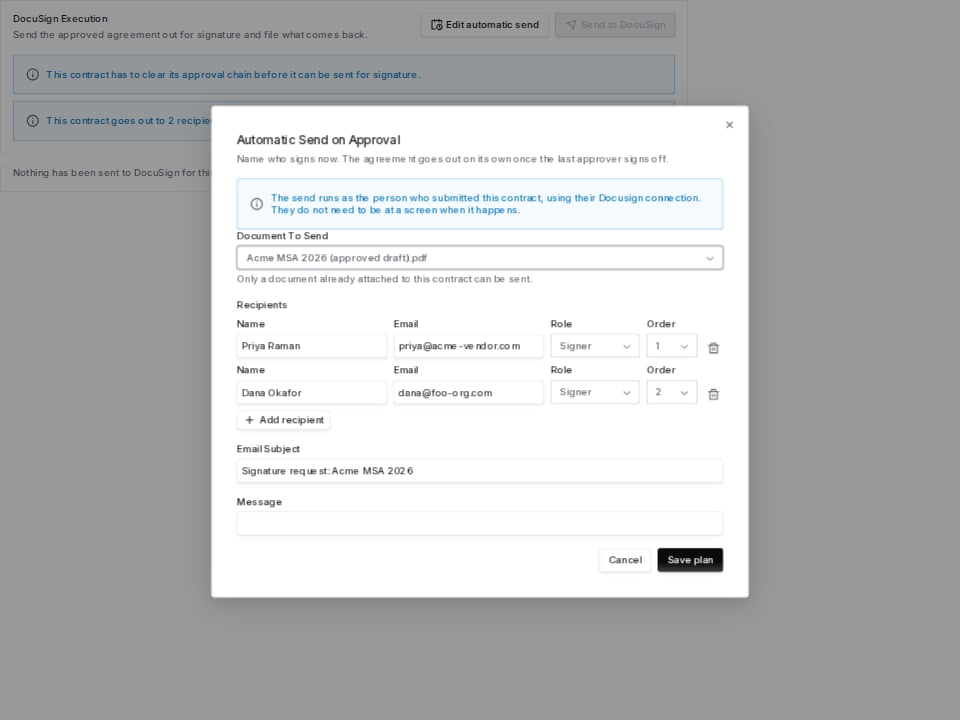
A policy with Send for signature on approval sends the agreement as soon as its last approver signs off, with nobody at a screen.Coverbase needs to know who signs before the approval finishes. While the contract is still moving through its chain, Execution → Set up automatic send asks the same questions the Send dialog asks: which document, who signs, in what order, and who is copied.
The automatic send editor. Same questions as the manual send, asked while there is still somebody to answer them.
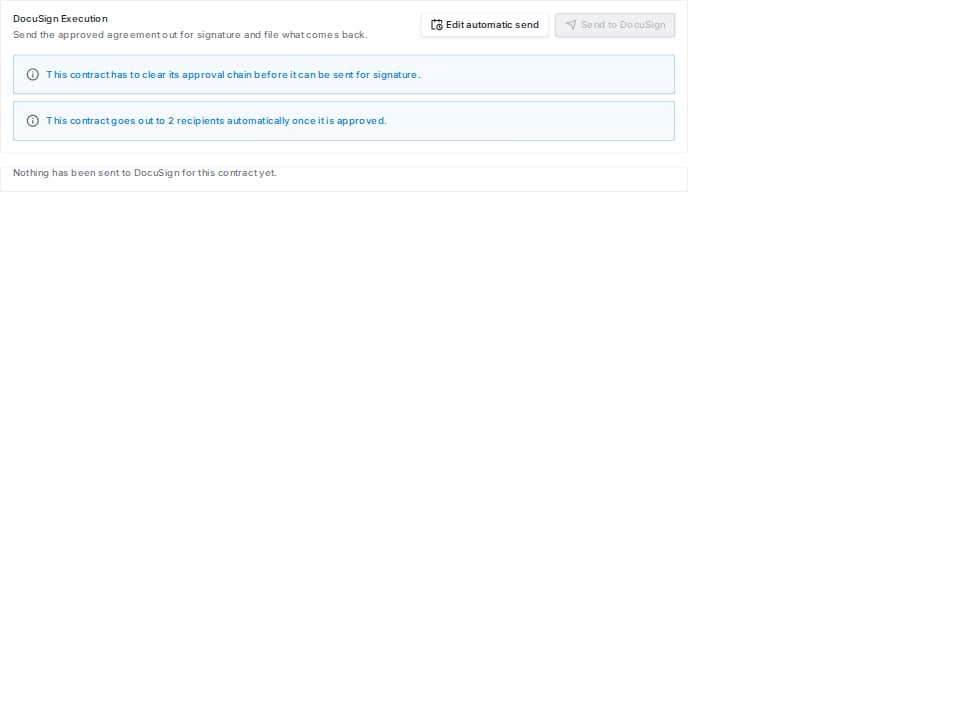
Once it is set up, the Execution section says what is about to happen.
The contract is still in approval, and this is what will go out when it clears.
The envelope goes out as the person who set up the automatic send, using the DocuSign connection they made. They do not have to be at a screen when it happens, but they do have to have connected: see Connecting DocuSign.
Whoever last saved the plan is who it is sent as. Anybody who can edit the contract can change the recipient list, and doing so also moves the send to their own Docusign account. Nobody can send an agreement under somebody else’s name.
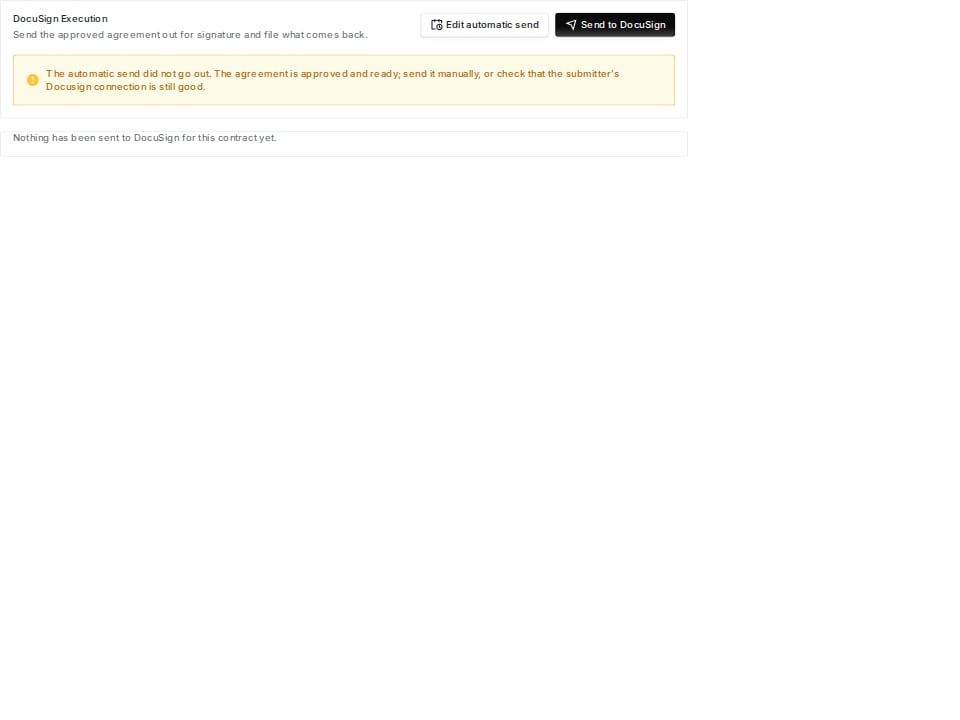
A send that does not go out never undoes an approval. If DocuSign is unreachable, or the plan author’s connection has lapsed, the contract stays approved and the plan stays on it. The Execution section says the automatic send did not go out, and Send to DocuSign remains available to send it by hand. The one exception is a send that got as far as DocuSign and lost its answer, covered under When a send loses its answer.
Approved, with a plan and nothing out. The automatic send did not run, and the manual one is still available.
Clearing the recipient list and saving turns the automatic send back off. You can do that at any point while the contract is still in its chain, and until the send starts.Once the agreement has gone out, Coverbase refuses the change and tells you the envelope is already with your signers. Turning the plan off at that point would report the send as canceled while a copy sat in front of the counterparty. To stop an envelope that is already out, void it in DocuSign and choose Sync status.
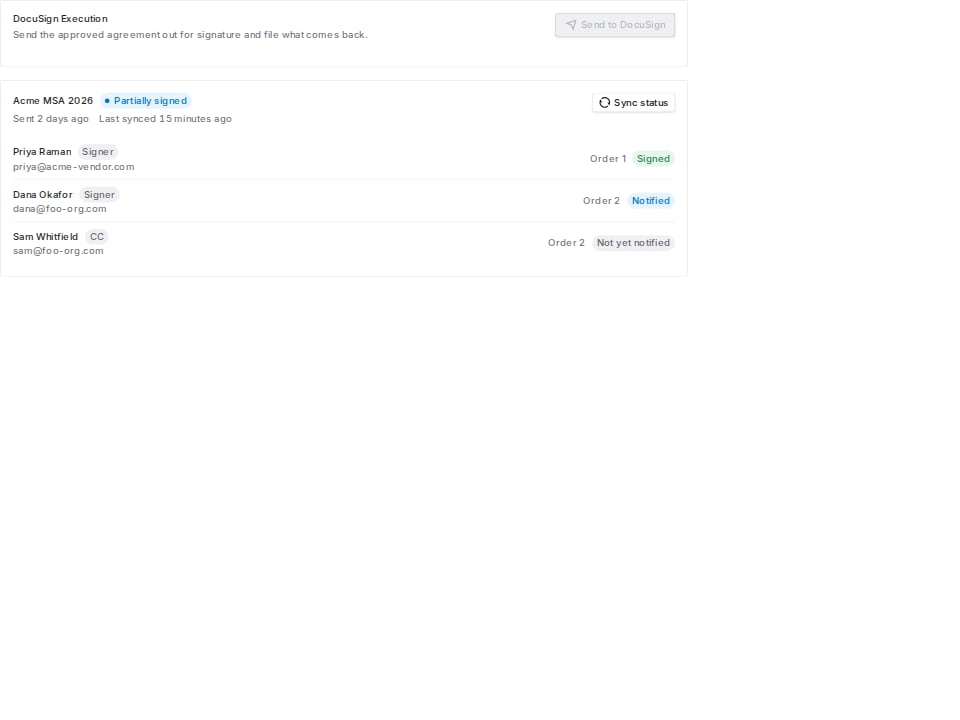
The Execution section shows every DocuSign envelope raised on this contract, each recipient’s state, and when the status was last read from DocuSign.
Envelope status
What it means
Draft
Created in Coverbase, not yet accepted by DocuSign.
Sent
Out with the first routing step.
Delivered
Everybody in the current step has opened it. Nobody has signed.
Partially signed
At least one signer has signed, at least one has not.
Completed
Everybody has signed.
Declined
A recipient refused. The contract returns to approved.
Voided
Canceled in DocuSign. The contract returns to approved.
Expired
DocuSign’s own expiry ran out before everybody signed. The contract returns to approved.
Every ending but Completed returns the contract to approved. It is ready to send again without anybody editing a record by hand.
An envelope out for signature. Each party carries its own state, and the order column shows who is asked when.
Status arrives on its own. DocuSign notifies Coverbase as the envelope moves, and a scheduled pass re-reads every in-flight envelope in case a notification was missed. Sync status on the envelope reads it back immediately, for when you are watching a signature land and do not want to wait.
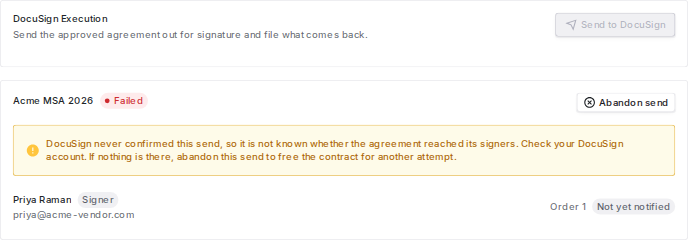
Very occasionally a send reaches DocuSign and the reply never comes back. Coverbase cannot tell that apart from DocuSign refusing the send outright, so it assumes the riskier of the two: the envelope may be out there with your signers. The contract is held as sent for signature, the envelope shows as failed, and the Execution section explains what happened instead of offering Sync status, which has nothing to ask about.
A send Docusign never confirmed. Abandon send replaces Sync status, because there is nothing to sync.
Only a person can settle it. Open DocuSign and look for the envelope:
1
Nothing is there
Choose Abandon send on the envelope. The contract returns to approved and can be sent again. The button appears once: an envelope that has already been abandoned shows no action, so a second click cannot free a contract whose retry is out with its signers.
2
The envelope is there
Leave it. It is a real envelope and it will report its own status. If you do not want it signed, void it in DocuSign and choose Sync status so Coverbase picks the void up, which returns the contract to approved.
Do not abandon an envelope you can still see in DocuSign. Abandoning says the agreement never went out. Doing that while a copy sits in front of your signers frees the contract for a second send, and you end up with two signed copies of one agreement. Coverbase refuses Abandon send on any envelope DocuSign acknowledged.
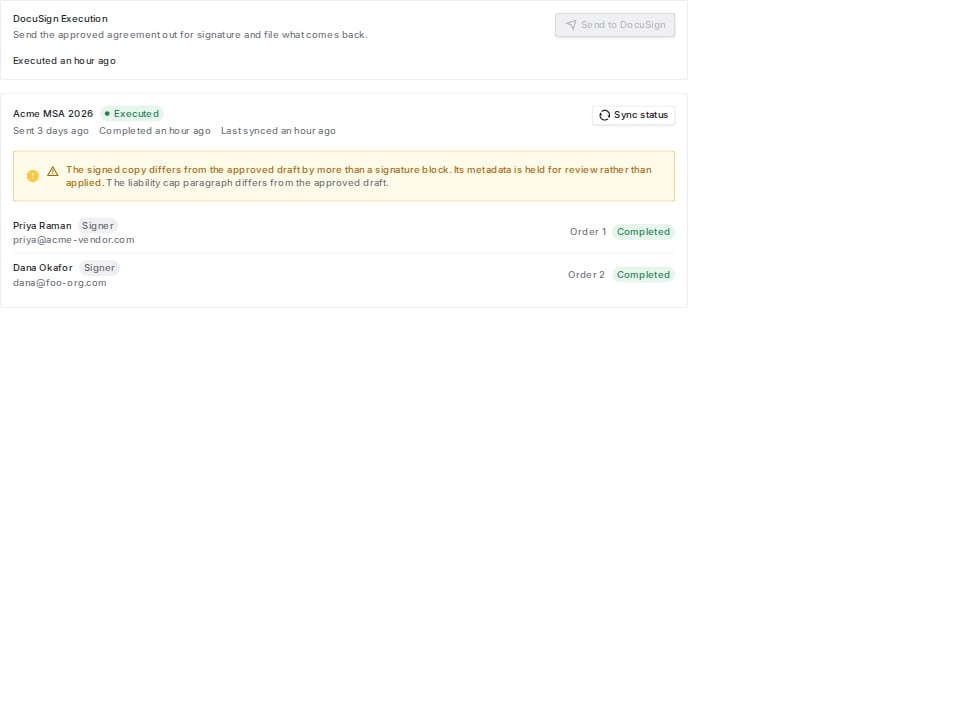
When an envelope completes, Coverbase downloads the signed PDF and the DocuSign certificate of completion and attaches both to the contract. The unsigned draft is kept rather than replaced. The record still shows what was sent out.
A signed copy that differs from the approved draft is flagged, not applied. Coverbase compares the returned text with the draft the approvers read, and the envelope is marked for review whenever either check fires: the paper grew or shrank by more than a signature block can account for, or a figure the draft stated no longer appears anywhere in the signed copy. The second check catches a term rewritten in place: net 30 becoming net 90 does not change the length, so only the missing figure reveals it. When an envelope is flagged the contract’s metadata is left alone and somebody has to look at it.
A completed envelope whose returned paper does not match the approved draft. The contract's metadata is held rather than overwritten.
Everything is recorded on the contract’s Activity section: the submission, each review and decision, the comments, the status changes, the send, and the filing of the executed copy.
The vendor’s Contracts tab shows every contract you hold with that vendor in one list, with the title, type, status, value, dates, renewal, notice deadline, owner, and the parent agreement.Above the list:
Committed value across active contracts. Contracts that bill on usage are counted at their committed floor and reported separately, because a usage forecast added to signed commitments would give a total that is part estimate.
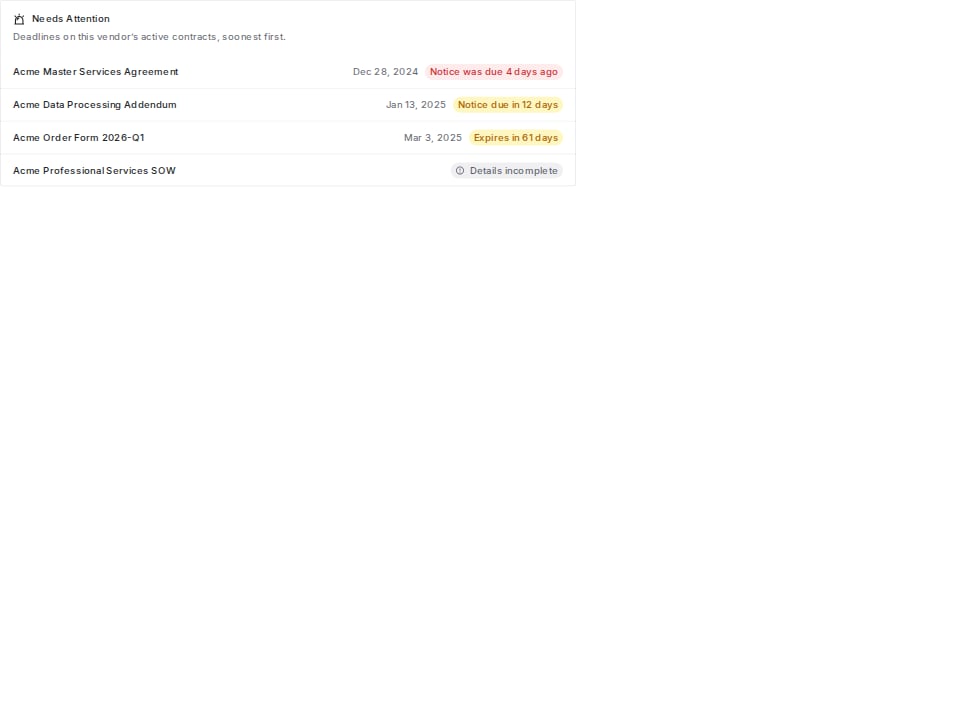
Needs attention. Contracts with a notice deadline or expiry inside the next ninety days, soonest first, plus any whose required details are still incomplete. An overdue notice deadline is shown in red and stays in the list.
The needs-attention panel on a vendor's Contracts tab. Overdue in red, approaching in amber, incomplete details in gray.
The Actions menu exports the vendor’s contract list to Excel. The export respects the filters and columns you are looking at.