

For AI agents: a documentation index is available at https://docs.coverbase.com/llms.txt. This page is also available in markdown by appending .md to the URL.
This guide is part of the User Guides collection. It covers the Assessment Method card on an assessment, service-level questions in the questionnaire editor, and the due diligence features of the supplier portal. It sits beside How to run an assessment and The issue acceptance chain. For what the module is, see Due diligence.
Choose the assessment method
Open the assessment. The Assessment Method card in the sidebar offers:
Changing the method needs permission to update the assessment. With Onsite, the card adds Upload onsite evidence and Record control effectiveness.
Schedule a review session
On a remote or onsite assessment, click Schedule session on the card.1
Describe it
Give a Title, choose the Format (Remote or Onsite), pick When (shown in your time zone) and the length in Minutes.
2
Say where
Enter a Location or Link: a meeting link or a site address.
3
Invite people
Choose Internal Participants, and type each Vendor Attendees email address followed by Enter. Add the Agenda and Notes.
4
Schedule
Click Schedule session. Participants are notified with the time, place and agenda, and vendor attendees get an email.
Let the supplier delegate questions
In the supplier portal, a respondent can hand parts of a questionnaire to colleagues who are portal members.- Who Is Answering What lists each section with its Owner and Progress. Click Assign on a section to hand it to one colleague.
- Assign several questions lets the respondent select questions and assign them together. Done ends the selection.
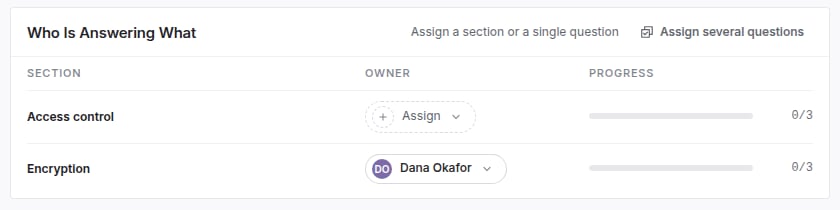
Who Is Answering What in the supplier portal, with one section assigned and one waiting for an owner.
Carry answers forward
When a vendor receives a questionnaire they have submitted before, their previous answers are copied into the new request, marked Carried forward. Questions are matched across versions of the questionnaire, so an edited question keeps its answer, while a question added since starts empty. Nothing already answered on the new request is overwritten. In the portal, the vendor sees how many answers were carried forward, from which submission, and Still accurate? beside each. They Confirm an answer, or click Confirm all with the count, or change it. A changed answer stays marked Updated since last time. On your side, the review workbench labels each answer Carried forward, not confirmed, Carried forward, confirmed or Changed since last time, so you can go straight to what moved.Have the supplier approve your edits
When a reviewer edits a vendor’s answer, the vendor is asked to agree. In the portal, Changes From followed by your organization’s name shows each edit with Your answer and your organization’s edit. The vendor clicks Approve edit, or Suggest a change with Suggested wording. Approve all with the count approves every waiting edit at once.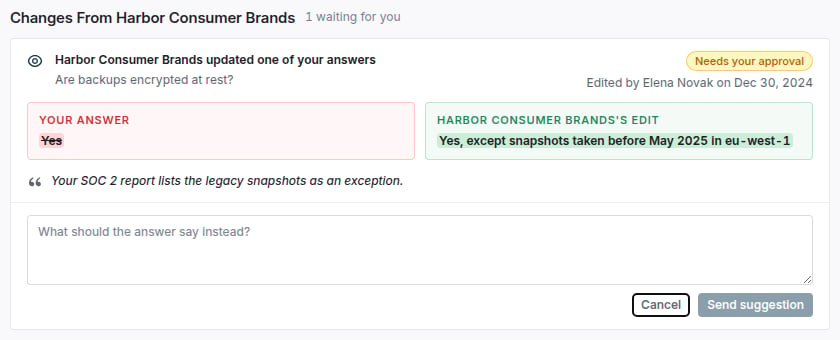
A reviewer's edit in the supplier portal, with the vendor writing a suggested change.
Send service-level questions only
A vendor whose company-wide due diligence is current should not answer company-wide questions again for every new service.1
Mark the questions
In the questionnaire editor, turn on Service-level question for each question that is about the service rather than the company. Save the questionnaire first if it is new.
2
Send
When you send the questionnaire for a new service, turn on Send service-level questions only. The vendor sees, and must answer, only the marked questions.
Raise a finding on a question
In the review workbench, open an answer and choose Raise finding on this question. The dialog quotes the vendor’s answer, and the finding records the question it was raised on. On the finding, Raised On shows the level (question, domain, questionnaire, assessment, service or vendor), and Other Open Findings lists the vendor’s other open findings across assessments. A finding can also name the Service it applies to. What happens next to the finding’s risk is covered in The issue acceptance chain.Troubleshooting
Related
How to run an assessment
The full assessment lifecycle.
The issue acceptance chain
Routing a decision to accept a finding’s risk.
The supplier portal, for suppliers
What your vendor sees.
Questionnaires
Building and sending questionnaires.